Start with age and history
The first question is how old the roof is and what it's been through. An architectural shingle roof in North Texas commonly lasts somewhere around 18 to 25 years, less if the attic runs hot or the roof has taken repeated hail. If you don't know the age, the city permit history for your address or the paperwork from when you bought the house usually tells you.
History matters as much as age. A twelve-year-old roof that has come through several hail seasons with hits on every slope may be closer to the end than a twenty-year-old roof under heavy tree cover that has never seen a big storm. Write down every leak, repair and claim you know about. A pattern of problems in different spots tells a different story than one stubborn leak. If the roof was installed over an older layer, count that against it, since two layers run hotter and hide decking problems.
When a repair is the right call
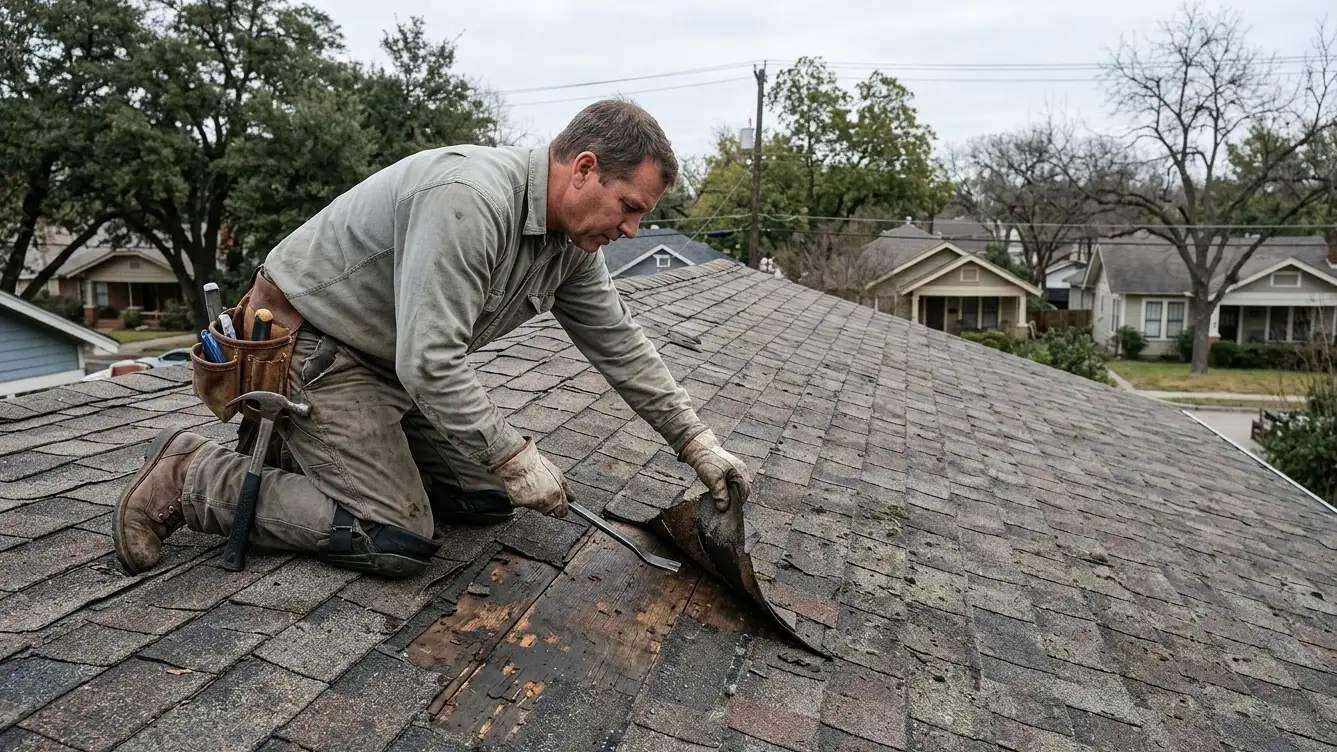
Repairs make sense when the problem is limited and the rest of the roof still has life in it. Most leaks on a roof under fifteen years old trace back to a single detail, not the whole surface. A good repair comes with an explanation of what failed and why. If someone offers to smear sealant across a wide area without finding the source, that's a patch, not a repair, and the leak usually returns after the next hard rain.
- A leak at one penetration, like a vent boot, pipe collar or chimney flashing
- A few shingles lifted or torn off by wind, with the rest lying flat and holding granules
- Damage confined to one area, such as where a limb came down
- Flashing that has pulled away at a wall or skylight
- A roof under about fifteen years old with no widespread granule loss or cracking
When replacement makes more sense
Replacement starts to win when problems are spread across the roof or keep coming back. Paying for a new repair every spring on a roof that's wearing out everywhere is a slow way to buy a new roof anyway. Replacing on your own schedule, rather than after a ceiling comes down in May, also gives you time to compare materials, get HOA approval and pick a dry week.
- Granule loss across multiple slopes, with bare mat showing
- Shingles that are curling, cupping, cracking or brittle when lifted
- Hail bruising on every slope, not just one side
- Leaks in more than one place, or repeat leaks after repairs
- Soft or sagging spots in the decking
- Two layers of shingles already on the house
The matching problem
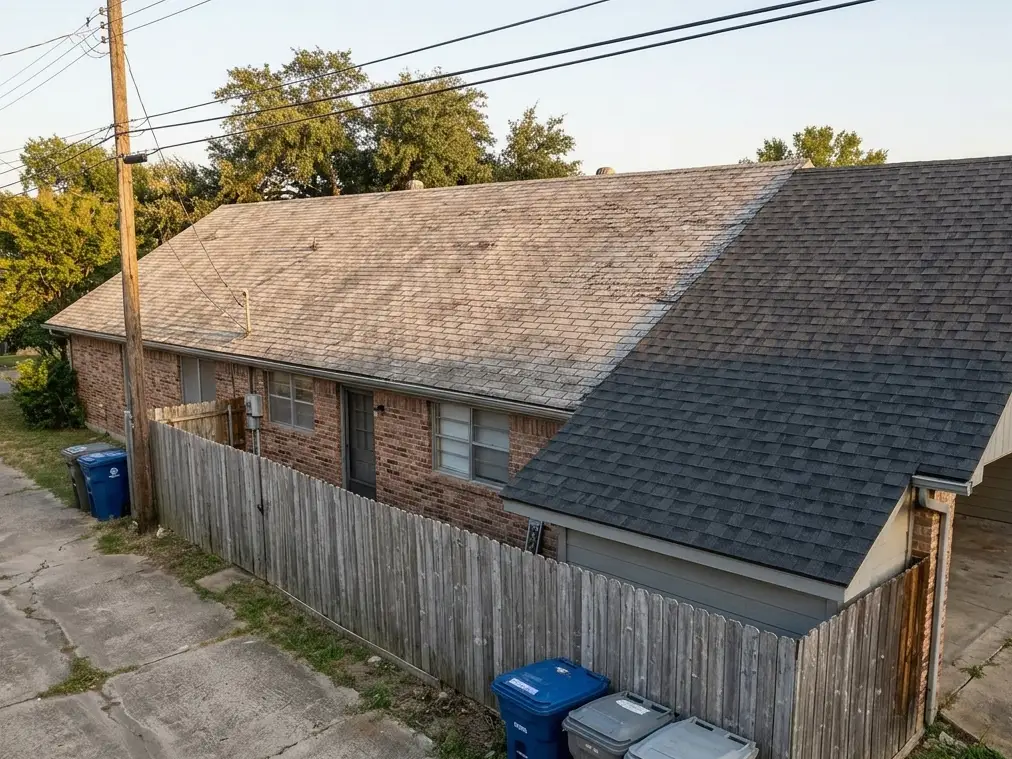
One issue homeowners don't expect is matching. Shingle colors and product lines change over time, and a roof that has baked in the Texas sun for a decade won't match a fresh bundle even when the color name is identical. A repair on the back slope may not bother you. A bright patch on the front of the house facing the street usually does.
If the original shingle has been discontinued, the closest match may differ in size or profile, which can make the patch look obvious and occasionally causes fit problems at the edges. Before approving a large repair on a visible slope, ask to see the replacement shingle next to your existing roof. If the match is poor, that tips the decision toward a larger section or a full replacement.
What's under the shingles
The surface is only part of the picture. Decking that has stayed damp from a slow leak can delaminate or rot, and you won't see it until someone walks the roof or looks from the attic. Older Dallas homes may have plank decking with gaps that needs extra work before new shingles go down. If the roof already carries two layers, a new roof means tearing both off.
North Texas adds one more wrinkle. The expansive clay soils of the Blackland Prairie cause foundation movement, and that movement can twist rooflines, open gaps at valleys and pull flashing loose. A roof that keeps leaking at the same valley may be reacting to the house shifting. In that case a repair can still work, but it helps to know the cause before spending money.
Questions to ask the inspector
Whoever inspects the roof, a few direct questions get you a clearer picture than a simple yes or no on replacement. Ask for photos of every problem area rather than a verbal summary, and ask what would happen if you waited another year. The answers below are what you need to compare a repair bid against a replacement bid fairly.
- What exactly is causing the leak or damage, and where is it?
- Roughly how much life does the rest of the roof have?
- Will a repair match the existing shingles on this slope?
- Is there soft or stained decking, and how much?
- Does any of this look like storm damage that might fall under a claim?
- If I repair now, what should I budget for next, and when?
Running the numbers
Typical Dallas roof repairs run about $385 to $1,450 for a single leak, flashing fix or small wind repair. Larger repairs that involve a full slope or decking sections can reach $1,650 to $4,300. A full asphalt shingle replacement usually lands around $5.15 to $7.40 per square foot installed, depending on pitch, layers and material.
Weigh the repair against how much life the roof has left. A $900 repair on a roof with ten good years ahead is a bargain. The same repair on a roof that will need replacement in two years is money you'll spend twice. Also check whether recent hail damage could put part of the cost under a claim. If you want an honest read on which way your roof leans, call us at (214) 910-6728 and we'll inspect it and give you both numbers.
Questions homeowners ask
Is it worth replacing just one side of my roof?
Sometimes, if damage is confined to one slope and the shingles still match well. The risk is that the old slopes fail a few years later and you pay for setup and tear-off twice. On a roof past the middle of its life, a full replacement often costs less per square foot than doing it in pieces over time.
Can a roofer tell me how many years my roof has left?
A good inspector can give a fair range based on granule loss, shingle flexibility, decking condition and ventilation, but not an exact date. Treat it as a planning number. A roof judged to have three to five years left gives you time to budget and pick a season, rather than replacing in a hurry after a leak.
Should I repair a leak if I plan to sell the house soon?
Yes, fix active leaks before listing, because a buyer's inspector will find stains and wet decking. Whether to replace the whole roof depends on its age and your market. In many cases a documented repair plus an inspection report satisfies buyers, while a roof near the end of its life often becomes a negotiating point anyway.