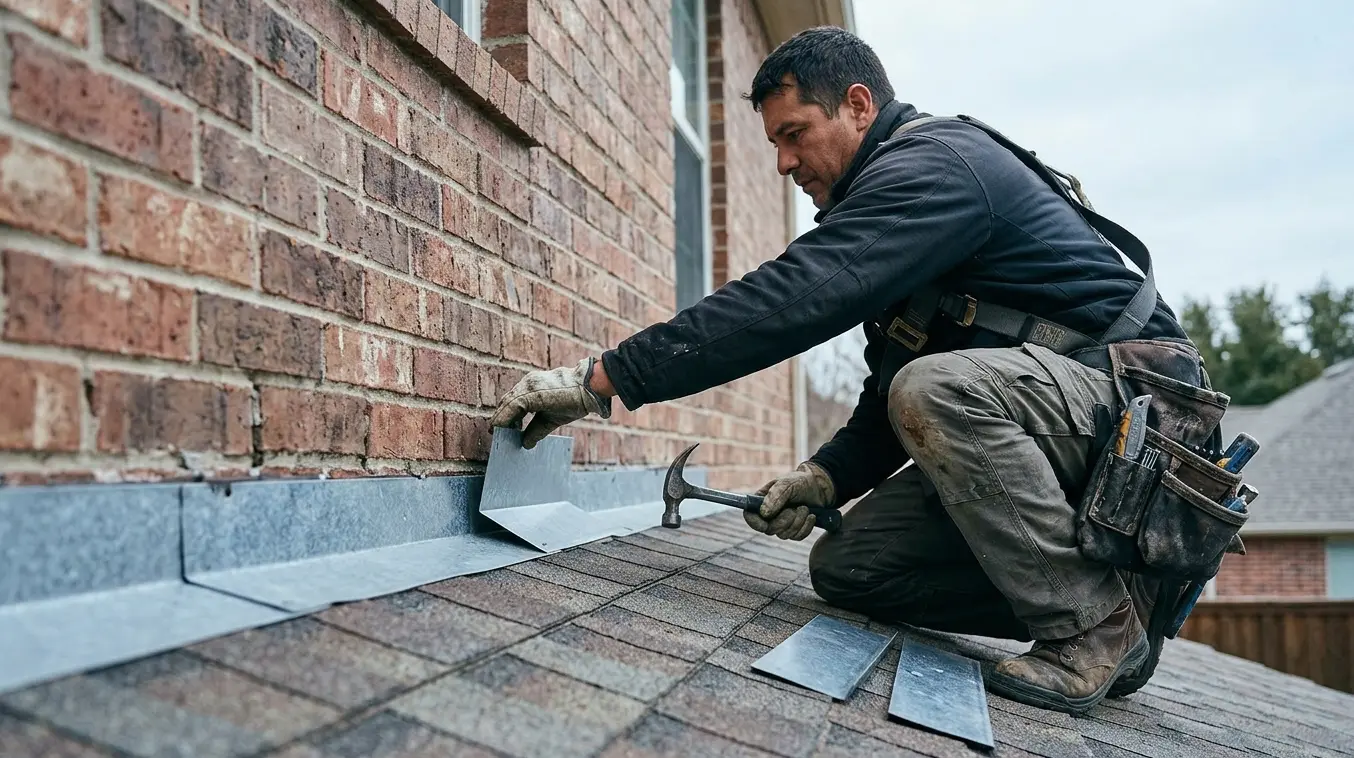
Roof flashing repair replaces or rebuilds the metal pieces that seal joints between the roof and walls, chimneys, skylights, valleys and edges. You need it when leaks appear near those joints or the metal is rusted, loose or sealed only with caulk. Most Dallas flashing repairs run $345 to $1,875 per area, varying with materials and access.
Shingles are good at shedding water across an open plane. They are not designed to seal a joint. Everywhere the roof changes direction or meets something vertical, metal flashing does that job: step flashing woven course by course along sidewalls, counterflashing set into mortar on chimneys, apron and headwall pieces across fronts of dormers, valley metal in the low channels and drip edge at the eaves. Each piece is lapped so water always runs over the next one down.
When flashing fails, it fails quietly. Sealant dries out and pulls away, a piece of step flashing gets left out during a past repair, or a counterflashing strip works loose as the house moves. We repair flashing by rebuilding it the right way rather than smearing roof cement over the top. That usually means lifting shingles, sometimes removing siding, installing new metal and putting everything back in the correct overlap.
Signs your flashing has failed
- Caulk doing the work: thick beads of tar or caulk along a wall or chimney mean someone patched a joint that needs real flashing.
- Rust streaks: brown streaks running down shingles from a chimney or vent point to corroded metal.
- Bent or lifted metal: drip edge or valley metal that has lifted or bent lets wind-driven rain get underneath.
- Wet drywall at wall corners: stains where a ceiling meets an exterior wall below a roof-to-wall joint suggest missing step flashing.
- Rot at the bottom of a wall: soft siding or trim where a roof edge ends against a wall usually means there is no kickout flashing.
- Loose counterflashing: metal strips on a chimney that you can pull out of the mortar joint by hand have lost their seal.
Flashing work our crews handle
- Step flashing along sidewalls is replaced one piece per shingle course, lapped so each piece sheds water onto the shingle below.
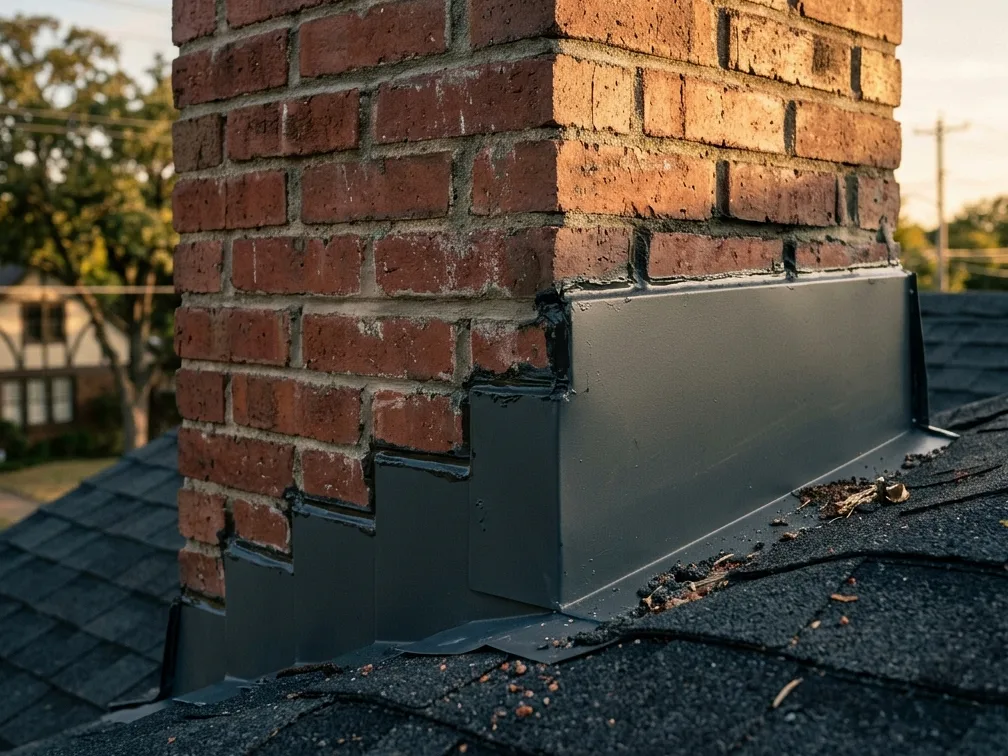
- Counterflashing on brick and stone is reset into a freshly ground mortar joint and sealed, so it covers the step flashing beneath it.
- Kickout flashing is added at the bottom of every roof-to-wall joint so water is directed into the gutter, not behind the wall.
- Valley metal or ice-and-water shield is renewed in open or closed valleys that have worn through or rusted.
- Drip edge is installed or replaced at eaves and rakes, with underlayment lapped correctly over or under it to suit the edge.
- Pipe, vent and skylight flashings are replaced with new collars, curbs or kits rather than resealed over old metal.
Flashing failures we find on Dallas homes
Dallas is full of two-story homes built in waves of fast growth, and roof-to-wall flashing is where shortcuts tend to show up first. We regularly open a sidewall and find one long bent piece of metal instead of individual step flashing, or no kickout at the bottom where the roof ends against brick. The result is staining on the inside of the wall and rot in the sheathing behind the siding, sometimes years before anyone sees it.
Our clay soils add another stress. Expansive Blackland Prairie clay swells when wet and shrinks in drought, and that seasonal movement can shift a foundation enough to flex walls and chimneys away from the roof. Rigid joints sealed with caulk crack open when that happens. Properly lapped step flashing and counterflashing can tolerate some movement because they are separate overlapping layers, not one glued seam. We see this most on homes with visible foundation cracks or sticking doors.
Flashing types and where each one belongs
Each joint on a roof needs a specific kind of flashing. Using the wrong piece, or relying on sealant alone, is one of the most common reasons a roof leaks long before its shingles wear out. Here are the types we install and repair most on Dallas roofs.
| Option | Best for | What to know |
|---|---|---|
| Step flashing | Roof slopes meeting a sidewall | One L-shaped piece per course, woven between shingles; never a single long strip |
| Counterflashing | Chimneys and masonry walls | Cut into the mortar joint and lapped over step flashing to cover the top edge |
| Kickout flashing | The bottom of a roof-to-wall joint | A small piece that prevents a lot of wall rot; often missing on older installs |
| Valley metal | Open valleys where two slopes meet | Galvanized or painted steel over ice-and-water shield handles heavy runoff |
| Drip edge | Eaves and rake edges | Keeps water off fascia and helps hold the first course in wind |
What roof flashing repair costs in Dallas
| Step flashing rebuild, per 10 feet of wall | $345 to $725 |
| Chimney counterflashing reset | $465 to $1,140 |
| Kickout flashing, each | $135 to $265 |
| Valley metal replacement, per valley | $585 to $1,425 |
| Drip edge replacement, per 10 feet | $38 to $72 |
Price depends on the joint type and what has to come apart to reach it. Replacing a pipe flashing is simple. Rebuilding step flashing along a two-story wall can mean removing and reinstalling siding courses or cutting a new mortar line on brick. Painted metal to match trim, copper on historic homes and any rotted sheathing found behind the joint add to the cost.
How the job runs
Call
Tell us what you see. Describe the stain, the noise in the wind or the shingles in the yard. If water is coming in, we talk you through what to move and when a crew can be there.
Look
We find the entry point. A crew walks the roof and checks the attic side, because the wet spot on a ceiling is often several feet downslope of the real failure.
Price
Written scope, fixed number. You get the repair in writing, with what we will replace, the materials and the price, before anyone pulls a shingle.
Fix
Repair matched to the roof. We seal, flash, replace or rebuild the damaged section with materials that match what is already up there as closely as the market allows.
Check
Water test and cleanup. Where it makes sense we hose-test the area, then magnet-sweep the yard for nails and photograph the finished work for your records.
Roof Flashing Repair questions
Can old flashing be reused when I get new shingles?
Sometimes. Counterflashing set properly in a chimney mortar joint can stay if it is in good shape. Step flashing, drip edge and pipe boots are almost always replaced, because they are cheap compared with the labor and their condition is hard to judge until they are out. We tell you what we plan to reuse before work starts.
Is roof cement good enough to seal a flashing joint?
Roof cement is useful for sealing nail heads and small gaps, but it is not a flashing. In Dallas heat it dries, shrinks and cracks within a few seasons, and water then follows the crack. A joint that relies on cement is one that will leak again; real metal flashing lapped in the right order is what lasts.
Why is my wall rotting where the roof ends?
That pattern almost always means a missing kickout flashing. Without it, water running down the roof-to-wall joint leaves the roof edge and runs behind the siding or stucco instead of into the gutter. Over time it rots the sheathing and the bottom plate of the wall. We add the kickout and repair the damaged siding area.
Does flashing come in colors to match my house?
Yes. Step flashing is mostly hidden under shingles, but visible pieces like drip edge, counterflashing and apron flashing come in prefinished colors such as bronze, white and black. On brick homes in older Dallas neighborhoods, we can also use copper or painted steel so the metal blends with the trim and masonry.