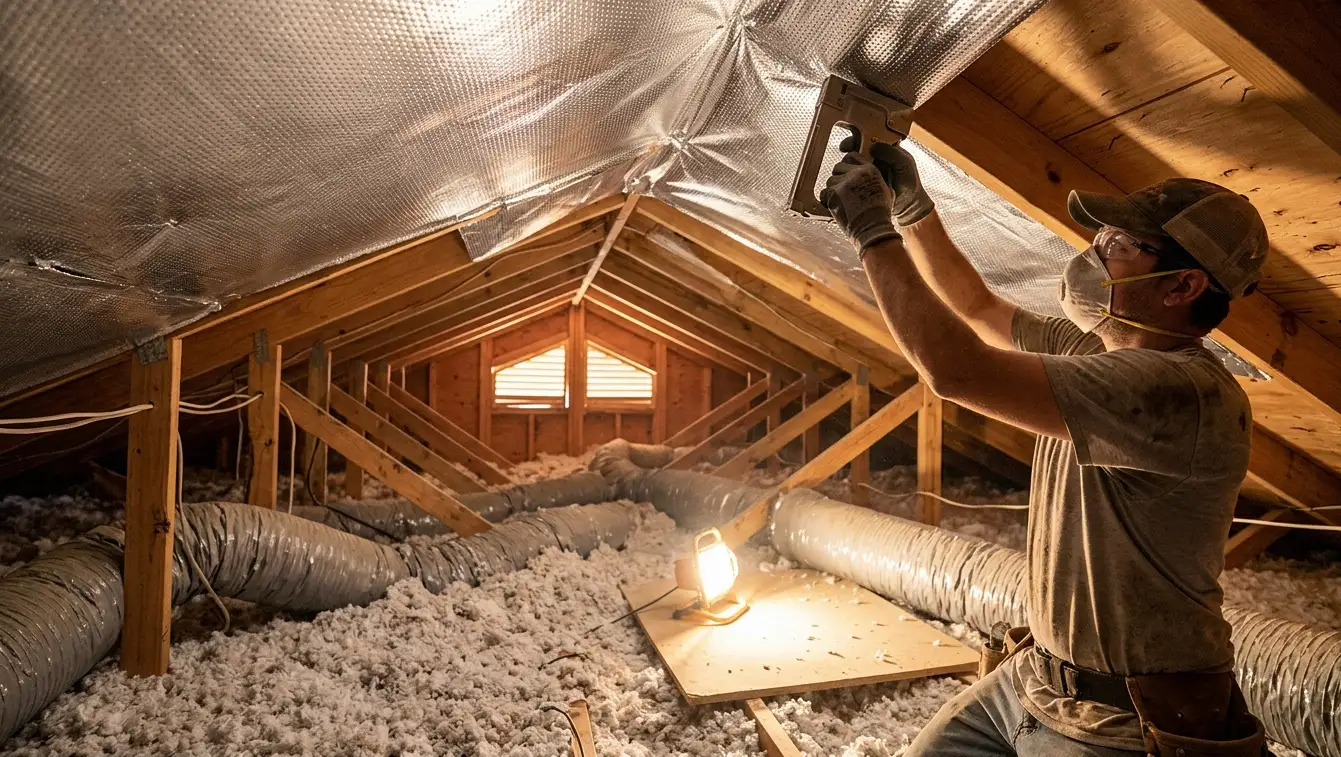
Radiant barrier installation adds a reflective foil layer in the attic that blocks much of the radiant heat coming off a hot roof deck. It suits Dallas homes with ducts or HVAC equipment in the attic and upstairs rooms that run hot. Stapled foil typically costs $0.68 to $1.35 per sq ft of roof area, and radiant sheathing on a reroof adds about $0.28 to $0.54 per sq ft.
A radiant barrier is a thin layer of aluminum foil that faces an open air space in the attic and reflects radiant heat instead of passing it along. In a Dallas summer, the underside of a dark shingle roof runs far hotter than the outdoor air, and that heat beams down onto insulation, air handlers and duct runs. A barrier does not slow conducted heat the way insulation does. It cuts the radiant part, which is the largest share of heat moving down from a sun-baked deck.
We install barriers two ways. On a roof that is staying in place, our crews staple perforated foil to the underside of the rafters, leaving an air gap between the foil and the decking. On a reroof, we can lay radiant barrier sheathing, which is OSB with foil laminated to one face, wherever decking is being replaced or across the whole roof. Either way we check the attic ventilation first, because a barrier that holds hot air under the deck with no way out works against the shingles and the house.
Signs your attic would benefit from a radiant barrier
- Hot upstairs bedrooms: second-floor rooms stay noticeably warmer than downstairs long after sunset, even with the thermostat set low.
- Ductwork in the attic: supply ducts and the air handler sit in the attic, where they pick up heat before cool air ever reaches a register.
- Long AC run times: the system runs nearly nonstop on July afternoons and still struggles to hold the set point.
- An attic you cannot stand in: the space feels like an oven by midmorning, and the top of the insulation is warm to the touch.
- Dark shingles in full sun: a dark roof with no tree shade on the west and south slopes takes the full afternoon load.
- A reroof on the calendar: a planned replacement is the cheapest moment to add radiant sheathing, since the decking is already exposed.
How we install a radiant barrier
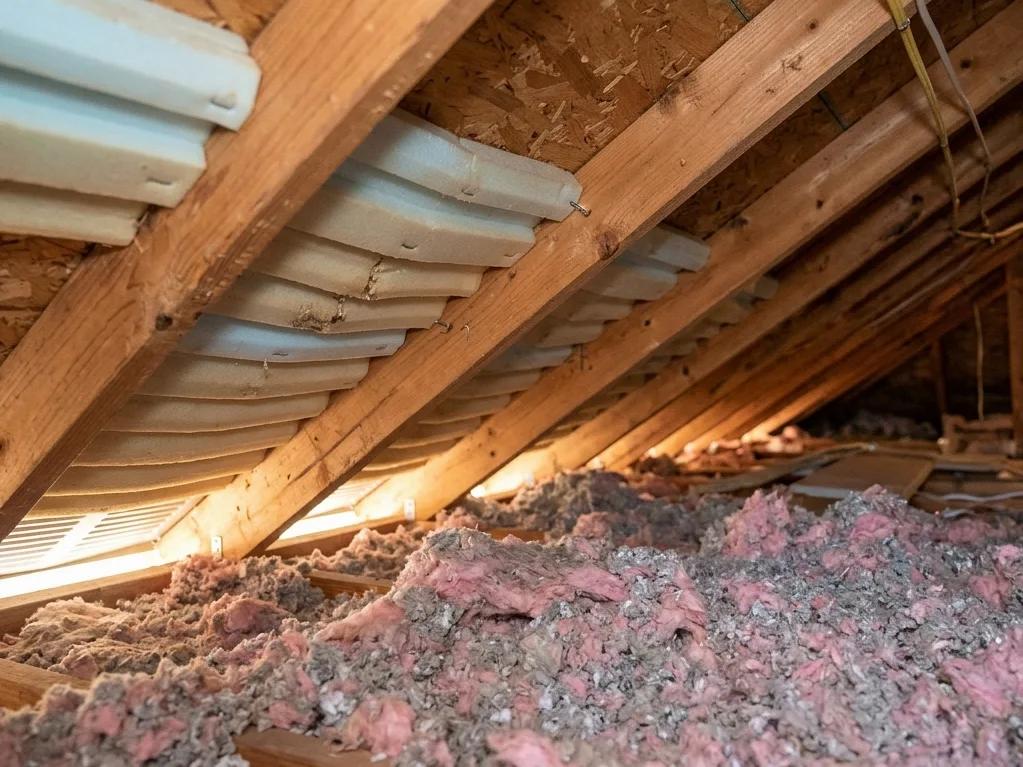
- We start in the attic, checking soffit intake, exhaust vents, bath fan routing and insulation depth before any foil goes up.
- Perforated foil is stapled to the underside of the rafters with the reflective face toward the attic, leaving an air gap behind it.
- Seams are overlapped and runs stop a few inches short of the ridge so hot air can still reach the ridge or attic vents.
- Foil is kept clear of recessed light housings, flue pipes and the water heater vent, holding the clearances those items need.
- On a reroof, radiant barrier sheathing goes on foil side down, fastened on the same nailing schedule as standard decking.
- We clear foil scraps and staples off the insulation before we leave and send you photos of every slope we covered.
Why Dallas attics get so hot, and where foil helps
Summer attic temperatures in North Texas often exceed 140°F, and the source is mostly the roof deck itself. Shingles absorb sun all afternoon, the decking warms through, and its underside radiates that heat across the attic. Insulation on the floor slows heat moving into the ceiling, but most Dallas homes also run ducts and an air handler up there, sitting in that heat for hours. Foil under the rafters keeps much of the radiant load from ever reaching those surfaces.
Placement matters more than most people expect. Foil laid flat on top of insulation gathers dust over time and loses its reflectivity, and it can hold moisture against the attic floor. That is why we attach it to the rafters or use foil-faced sheathing instead. The barrier also has to work with the ventilation. Soffit intake and ridge or box vent exhaust carry off the hot air the foil turns back, and without that airflow the heat simply stalls under the deck.
Radiant barrier options for Dallas homes
The right barrier depends on whether the roof is staying or being replaced, how open the attic framing is and where your ducts run. Here is how the common approaches compare on the houses we work on across Dallas and the surrounding suburbs.
| Option | Best for | What to know |
|---|---|---|
| Foil stapled to rafters | Existing roofs with open, walkable attics | Lowest disruption; needs an air gap behind the foil and room to work between truss webs |
| Radiant barrier sheathing | Homes already scheduled for roof replacement | Foil is laminated to the OSB, so coverage is complete and nothing sags over the years |
| Foil over floor insulation | Attics where the rafters cannot be reached | Dust dulls the foil and moisture can collect beneath it, so we use it only as a last resort |
| Barrier plus ventilation upgrade | Attics with weak intake or blocked soffits | Pairs the foil with added soffit vents or baffles so reflected heat has a way out |
| Barrier plus added insulation | Attics with thin or matted blown insulation | Foil handles radiant heat and insulation handles conducted heat, so the two work together |
What radiant barrier installation costs in Dallas
| Stapled foil barrier, per sq ft of roof | $0.68 to $1.35 |
| Radiant sheathing upgrade on a reroof, per sq ft | $0.28 to $0.54 |
| Single-story attic, about 2,300 sq ft of roof, stapled foil | $1,565 to $3,085 |
| Soffit baffles added, per rafter bay | $14 to $27 |
| Attic debris and old insulation cleanup before install | $385 to $940 |
Attic layout drives most of the labor. Open stick-framed attics with good headroom go quickly, while low-pitch roofs, tight truss webs and attics packed with ductwork take longer. Two-story homes with several separate attic spaces add setup time. Adding sheathing during a reroof costs far less than retrofitting later, because the old decking is already coming off. Ventilation fixes and insulation top-ups are priced separately.
How the job runs
Call
Describe the symptom. Hot upstairs rooms, a damp attic smell, a drip around a skylight or a solar array that needs to come off: tell us what you are noticing.
Inspect
Roof and attic together. We look at intake and exhaust, decking condition, insulation depth and every penetration from both sides of the roof deck.
Price
Clear scope. You get a written scope that says what changes, why it helps in a Dallas summer and what it costs.
Install
Work done clean. Our crew protects the living space below, works from the roof side where possible and seals every opening it touches.
Verify
Check the result. We confirm airflow paths, flashing laps and fit, then photograph the finished work for your file.
Radiant Barrier Installation questions
Will a radiant barrier make my shingles run hotter?
Shingle temperature can rise a little with a barrier under the deck, since less heat escapes downward. In a properly vented attic the change is small, and most shingle manufacturers allow radiant sheathing under their products; we check the installation instructions for your specific line. The real risk is a barrier in an attic with blocked soffits, so we fix intake and exhaust first.
Can foil go in an attic that already has blown-in insulation?
Yes. Stapled foil goes on the rafters, well above the insulation, so the two never touch. Our crews walk on the joists and lay boards to avoid crushing the blown insulation while we work. If the insulation is thin, matted or below the recommended depth for North Texas, we tell you, since the barrier and the insulation solve different parts of the heat problem.
Does a radiant barrier weaken cell phone or Wi-Fi signal?
It can reduce signal a little, mostly for an antenna or router placed up in the attic. Perforated foil lets some signal through, and most homes notice no change in the living space. If you run an antenna or a mesh unit in the attic, tell us beforehand so we can leave a gap in the foil or suggest moving the device below the ceiling.
How much cooler will my attic be with a radiant barrier?
That varies with roof color, shade, ventilation and duct layout, so we do not promise a number. What homeowners usually notice is a cooler attic on summer afternoons, ducts and an air handler that are no longer hot to the touch, and upstairs rooms that recover faster in the evening. The gain is largest when ducts run through the attic.