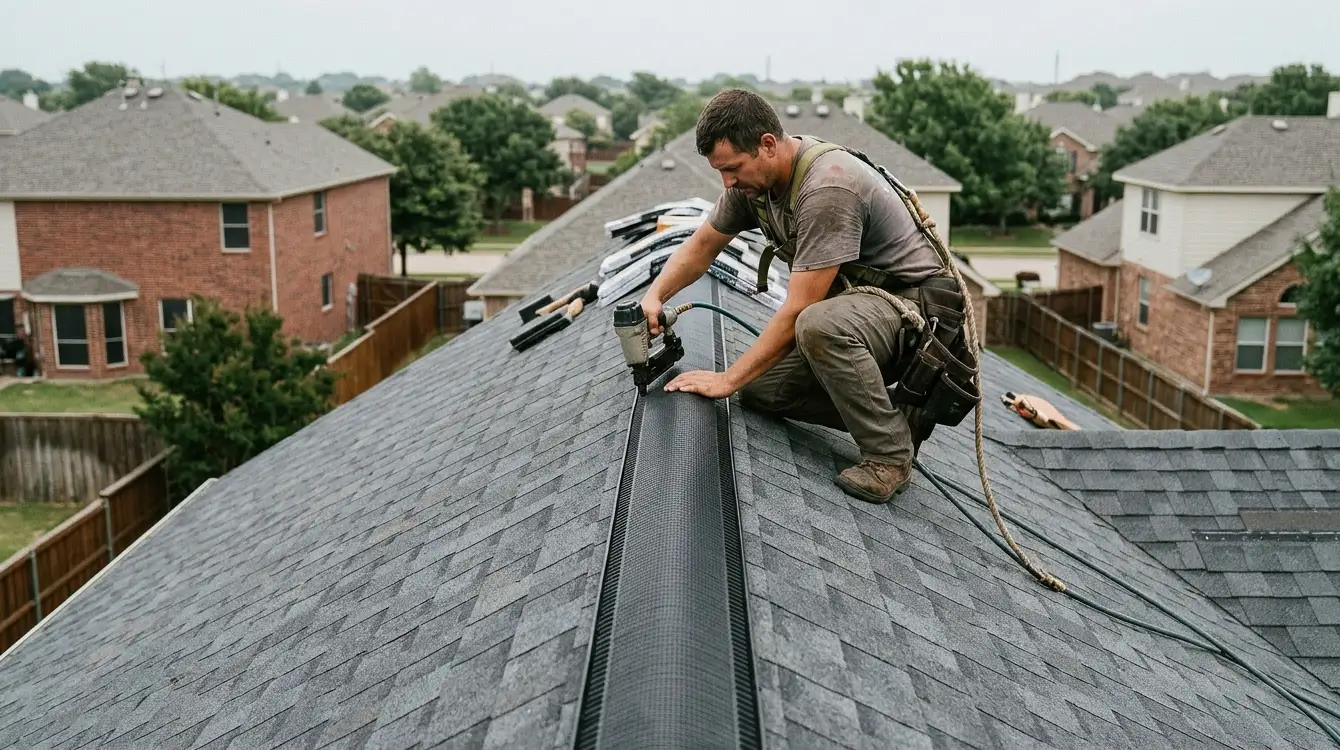
Attic ventilation is the balance of soffit intake and ridge or roof exhaust that moves heat and moisture out of the attic. Dallas homes need it fixed when attics overheat, shingles age early, or intake is blocked. Most ventilation corrections here run $645 to $2,870, and more when added during a full reroof with new ridge vent.
Attic ventilation works on a simple idea: cool outside air comes in low at the soffits, warm air leaves high at the ridge, and the flow carries heat and moisture out before it damages the roof. The math behind it is net free area, the open area of each vent after screens and louvers. A common guideline calls for one square foot of net free area per 150 square feet of attic floor, or per 300 square feet when a vapor retarder is present, split close to evenly between intake and exhaust.
Most problems we find in Dallas attics come from imbalance, not a lack of vents. A house might have six box vents, a power fan and a ridge vent all competing as exhaust, with painted-over or insulation-blocked soffits providing almost no intake. When exhaust outpulls intake, the attic draws air from the house itself, through can lights and attic hatches. We measure what is there, calculate what the attic needs, and rebuild the system so intake and exhaust actually work together.
Signs your attic is not venting properly
- Upstairs rooms stay hot: The AC runs nonstop and bedrooms under the roof never reach the set temperature.
- Shingles blister or curl early: Trapped heat cooks asphalt from below, often worst on south and west slopes.
- Mixed exhaust types: Box vents, turbines, a power fan and a ridge vent all sit on the same roof.
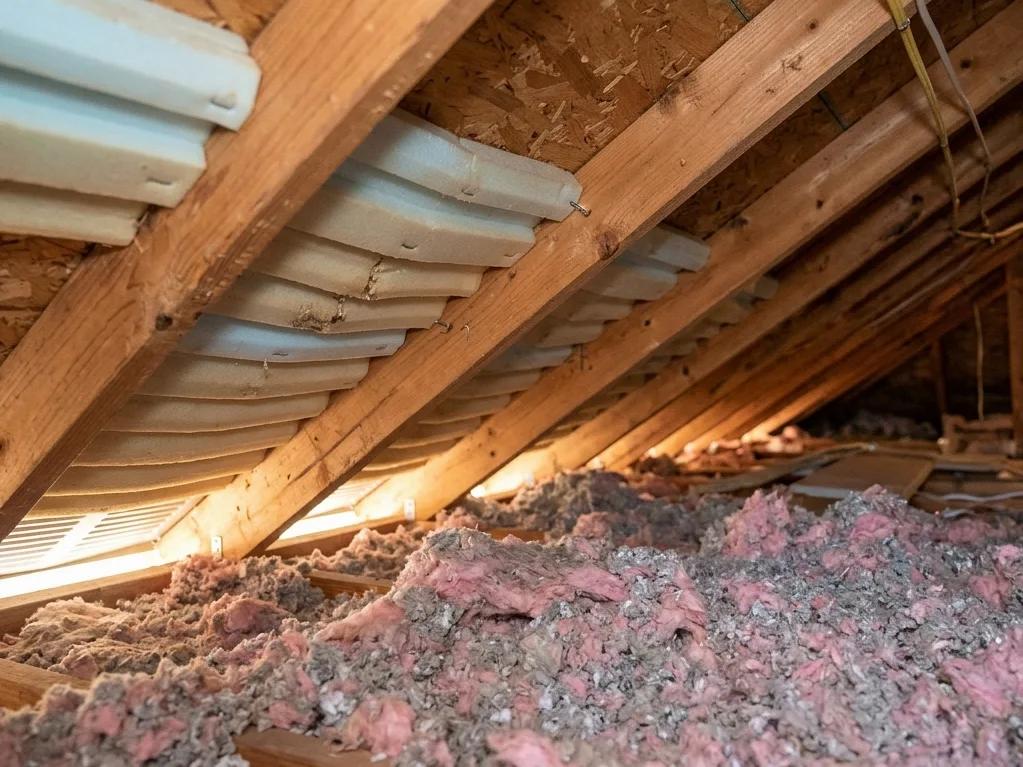
- Blocked soffit vents: Insulation is packed against the eaves, or solid soffit panels have no perforations at all.
- Frost or damp spots in winter: Moisture from the house condenses on the cold underside of the deck.
- Dark rust on nail tips: Condensation in the attic is rusting the points of roofing nails poking through the deck.
How we correct attic airflow
- We measure the attic floor area and count every existing vent to calculate current net free area for intake and exhaust.
- Blocked soffits are cleared, and baffles are set between rafters so insulation cannot creep into the airflow path.
- Solid soffit panels are cut in for continuous vented soffit, or individual intake vents are added between rafter bays.
- Competing exhaust is removed: extra box vents and turbines are taken out and the openings decked and shingled over.
- A shingle-over ridge vent is installed along the ridge with the deck cut back to the correct slot width.
- Bath fans and dryer ducts that dump into the attic are rerouted to their own roof or wall caps.
Venting for Dallas heat, humidity and spring storms
Dallas summers are the main reason ventilation matters here. Attic air above 140°F is common in July and August, and dark shingles over a poorly vented deck run even hotter. That heat ages asphalt fast, softens sealant strips, and pushes heat down into ductwork that often runs through the attic in North Texas homes. Good passive ventilation will not make an attic as cool as the outdoors, but it pulls the deck temperature down and slows the damage.
Storms are the other local concern. Box vents and turbines are among the first parts dented by hail, and turbines can seize or blow off in high wind. Wind-driven rain during spring storms sometimes gets into poorly baffled ridge vents, so we use ridge products with external baffles and weather filters rated for high winds. On homes with radiant barrier decking, we still need full ventilation, because the barrier reflects heat but does not move it out.
Exhaust and intake choices we install
The right setup depends on roof shape, how much ridge length is available, and whether soffits can take vents. Hip roofs with short ridges need different solutions than long gable roofs. These are the systems we most often recommend for Dallas homes.
| Vent type | Best for | What to know |
|---|---|---|
| Shingle-over ridge vent | Gable and long-ridge roofs | Even exhaust along the peak; needs matching soffit intake to work. |
| Low-profile box vents | Hip roofs with very short ridges | Placed near the top of each slope; dented easily by hail. |
| Continuous vented soffit | Homes with open eaves and wood soffit | Strong, even intake; we add baffles so insulation stays clear. |
| Edge or fascia intake vent | Homes with little or no soffit overhang | Installed at the roof edge under the shingles to add intake. |
| Solar-powered attic fan | Attics with no room for more passive vents | Must be sized to intake, or it pulls conditioned air from the house. |
What attic ventilation costs in Dallas
| Ridge vent install, per linear foot | $9.85 to $15.40 |
| Soffit vent cut-in, each | $48 to $86 |
| Rafter baffle install, per bay | $14 to $27 |
| Box vent or turbine removal and patch, each | $115 to $195 |
| Bath fan duct reroute to roof cap | $285 to $545 |
Cost depends on how many vents need to be removed or added, ridge length, soffit material, and whether insulation has to be pulled back for baffles. Cutting in a ridge vent during a reroof costs much less than retrofitting one later. Two-story homes and tile roofs need more labor, and rerouting bath fan ducts adds a separate line.
How the job runs
Call
Describe the symptom. Hot upstairs rooms, a damp attic smell, a drip around a skylight or a solar array that needs to come off: tell us what you are noticing.
Inspect
Roof and attic together. We look at intake and exhaust, decking condition, insulation depth and every penetration from both sides of the roof deck.
Price
Clear scope. You get a written scope that says what changes, why it helps in a Dallas summer and what it costs.
Install
Work done clean. Our crew protects the living space below, works from the roof side where possible and seals every opening it touches.
Verify
Check the result. We confirm airflow paths, flashing laps and fit, then photograph the finished work for your file.
Attic Ventilation questions
Can I keep my power attic fan with a new ridge vent?
Usually not. A powered fan near a ridge vent pulls air in through the ridge instead of the soffits, short-circuiting the system. Worse, if intake is weak, the fan draws cooled air out of the house through ceiling gaps. We generally remove the fan and seal the opening when we install a ridge vent.
Do I need ridge vents and box vents at the same time?
No, and mixing exhaust types often hurts airflow. Two different exhaust vents at different heights can pull from each other, so air flows between them instead of from the soffits up. We pick one exhaust type for the roof, size it to the intake, and remove the extras.
Does radiant barrier replace the need for attic ventilation?
No. Radiant barrier reflects much of the sun's heat that would radiate down from the deck, but the attic still collects warm, humid air that has to leave. Radiant barrier and balanced ventilation work best together, and many shingle warranties still require ventilation regardless of the barrier.
Why does my ventilation matter to my shingle warranty?
Shingle makers publish ventilation requirements, and some reduce or deny coverage when an attic is underventilated, because excess heat ages shingles faster. Exact warranty terms depend on the product line and installer registration. We document the vent math and photos on every reroof so you have a record.