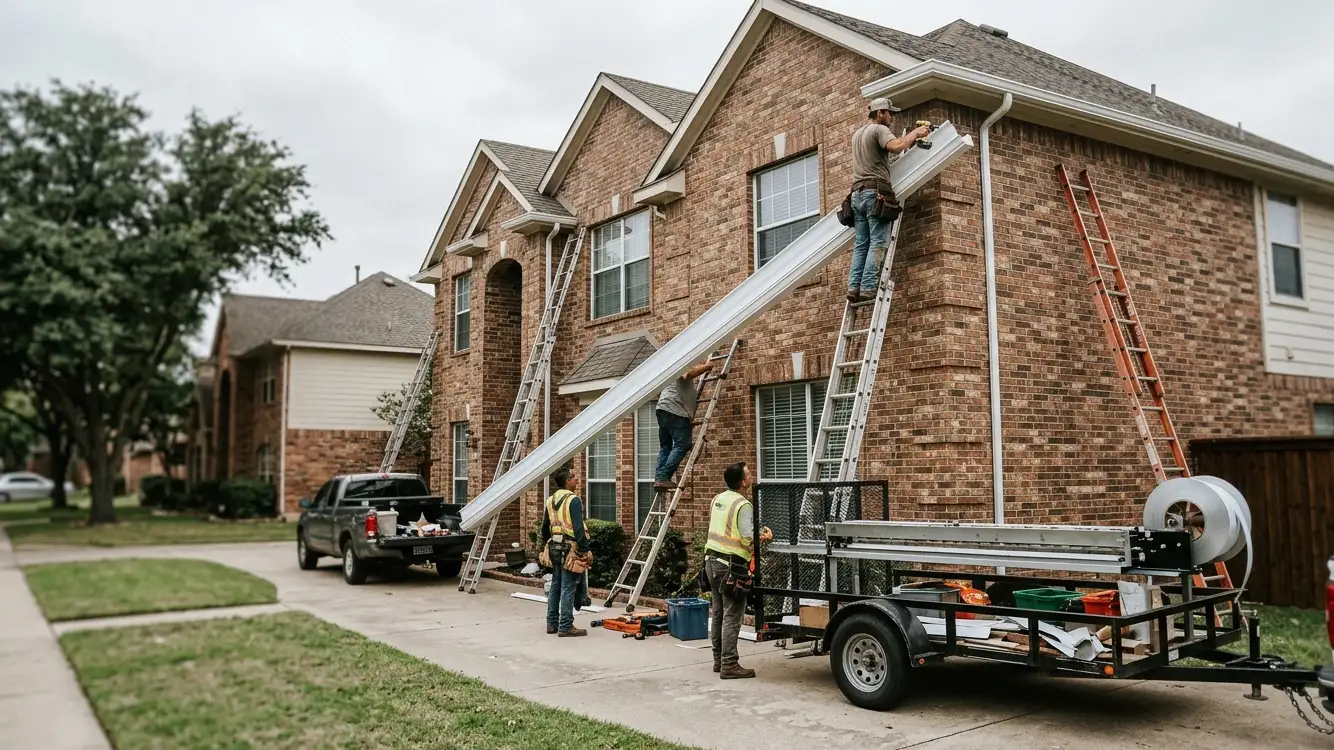
Installing seamless gutters means forming aluminum gutters on site in one continuous piece per run, hanging them on hidden hangers, and sizing downspouts to the roof area each one drains. You need new gutters when the old ones leak, sag or overflow, or after a reroof. Most Dallas homes land between $1,465 and $3,890 for the whole house.
Dallas rain tends to arrive all at once. A spring thunderstorm can drop an inch in under an hour, and a gutter system that handles a drizzle fine will overflow at every inside corner when that happens. Most of the gutter trouble we see traces back to sizing and pitch rather than the metal itself: 5 inch troughs on roofs that need 6 inch, two downspouts doing the work of four, and runs that hold standing water because the slope was never set right.
We roll seamless gutters on site from coil, cut to the exact length of each run, so the only joints are at corners and end caps. That matters on long Dallas ranch eaves where a sectional system would have a seam every ten feet, each one a future drip. Our crews hang the gutters on hidden hangers screwed into the fascia, set the pitch with a string line, and place downspouts where water can actually leave the property instead of dumping against the slab.
Signs it is time for new gutters
- Overflow at inside corners: Water jumps the gutter where two roof planes meet because the trough or downspout is undersized.
- Sagging runs: Spikes and ferrules have backed out of the fascia, so sections droop and hold water in the low spots.
- Drips at every joint: Sectional gutters with dried joint sealant leak at each connection down the run.
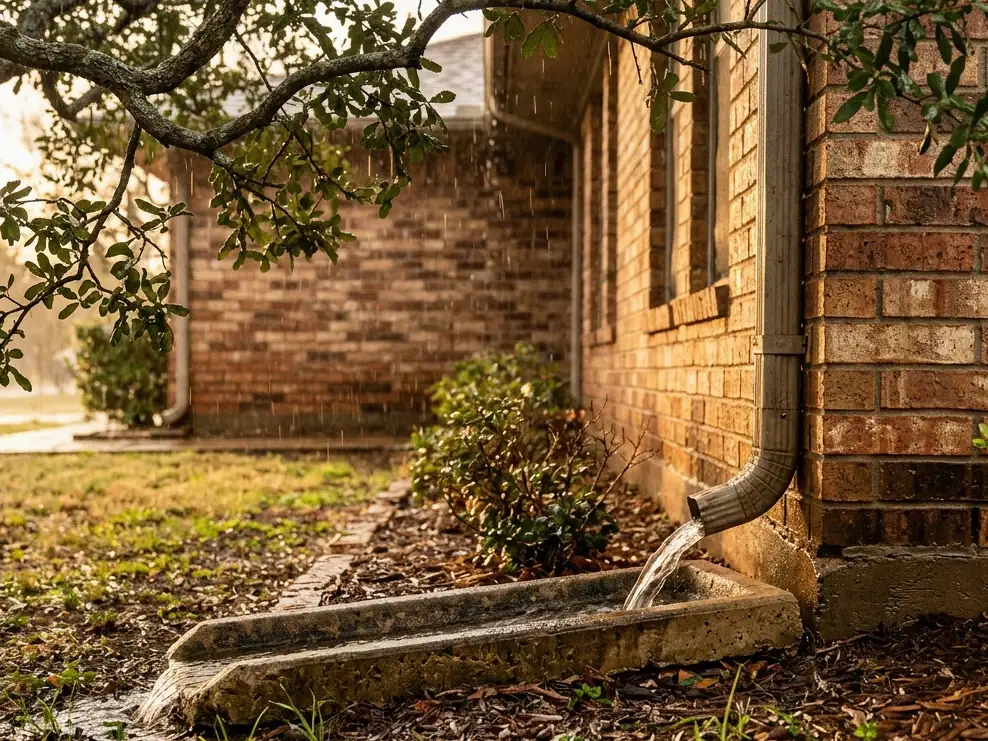
- Trenches in the flower beds: A line of washed-out mulch under the eave means water is leaving the roof in a sheet.
- Soft fascia behind the gutter: Peeling paint or punky wood behind the trough shows water has been running down the back side.
- Downspouts ending at the slab: Water dumped right at the foundation keeps the clay soil there swelling and shrinking unevenly.
What goes into a new gutter system
- We measure every eave and work out the roof area feeding each outlet to choose 5 inch or 6 inch K-style and 2x3 or 3x4 downspouts.
- Old gutters and spikes come off, and any rotted fascia is replaced before anything new is hung.
- Gutters are formed on site from .027 or .032 aluminum coil in your chosen color, one piece per run.
- Hidden hangers go in about every two feet, screwed into solid wood, with a fall of roughly a quarter inch per ten feet toward each outlet.
- Corners are mitered and sealed, outlets are cut clean, and downspouts are strapped to the wall with extensions or splash blocks at the base.
- Before we leave, we run a hose down every run to confirm water heads for the outlets with nothing left standing.
Gutter sizing for North Texas storms and trees
Many Dallas homes from the 1960s through the 1990s were built with 5 inch gutters and 2x3 downspouts, which suited low one-story roofs but struggles with the broad, steep planes on newer two-story homes in Frisco, Plano and Flower Mound. Where a valley drains a big upper roof onto a lower one, a 6 inch gutter feeding a 3x4 downspout, which has roughly double the opening of a 2x3, keeps up far better. We look at where every valley lands before choosing a size.
Trees shape the plan as much as rain does. Live oaks drop small leaves and tassels nearly year round, pecans shed husks and nuts every fall, and cottonwoods along creeks coat everything in fluff each spring. Under that kind of canopy, we lean toward larger downspouts that clog less often and plan for guards. Clay soil is the other half of the picture: downspouts should carry water several feet from the slab, since uneven wetting is one reason Blackland Prairie foundations shift.
Gutter sizes and metals compared
Most Dallas homes get aluminum K-style gutters, but the size and gauge make a real difference in how the system handles a downpour and how it stands up to ladders, falling limbs and hail. Here is how the common choices compare on Dallas houses.
| Option | Best for | What to know |
|---|---|---|
| 5 inch K-style, .027 aluminum | One-story homes with modest roof planes | Lowest cost and fine for typical runoff, but dents easily from hail and ladders |
| 5 inch K-style, .032 aluminum | Standard size with a stiffer trough | Heavier gauge holds its shape and resists sagging between hangers |
| 6 inch K-style, .032 aluminum | Two-story homes, big valleys, heavy tree cover | Carries much more water and pairs with 3x4 downspouts that clog less |
| Half-round aluminum or copper | Historic homes in Winnetka Heights or the M Streets | Traditional profile with round downspouts; costs more and uses exposed brackets |
| Built-in box gutter rebuild | Older homes with gutters framed into the eave | Custom-lined trough that keeps the original roofline; priced as a custom job |
What seamless gutter installation costs in Dallas
| 5 inch .027 aluminum, per linear foot installed | $7.35 to $10.60 |
| 6 inch .032 aluminum, per linear foot installed | $10.85 to $15.40 |
| Downspout, 2x3 or 3x4, each installed | $88 to $214 |
| Fascia board replacement, per linear foot | $9.45 to $17.80 |
| Old gutter tear-off and haul away | $145 to $385 |
Linear footage sets most of the price, then gutter size, gauge, the number of corners and downspouts, and two-story height. Replacing rotted fascia behind the old gutters adds wood and paint. Copper and half-round styles cost several times what aluminum K-style does. Underground drain lines that carry water away from the foundation are priced on their own, since trenching depends on the yard and landscaping.
How the job runs
Call
Tell us what failed. Overflowing gutters, a sagging run, cracked siding after hail or bare wood showing: describe it and we set a visit.
Measure
Measure and match. We measure runs, wall areas and downspout locations, and match colors and profiles to what is already on the house.
Price
Written proposal. Material, gauge or thickness, color and the full price are written down before work begins.
Install
Built to drain. We set pitch, fasteners and flashing so water leaves the house the way it should during a North Texas downpour.
Clean up
Haul away and check. Old material leaves with us, and we run water through new gutters before we call it done.
Seamless Gutter Installation questions
Should my Dallas house have 5 inch or 6 inch gutters?
It depends on the size and pitch of the roof planes feeding each run and how many downspouts can be placed. Single-story ranches with short eaves often do fine with 5 inch. Two-story homes, steep roofs and any spot where a valley empties onto a lower roof usually call for 6 inch with 3x4 downspouts. We measure on site and walk you through the reasoning.
What is the real difference between .027 and .032 aluminum?
It is the thickness of the coil in inches. The .032 metal is noticeably stiffer, so it resists sagging, dents less when a ladder leans on it, and holds up a little better in hail. It costs somewhat more per foot. On 6 inch gutters and under heavy trees, we recommend .032 because a full trough carries a lot of weight.
Why hidden hangers instead of spikes?
Spike and ferrule systems depend on a long nail driven through the gutter into the fascia, and Dallas heat cycles slowly work those nails loose until the gutter droops. Hidden hangers screw into the fascia and clip inside the front lip, so the hold does not depend on friction. They also stay out of sight, which keeps the face of the gutter clean.
Should gutters go up before or after a new roof?
After, whenever possible. A reroof brings new drip edge and sometimes fascia repair, and gutters hung first tend to get bent or nicked while the roof goes on. When we handle both, the gutters go up right after the roof, so the drip edge laps correctly into the trough and the gutter color is picked to work with the new shingles.