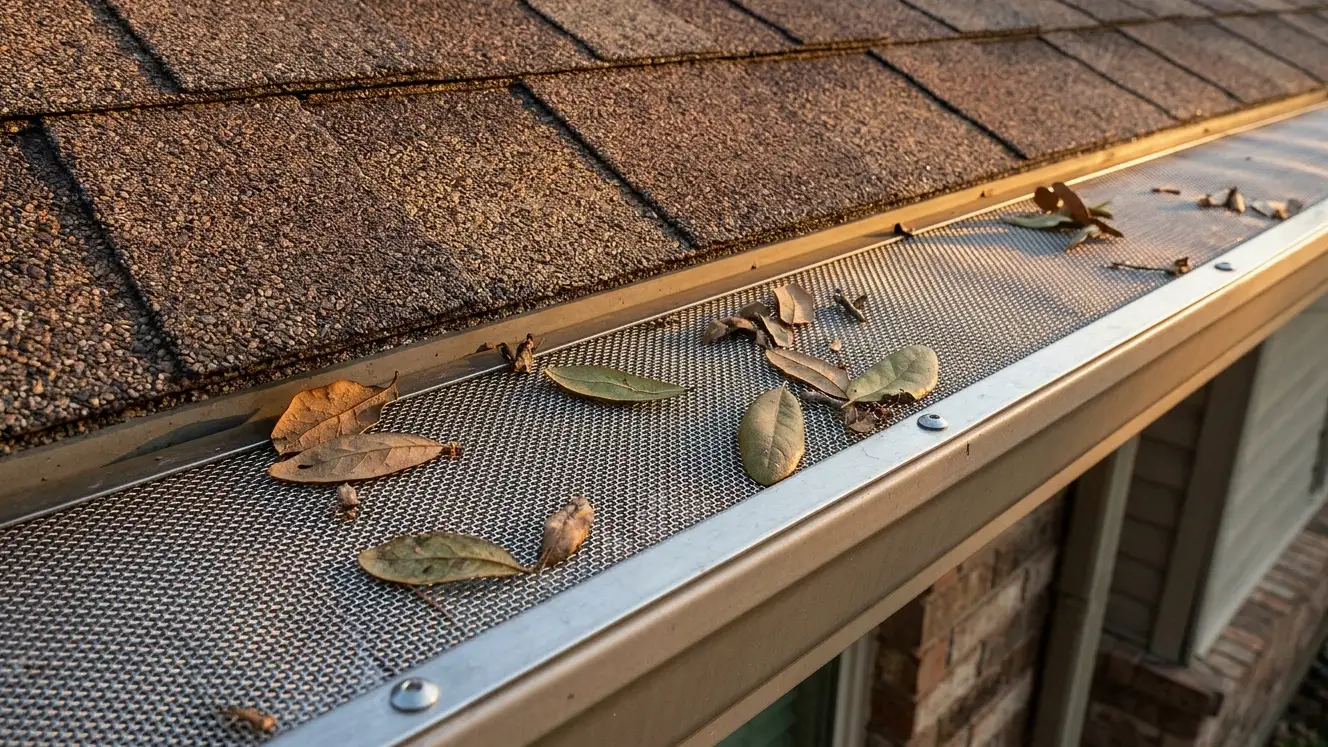
Gutter guards are covers fitted over the gutter trough that keep leaves, husks and twigs out while letting rain through. They pay off when you clean gutters more than twice a year or have trees hanging over the roof. Installed guards on a typical Dallas home run about $1,185 to $3,460, depending on footage and the guard you choose.
A gutter guard works only as well as its match to the trees above it. A coarse screen that does fine under a pine will pass live oak tassels straight through, while a fine micro-mesh stops oak debris but needs an occasional brushing when cottonwood fluff mats on top. Dallas yards often have several of these trees at once, so choosing a guard means looking at what actually lands on your roof across the year, not buying whatever product costs the most.
We install guards on new and existing gutters. On existing systems we clean and flush every run first, fix leaks and re-pitch any sag, because a guard laid over a broken gutter only hides the problem. The guard then fastens to the front lip and either rests on the drip edge or slips just under the first course, depending on the product and what the shingle manufacturer allows. Every downspout is left clear, and we check the flow with a hose.
Signs guards would pay off
- Constant cleaning: You or a service clean the gutters several times a year and they still fill between visits.
- Branches over the roofline: Live oak, pecan, elm or cottonwood limbs hang over the eaves and drop debris most months.
- Clogs after one storm: Freshly cleaned gutters fill with enough washed-down debris in a single storm to block the outlets.
- Seedlings sprouting in the trough: Little trees growing in your gutters mean rotted leaves have turned into soil.
- Jammed downspout elbows: Water backs up at the outlet because husks and twigs have wedged in the bend.
- Tall ladder on uneven ground: Cleaning a two-story eave over beds or a slope is work you would rather stop doing.
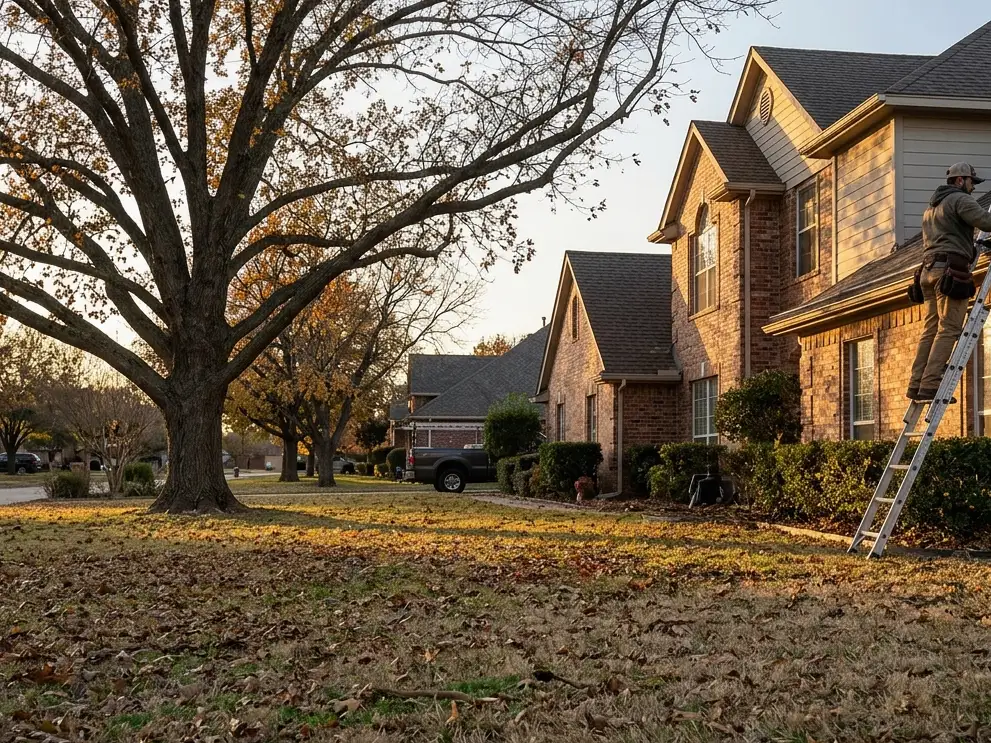
How we install gutter guards
- We look at the trees over each run and the roof edge detail, then recommend the guard that suits that debris and that roof.
- Every gutter is scooped, flushed and checked so the guard goes on over clean, leak-free troughs.
- Loose hangers, failed corners and flat spots get fixed before any guard is fastened down.
- Guards are cut to length and fastened to the front lip, seated at the roof edge without lifting or nailing through shingles.
- Inside and outside corners are trimmed and overlapped so there are no open gaps for debris to drop through.
- We run water across the guards at the heaviest flow points, usually under valleys, to confirm they take it in.
Picking a guard for Dallas trees
Live oaks are the toughest test. They drop narrow leaves almost all year and shed fine tassels in spring that slip through anything with large openings. Under live oaks, stainless micro-mesh is the most reliable choice, with the trade-off that pollen and fine grit can film the surface and need a brush now and then. Pecans drop husks and nuts in the fall that mostly bounce off guards but can pile up in valleys, where we sometimes add a small diverter.
Cottonwoods grow thick along creeks in older parts of Dallas and around the lakes near Rowlett and Wylie, and in late spring they release a cottony seed fluff that mats on top of any guard. It usually dries and blows off on its own, but on low-pitch roofs it can sit and slow the water during a storm. Heavy rain is the other factor, because a guard has to take a flash downpour without water sheeting over it below the valleys.
Gutter guard types side by side
Guards come in a handful of designs, and each handles debris and heavy rain differently. The right pick depends on tree type, roof pitch, and how much you want to spend upfront versus how much upkeep you will accept later.
| Guard type | Best for | What to know |
|---|---|---|
| Stainless micro-mesh | Live oak tassels, fine debris, pine needles | Blocks the most debris; needs an occasional brushing when pollen or fluff mats on top |
| Perforated aluminum | Mixed leaves from elms, pecans and maples | Sturdy and moderately priced; small seeds and oak tassels can work through |
| Reverse curve hood | Big leaves and moderate rain | Leaves slide off the front; heavy Dallas downpours can overshoot the curve |
| Vinyl or plastic screen | Light debris and tight budgets | Lowest cost, but warps and turns brittle in North Texas sun within a few years |
| Foam or brush inserts | Short-term fixes | Cheap and simple, but they hold debris and moisture and must be pulled out to clean |
What gutter guards costs in Dallas
| Stainless micro-mesh, per linear foot | $9.80 to $16.45 |
| Perforated aluminum, per linear foot | $5.65 to $9.30 |
| Reverse curve hood, per linear foot | $11.40 to $19.75 |
| Cleaning and flush before install | $135 to $295 |
| Valley diverter, each | $42 to $87 |
Linear footage and guard type set the price, with micro-mesh and hoods at the top and screens at the bottom. Two-story eaves and steep roof edges add labor. If the gutters need cleaning, resealing or re-pitching first, those repairs are added to the job. Homes with many inside corners and short runs cost more per foot than long, straight eaves, since every corner needs careful trimming.
How the job runs
Call
Tell us what failed. Overflowing gutters, a sagging run, cracked siding after hail or bare wood showing: describe it and we set a visit.
Measure
Measure and match. We measure runs, wall areas and downspout locations, and match colors and profiles to what is already on the house.
Price
Written proposal. Material, gauge or thickness, color and the full price are written down before work begins.
Install
Built to drain. We set pitch, fasteners and flashing so water leaves the house the way it should during a North Texas downpour.
Clean up
Haul away and check. Old material leaves with us, and we run water through new gutters before we call it done.
Gutter Guards questions
Will gutter guards end gutter cleaning for good?
No guard removes upkeep entirely. Guards shift the work from scooping out troughs to an occasional check and brush of the guard surface, which in most yards means once or twice a year instead of several times. Under heavy live oak cover, micro-mesh may need a soft brush after the spring tassel drop, and downspouts still deserve a look after big storms.
Can guards interfere with my shingle warranty?
Some designs tuck far under the first course of shingles, which can conflict with shingle manufacturer installation rules if nails are disturbed or the seal strip is broken. We use guards that fasten to the gutter lip and either rest on the drip edge or slip under without lifting the shingles. Manufacturer warranty terms depend on the product line, so we check before choosing.
Can guards keep up with a Dallas flash downpour?
Good micro-mesh and perforated guards take in a lot of water, but every guard has a limit, and the weak point is almost always below a valley where two roof planes concentrate the flow. We add a small diverter there when needed. If your gutters overflowed before guards because they were undersized, guards will not solve that; bigger gutters will.
Can you put guards on the gutters I already have?
Yes, as long as those gutters are in decent shape. We clean, flush and repair them first, because a guard over a leaking corner or sagging run just covers up the problem. If the existing gutters are sectional with leaking seams everywhere, or badly undersized, we say so and price replacement alongside the guards so you can compare the two.