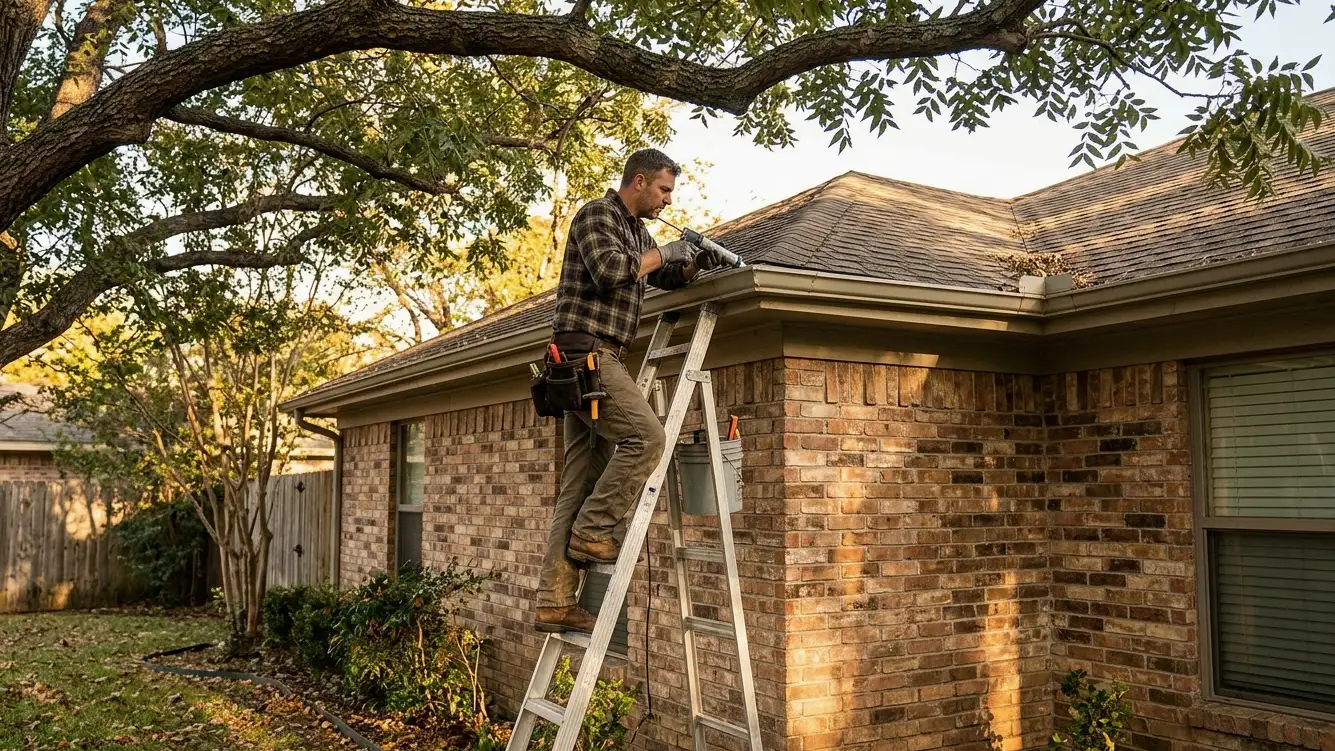
Gutter repair covers resealing leaking joints, re-hanging sagging runs, re-pitching gutters that hold water, clearing and reattaching downspouts, and swapping out dented sections. It makes sense when the system is mostly sound but has a handful of specific failures. Most Dallas gutter repair visits fall between $185 and $735, depending on how many trouble spots there are.
Plenty of gutter systems do not need replacing; they need an afternoon of focused repair. A run that sags in the middle usually has two or three failed fasteners. A corner that drips usually has sealant that cracked after a few summers in the sun. A downspout that backs up usually has a packed elbow. Fixing those specific failures costs a fraction of new gutters, and on a system that is otherwise straight and sound, it is the sensible call.
We look at the whole system before pricing anything, because one symptom can have a cause somewhere else. Water spilling over the front edge might be a clog, or it might be a run hung with the slope going the wrong way. A gap behind the gutter might be a loose hanger, or fascia so soft it no longer holds a screw. Our crews fix what is actually wrong and tell you plainly when a run is past saving.
Gutter problems we fix most
- Dripping miters and end caps: Sealant has dried and split, so water drips from the corners in a steady line.
- Water standing in the trough: The pitch has flattened or reversed, leaving a puddle that breeds mosquitoes and corrodes fasteners.
- Gap behind the gutter: The run has pulled off the fascia and water now runs down the wall instead of into the trough.
- Swinging downspout: An elbow popped loose or a strap broke, and the downspout moves every time the wind picks up.
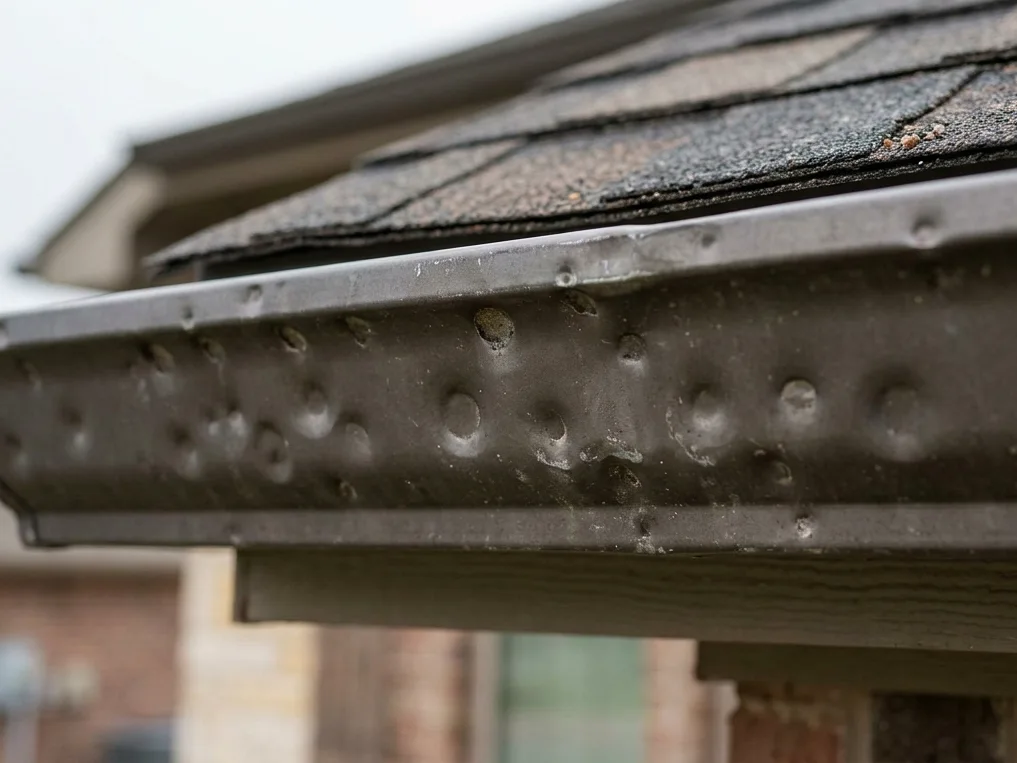
- Crushed or dented sections: Hail or a falling limb flattened part of the run or bent the front lip outward.
- Leaks at the outlet: The drop where the downspout attaches was cut rough or its sealant has failed.
Typical gutter repairs on a service visit
- We clear the debris first so every joint, outlet and hanger is visible, then hose test to find each leak.
- Failed miters and end caps are cleaned to bare metal and resealed, or riveted tight and then resealed if the joint has loosened.
- Sagging runs get new hidden hangers driven into solid wood, and the slope is reset against a string line.
- Soft fascia behind a loose run is replaced so the new fasteners have something firm to bite into.
- Dented sections are cut out and replaced with matching color aluminum joined by a sealed slip joint.
- Downspouts are cleared, refastened with new straps and screws, and given extensions that move water away from the slab.
What Dallas weather does to gutters
Hail is hard on gutters in ways that are easy to miss from the ground. A storm that leaves round dents along the face of a gutter has often left similar damage on the roof, and those dents are useful evidence for an adjuster. If your gutters took a beating this spring, we document them alongside the roof. Bent lips and crushed corners also change how water flows, so a storm-dented system can start overflowing in spots that never gave trouble before.
The steadier stress is heat. Aluminum expands and contracts every day through a Dallas summer, and that movement slowly works on the sealant at each joint and the fastener at each hanger. Runs longer than about forty feet do better with an expansion joint so the gutter is not fighting itself. Tree debris adds weight on top of that, and a trough loaded with wet pecan husks or live oak leaves puts real strain on old spikes in a heavy storm.
Repair or replace: how we decide
Not every failing gutter has to come down, and replacing a sound system is money you do not need to spend. These are the situations we run into most and how each one usually gets resolved, so you know what to expect before anyone climbs a ladder.
| Situation | Typical cause | Usual fix |
|---|---|---|
| A few leaking corners | Sealant aged out on otherwise solid gutters | Reseal or rivet the joints, the most common and least expensive repair |
| One sagging run | Failed hangers or soft fascia | New hangers into sound wood and a reset slope; fascia replaced if it is rotted |
| Storm-dented sections | Hail or limb strikes on part of the system | Replace the damaged lengths in matching color after documenting them for the claim |
| Leaks along the whole run | Sectional gutters with a joint every ten feet | Repairs add up fast here, and seamless gutters usually make more sense |
| Overflow even when clean | Gutters too small for the roof | Repair cannot fix undersizing; larger gutters or added downspouts can |
What gutter repair costs in Dallas
| Reseal a corner or end cap, each | $24 to $58 |
| Re-hang and re-pitch a sagging run | $135 to $345 |
| Replace a damaged section, per foot | $11.25 to $18.70 |
| Reattach or replace a downspout | $76 to $198 |
| Fascia repair behind a run, per foot | $10.20 to $18.35 |
The number of leaking joints, sagging runs and damaged sections sets most of the price. Two-story work and steep landscaping under the eave take longer to set up. If the fascia behind a run has rotted, wood replacement and paint are added. Matching an unusual color or older profile can mean ordering coil, which adds a short wait and a little cost.
How the job runs
Call
Tell us what failed. Overflowing gutters, a sagging run, cracked siding after hail or bare wood showing: describe it and we set a visit.
Measure
Measure and match. We measure runs, wall areas and downspout locations, and match colors and profiles to what is already on the house.
Price
Written proposal. Material, gauge or thickness, color and the full price are written down before work begins.
Install
Built to drain. We set pitch, fasteners and flashing so water leaves the house the way it should during a North Texas downpour.
Clean up
Haul away and check. Old material leaves with us, and we run water through new gutters before we call it done.
Gutter Repair questions
Why do my gutter corners keep leaking after I caulk them?
Most hardware store caulk is not made for aluminum that moves every day in Texas heat, and it bonds poorly when laid over old sealant and dirt. We strip the joint to clean metal, rivet it tight if it has loosened, and use a gutter sealant that stays flexible. Done that way, a corner repair holds for years rather than a single season.
Can you match the color on a replaced gutter section?
Common colors like white, almond, clay, bronze and black are easy to match from stock coil. Old gutters fade, though, so new metal can look slightly brighter, especially on the sunny side of the house. When the match matters on the front elevation, we sometimes replace the whole visible run so the color reads evenly from the street.
Is it worth filing a claim for hail-dented gutters?
Gutter dents alone rarely exceed a wind and hail deductible, especially a percentage deductible on a Texas policy. They matter when the same storm hit the roof, because adjusters treat soft metals like gutters, vents and flashing as evidence of hail size. Get the roof looked at before deciding. We photograph gutter and roof damage together so the record is complete.
Is standing water in my gutters a problem if they never overflow?
Yes. Standing water adds weight that pulls on the hangers, breeds mosquitoes through a long Dallas summer, and keeps fasteners wet so they corrode. It almost always means the pitch is flat or reversed somewhere along the run. Resetting the slope toward the outlet solves it, and while we are up there we check the hangers that carried the extra load.