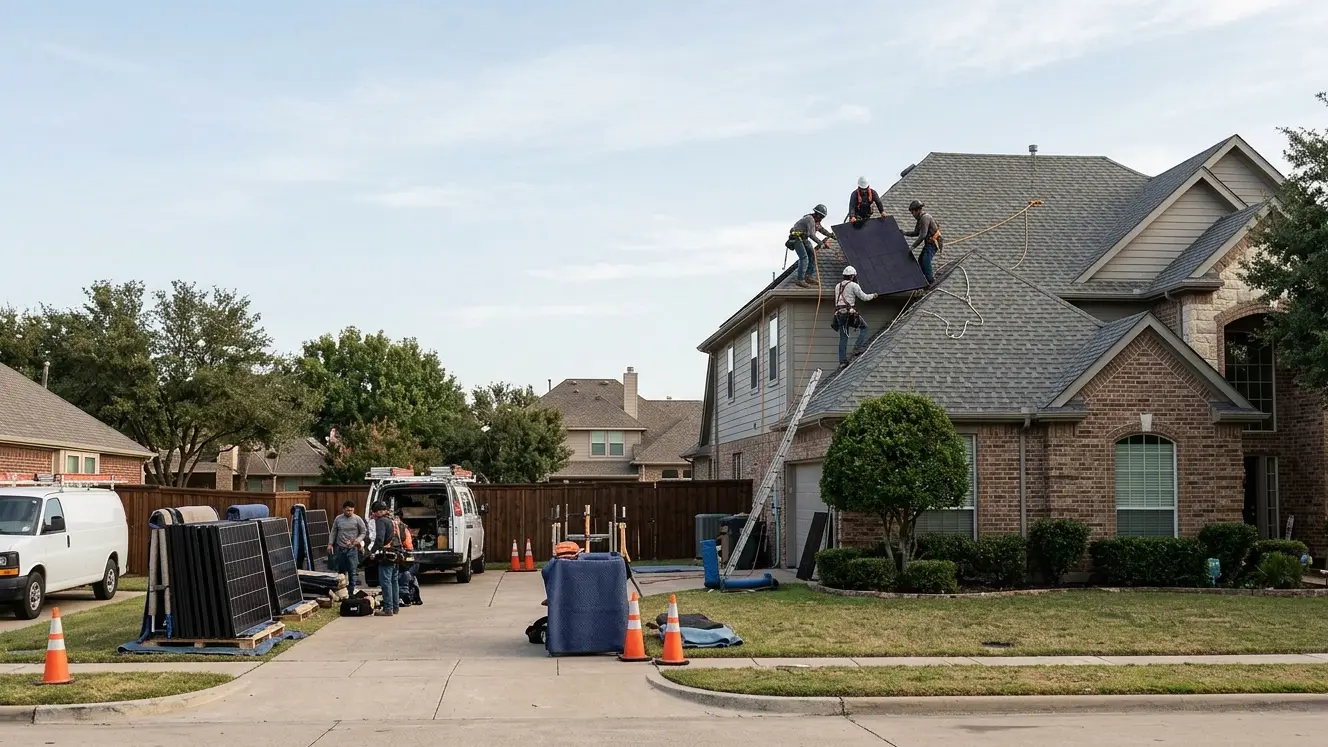
Solar panel removal and reinstall means taking an array off the roof so the roof can be repaired or replaced, then putting it back on new flashed mounts. You need it before any reroof under existing panels, or when leaks trace to mount points. In Dallas, a typical residential detach and reset runs about $2,365 to $5,840, mostly depending on panel count.
Solar panels usually outlive the roof they sit on. An array put up eight or ten years ago on a Dallas roof that was already a decade old will often still be producing when the shingles beneath it are worn out, and one spring hailstorm can close that gap overnight. When the roof below needs work, the array has to come down in an orderly way: panels labeled, wiring documented, racking pulled, and every penetration accounted for so nothing is lost or mismatched when it goes back up.
We handle the roofing side of that job and work alongside whoever handles the electrical side. Before a single clamp is loosened, the system has to be shut down and disconnected by the solar company or an electrician, and the same people recommission it once the panels are back on. Our crews take the array off, store the panels on padded racks, repair or replace the roof, set new flashed mounts, and reinstall the racking so the electrical team can reconnect and confirm production.
When the panels need to come off
- Reroof on the calendar: A roof replacement under an existing array cannot be done properly by shingling around the mounts.
- Leak lined up with a mount row: Ceiling stains that follow a line of standoffs usually point to a failed flashing boot or dried sealant.
- Hail claim approved: The adjuster signed off on a new roof after a spring storm, and the panels sit right on the damaged field.
- Grit piling under the rails: Shingles shedding granules beneath the racking show the roof is aging faster than the panels.
- Birds or squirrels under the array: Nesting material packed under the panels holds water against the shingles and chews wiring.
- Racking that moves: Rails that shift when pushed, or feet with rust bleeding onto the roof, need resetting before they loosen further.
How a detach and reset runs on our jobs
- We photograph and label every panel, string and rail so the layout goes back exactly as it was designed.
- The solar company or electrician shuts the system down and disconnects it before our crew touches any hardware.
- Panels come off by hand, get stacked on padded racks, and are stored away from foot traffic and falling debris.
- Old standoffs are pulled, holes are filled and sealed, and any rotted decking at mount points is cut out and replaced.
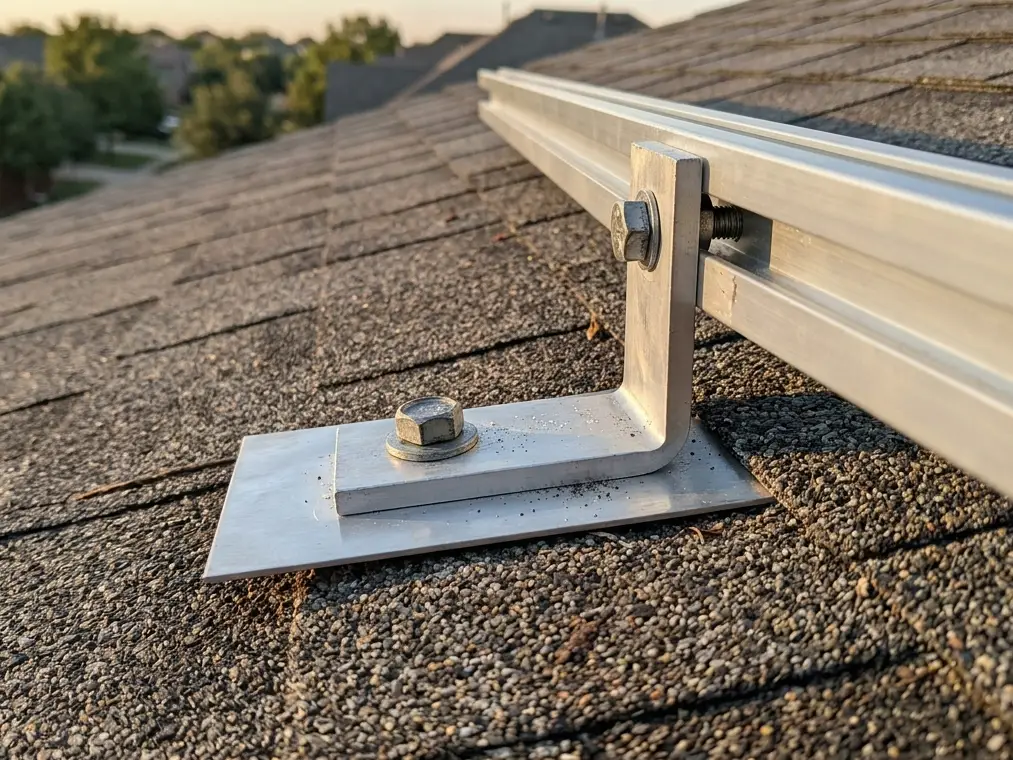
- The new roof goes on with flashed mounts or new boots set at each attachment point and lag-bolted into the rafters.
- Racking and panels are reinstalled, the electrical team recommissions the system, and we check the monitoring app for normal production.
Solar arrays on Dallas roofs: why timing matters
North Texas hail season runs roughly March through June, and an array is no shield for the shingles around it. Hail that tempered panel glass shrugs off can still bruise the exposed roof between rows, and adjusters often approve a full replacement with detach and reset written in as its own line item. Moving quickly matters here, because a roof with a damaged field and a heavy array bolted through it is not something you want to carry into the next round of storms.
Heat plays a part too. Summer attic temperatures often exceed 140°F, and the shaded strip under an array heats and cools on a different rhythm than open roof, which works on sealants at the mounts year after year. When we reset an array on a new Dallas roof, we use flashed mounts instead of relying on a bead of sealant, so the seal does not depend on caulk surviving the sun. The reroof itself needs a city permit, and leased systems may require notice to the leasing company.
Mount and flashing choices on reinstall
How an array attaches to the roof decides whether the mounts stay dry for the life of the new roof. These are the attachment options we see most on Dallas homes, and which one fits depends on the racking brand, the roof material and the rafter layout.
| Option | Best for | What to know |
|---|---|---|
| Flashed composition mount | Asphalt and Class 4 shingle roofs | A metal flashing slides under the course above, so water sheds over the mount instead of relying on sealant |
| Reusing existing standoffs | Newer hardware in good condition | Only sensible when the feet are not rusted and fresh flashing can be fitted around them |
| Rail-less mounting | Arrays where the installer specified it | Fewer roof penetrations in some layouts, but every attachment still needs its own flashing |
| Tile hook with flashed blank | Concrete or clay tile roofs | Tiles at each hook are swapped for flashed replacements so a cracked tile does not become a leak path |
| Standing seam clamp | Standing seam metal roofs | Clamps grip the seam with no holes through the panel, a strong reason to pair solar with metal |
What solar panel removal & reinstall costs in Dallas
| Detach, store and reset, 12 to 18 panels | $2,365 to $3,980 |
| Detach, store and reset, 20 to 30 panels | $3,745 to $5,840 |
| New flashed mount, per attachment | $38 to $74 |
| Critter guard mesh around the array | $415 to $1,085 |
| Rotted decking at mount points, per sheet | $78 to $126 |
Panel count drives most of the price, followed by roof pitch, two-story access, and whether the racking can be reused or needs new feet and flashing. Electrical disconnect and recommissioning are usually billed by the solar company or electrician. Storage time, critter guard mesh and replacing broken mid-clamps or end-clamps add to the total. On a covered hail claim, detach and reset is often paid as part of the roof.
How the job runs
Call
Describe the symptom. Hot upstairs rooms, a damp attic smell, a drip around a skylight or a solar array that needs to come off: tell us what you are noticing.
Inspect
Roof and attic together. We look at intake and exhaust, decking condition, insulation depth and every penetration from both sides of the roof deck.
Price
Clear scope. You get a written scope that says what changes, why it helps in a Dallas summer and what it costs.
Install
Work done clean. Our crew protects the living space below, works from the roof side where possible and seals every opening it touches.
Verify
Check the result. We confirm airflow paths, flashing laps and fit, then photograph the finished work for your file.
Solar Panel Removal & Reinstall questions
Who disconnects the electrical side before you remove the panels?
The solar company that installed the system, or an electrician familiar with your inverter, shuts it down and disconnects the array. We set the date with them so shutdown, removal, roof work and recommissioning line up without gaps. If the original installer has closed, we schedule an electrician who works on your inverter type so the system is not left sitting idle.
Will moving the array void the panel or inverter warranty?
Panel and inverter warranties usually turn on how the work is done, not on the fact that the array was moved. Read your installer agreement, since some installers want notice or prefer to handle the electrical work themselves. Before removal, we photograph each panel so any existing chips, scratches or delamination are on record.
How long will the panels be off my roof?
For a straightforward shingle reroof, the array is typically down from several days to about a week, depending on weather and how soon the electrical team can return to recommission. Panels sit flat on padded racks the whole time. Bigger arrays, decking repairs and tile roofs stretch the schedule, and you get the plan before the first clamp comes off.
How do you confirm the system works after reinstall?
Once the electrician reconnects and restarts the inverter, we look at the monitoring app with you to confirm each string or microinverter is reporting. A panel reading zero usually means a connector did not seat fully, which is a quick fix while the crew is still there. On roofs where leaks are hard to rule out, we also water test a sample of the mounts.