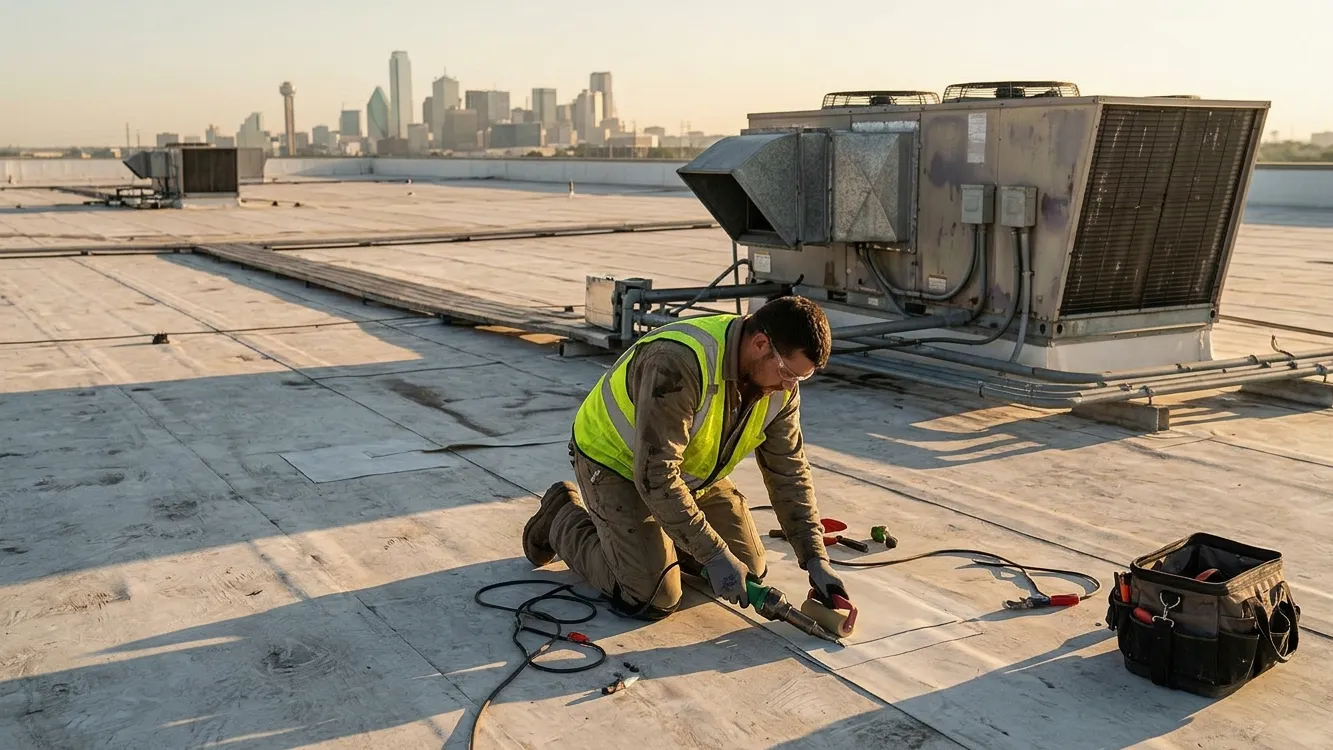
Flat roof repair means finding where water actually enters a low-slope roof and fixing that spot, whether a split seam, failed flashing, clogged drain or punctured membrane, and replacing any wet insulation beneath it. You need it at the first sign of interior leaks or after hail. Dallas commercial flat roof repairs usually run $565 to $3,780 per visit.
Leaks on a flat roof rarely come in where they show up inside. Water finds a split seam or a cracked pitch pan, runs along the deck or through the insulation, and drips out at a light fixture thirty feet away. That is why so many flat roof patches fail: the patch went over the stain on the ceiling rather than the actual entry point. Tracing the leak correctly is most of the job, and it is where we spend our time first.
We repair low-slope roofs on retail buildings, offices, warehouses, churches, apartment buildings and mixed-use properties across Dallas. Our crews repair TPO, PVC, EPDM, modified bitumen and built-up roofs, along with the drains, scuppers, parapet caps and curb flashing that tie into them. Property managers get a clear written report of what was found, what was fixed, and which areas of the roof should be watched or budgeted for next year.
Flat roof problems that lead to leaks
- Stained or sagging ceiling tiles: Brown rings or drooping tiles show water is already through the roof system.
- Split or lifted seams: Laps opening along TPO or EPDM sheets let rain run directly under the membrane.
- Cracked pitch pans and pipe boots: Sealant-filled pans around conduit and pipes shrink and crack in the heat.
- Clogged drains and scuppers: Leaves, gravel and debris block outlets, so water backs up over flashing heights.
- Soft spots underfoot: Areas that feel spongy when walked usually mean wet insulation or deck damage below.
- Torn parapet flashing: Base flashing pulling off walls or loose coping caps lets wind-driven rain into the wall cavity.

How we trace and repair flat roof leaks
- We gather the interior leak locations, then walk the roof above them and outward along the slope toward the drains.
- Seams are probed, flashings and penetrations are inspected, and moisture readings flag wet areas under the membrane.
- Wet insulation is cut out and replaced so trapped water cannot keep feeding leaks or rotting the deck.
- Repairs are made with materials compatible with the existing membrane, welded, adhered or torched as the system requires.
- Drains, scuppers and gutters are cleared, and drain strainers or clamping rings are replaced where they have failed.
- Managers get photos of each repair and notes on areas that should be watched or included in next year's budget.
Why Dallas flat roofs leak
Heat and UV are relentless on low-slope roofs here. A flat roof faces the sun all day with nothing to shade it, and summer surface temperatures on dark membranes climb well past what the air feels like. That daily cycle of heating and cooling stresses seams, dries out sealant at pitch pans, and makes older EPDM shrink away from walls. Most of the leaks we trace in late summer start at a flashing detail that has simply worn out.
Storm season adds its own problems. Flash downpours dump water faster than small drains can take it, so ponding water can rise above the flashing on curbs and walls. Hail fractures brittle membranes and punctures the cap sheet on mod bit, sometimes without any visible sign from the ground. Wind is a risk as well: gusts like the 80+ mph winds that crossed Dallas on May 28, 2024 are strong enough to lift loose membrane edges and coping caps. After any big storm, a walk-through of the roof is worth scheduling.
Repairs by roof type
Every low-slope roof system gets repaired a little differently, and using the wrong material on a patch is a common reason repairs fail within a season. These are the systems we repair most often on Dallas buildings and how each is usually handled.
| Roof type | Common failure | Typical repair |
|---|---|---|
| TPO or PVC | Open seams, punctures, flashing pulled loose | Clean and hot-air weld new membrane patches and flashing |
| EPDM rubber | Seam tape release, shrinkage at edges | Prime and tape seams, add cover strips, re-terminate edges at walls |
| Modified bitumen | Blisters, cracked cap sheet, open laps | Cut out blisters and torch or adhere new plies, recoat granules |
| Built-up gravel roof | Splits, bare spots, clogged drains | Spud gravel back, patch plies with matching asphalt, reset gravel |
| Coated roof | Coating peel or worn thin areas | Clean, prime and recoat in compatible material over the repaired base |
What flat roof repair costs in Dallas
| Leak tracing and roof walk with report | $335 to $785 |
| Seam or field membrane repair, per location | $245 to $690 |
| Pitch pan or pipe boot rebuild, each | $185 to $465 |
| Wet insulation replacement, per sq ft | $6.45 to $11.80 |
| Drain strainer and clamping ring replacement | $215 to $545 |
The hardest part to predict is how much wet insulation is found under the leak, since every square foot of soaked board has to come out. Access counts too, including roof hatches, ladders or lifts for multi-story buildings. Repairs around rooftop HVAC curbs and parapets take more labor than open field patches. After-hours or emergency calls during active rain cost more than scheduled repairs.
How the job runs
Call
Talk to us about the building. Tell us the building type, roof size, current membrane and whether there is an active leak, and we schedule a survey.
Survey
Core cuts and moisture. We walk the roof, check seams, drains and edges, take core samples where needed and map wet insulation.
Propose
Options with numbers. Repair, coating, recover or full replacement are priced side by side so owners and managers can plan the budget.
Schedule
Work around tenants. We plan staging, noise and access around business hours, and pull any permit the city requires.
Install
Membrane and details. Crews install insulation, membrane and flashing details, then water-test drains and transitions.
Close
Turnover package. You receive photos, material data and maintenance notes for the building file.
Flat Roof Repair questions
Why does my flat roof leak far from the stain on the ceiling?
Water that gets through a flat roof moves sideways along the deck, through insulation joints, and down conduits before it finds a way out, sometimes many feet from where it came in. Patching directly above the ceiling stain often misses the entry point. We start at the leak location and work outward and upslope toward the drains, checking seams, flashing and penetrations along the way.
Can you repair a flat roof leak while it is still raining?
During active rain we can make temporary repairs, clear blocked drains to lower ponding, and protect the interior, but permanent welded or adhered repairs need a dry surface. We come back once the roof dries to make the lasting fix. For buildings with tenants or inventory below, a fast temporary response limits damage until conditions allow the real repair.
How do I know if the insulation under my flat roof is wet?
Soft spots underfoot, blisters, and ceiling stains are the usual clues, but large wet areas often show nothing on the surface. We take moisture readings across the roof and confirm with small core cuts. Wet insulation loses most of its R-value, adds weight to the deck, and keeps feeding leaks, so finding it decides whether repair, coating or replacement makes sense.
How often should a commercial flat roof be checked?
Twice a year is a good rhythm for most Dallas buildings, once in spring before hail season peaks and once in fall after the summer heat. A walk after any major hailstorm or windstorm is also worth doing. Each visit, drains and scuppers get cleared, seams and flashing get checked, and small issues are fixed before they reach the ceiling tiles.