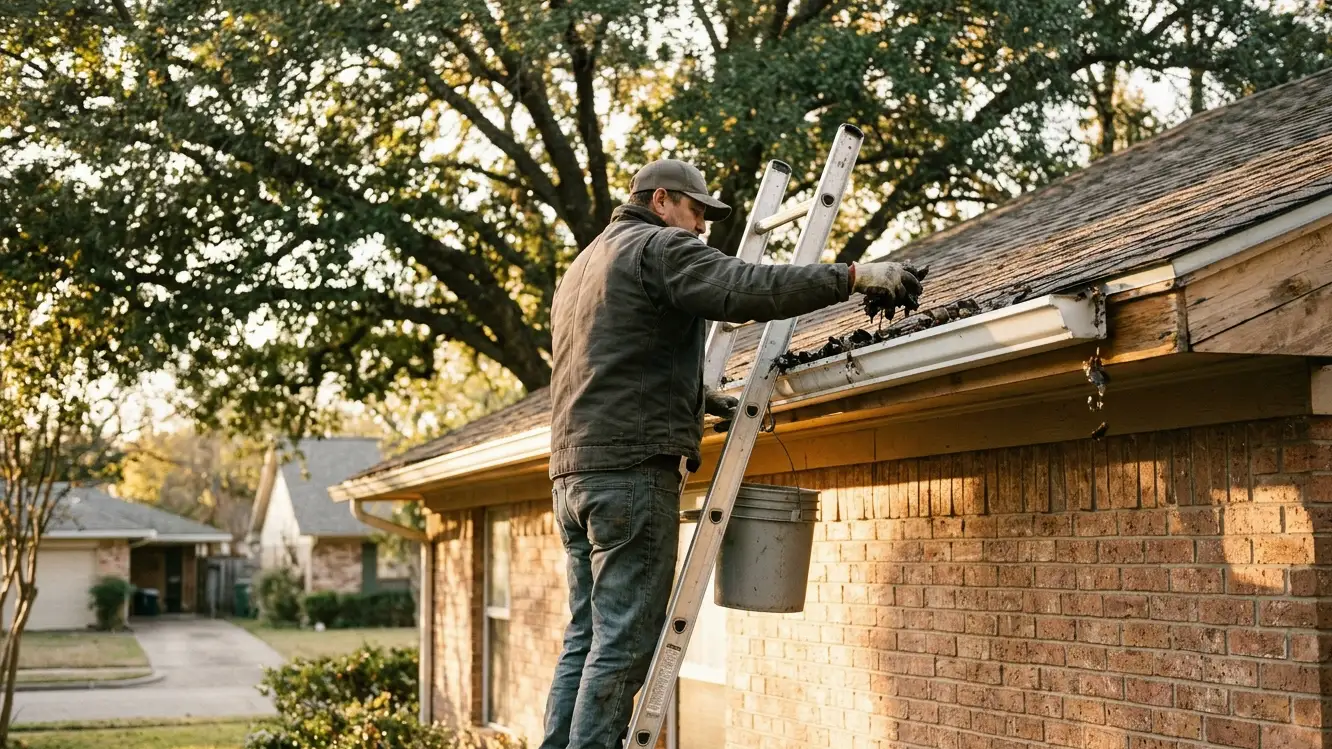
Gutter cleaning removes leaves, seeds and roof grit from gutters and downspouts so rain drains away from the house instead of over the edge. Most Dallas homes under mature trees need it two or three times a year, usually in late spring and after leaf drop. A cleaning with downspout flushing typically runs $165 to $385 for a single-story home and $245 to $565 for two stories.
Dallas trees drop something almost every month. Live oaks shed leaves and stringy catkins in spring, cottonwoods send out fluff that mats into a wet felt, red oaks let go of their leaves late into fall, and pecans rain husks and stems through autumn. All of it ends up in the gutter, packs around the downspout outlet and holds water. A clogged run overflows in the first heavy storm, soaks the fascia board, and dumps water right beside the slab.
Our crews clean gutters by hand from the ladder or the roof edge, bag the debris instead of blowing it across your beds, and flush every downspout until water runs clear at the bottom. While we are up there, we check the things most people never see: loose hangers, leaking corner seams, sagging runs that hold water, and how many shingle granules are mixed into the debris. You get photos and a plain note on anything that needs repair.
Signs your gutters need cleaning
- Water spilling over the front: rain sheets over the outer lip in the middle of a run instead of draining to the downspout.
- Plants growing in the gutter: seedlings or grass sprouting from the trough mean the debris has broken down into soil.
- A downspout that barely trickles: a downpour with only a weak flow at the bottom points to a clog at the outlet or an elbow.
- Stripes on the siding or brick: dark streaks below the gutter show where water has been running over the edge.
- Sagging sections: gutters pulling away from the fascia under the weight of wet debris and standing water.
- Mosquitoes near the eaves: standing water in clogged gutters gives them a place to breed all through a Dallas summer.

What our gutter cleaning visit covers
- We scoop debris by hand into buckets or bags, so wet leaves and husks do not land on your windows, siding or flower beds.
- Every downspout is flushed from the top with a hose, and we clear clogged elbows and any underground drain connections we can reach.
- We check the hangers along each run and reset or replace any that have pulled loose from the fascia.
- Corner seams and end caps are checked for drips, and we note any that need resealing or repair.
- We look at how much granule grit is sitting in the gutter, since a sudden heavy load can mean shingle wear or hail damage.
- Debris piled in roof valleys and behind chimneys is cleared while we are up there, and we send photos of what we found.
What Dallas trees put in your gutters, and when
The calendar here runs differently than in colder places. Live oaks hold their leaves through winter and drop them in spring along with their catkins, so the heaviest cleanup on many older Dallas streets comes in March and April, right as hail season starts. Cottonwoods along creeks and in older neighborhoods release their fluff in late spring. Red oaks and pecans drop through October and November. Under a mix of those trees, two or three cleanings a year keeps water moving.
Gutter debris is also one of the easiest places to spot hail damage. After a storm, a sudden pile of dark, sandy granules at the downspout outlets or in the troughs suggests hail knocked them loose from the shingles. Granules shed slowly from any aging roof, but a heavy load after a single storm is worth a closer look, especially during the March through June peak. When we see it during a cleaning, we tell you and offer to check the roof.
Gutter cleaning schedules that fit your trees
How often you need a cleaning depends almost entirely on what grows over your roof. A house with no overhanging trees may go a full year, while one under pecans and live oaks needs more frequent visits. Here are the schedules Dallas homeowners usually choose.
| Option | Best for | What to know |
|---|---|---|
| Once a year, late fall | Homes with few or no overhanging trees | Clears roof grit and blown-in leaves before the winter rains |
| Twice a year, spring and fall | Most homes under one or two mature trees | Catches live oak drop in spring and pecan and red oak leaves in fall |
| Three times a year | Lots heavy with oaks, pecans or cottonwoods | Adds a late spring visit for cottonwood fluff and catkins before summer storms |
| After a major storm | Any home after high wind or hail | Clears blown-in twigs and lets us look for granule loss and gutter dents |
| Cleaning plus gutter guards | Owners tired of repeat cleanings | Cuts down how often you need us, though guards still need an occasional rinse |
What gutter cleaning costs in Dallas
| Single-story home, up to about 160 linear feet | $165 to $385 |
| Two-story home, up to about 200 linear feet | $245 to $565 |
| Clearing a packed underground downspout drain | $95 to $235 |
| Hanger reset or replacement, per hanger | $9 to $18 |
| Corner or end cap reseal | $45 to $115 |
Linear footage and height set most of the price. A two-story house needs taller ladders and more time per run, and steep roofs make reaching the gutters from above harder. Heavy debris, packed downspouts, underground drain lines and guards that have to be lifted off all add labor. Small repairs we find, such as resetting hangers or resealing a corner, are priced on the spot before we do them.
How the job runs
Call
Tell us what failed. Overflowing gutters, a sagging run, cracked siding after hail or bare wood showing: describe it and we set a visit.
Measure
Measure and match. We measure runs, wall areas and downspout locations, and match colors and profiles to what is already on the house.
Price
Written proposal. Material, gauge or thickness, color and the full price are written down before work begins.
Install
Built to drain. We set pitch, fasteners and flashing so water leaves the house the way it should during a North Texas downpour.
Clean up
Haul away and check. Old material leaves with us, and we run water through new gutters before we call it done.
Gutter Cleaning questions
How often should gutters be cleaned under live oaks?
Under live oaks, plan on at least two cleanings a year, and one of them should come in April after the spring leaf and catkin drop. Live oak leaves are small and stiff, so they slip past many guards and pack tightly at downspout outlets. If pecans or cottonwoods hang over the roof too, a third visit in late spring or fall keeps the system clear.
Why are there so many black granules in my gutters?
Some granule shedding is normal, especially on a new roof in its first year and on older roofs as they age. A sudden heavy layer after one storm is different and often points to hail knocking granules loose. We photograph what we find and can inspect the shingles for bruising, since that evidence can matter if you decide to file a claim.
Do you clean gutters on two-story homes without walking on the roof?
On most two-story houses we work from extension ladders with standoffs that rest against the wall, not the gutter, so the gutter does not bend. On steep or very tall sections, we may tie off and reach from the roof edge instead. Either way we pick the method that protects your gutters, shingles and landscaping.
Can clogged gutters cause foundation problems in Dallas?
They can contribute. Water spilling over a clogged gutter lands in one spot beside the slab, and Blackland Prairie clay swells when wet and shrinks when dry. Repeated soaking in one area next to dry soil elsewhere adds to uneven movement. Clean gutters and downspouts that discharge several feet from the house help keep soil moisture more even around the foundation.