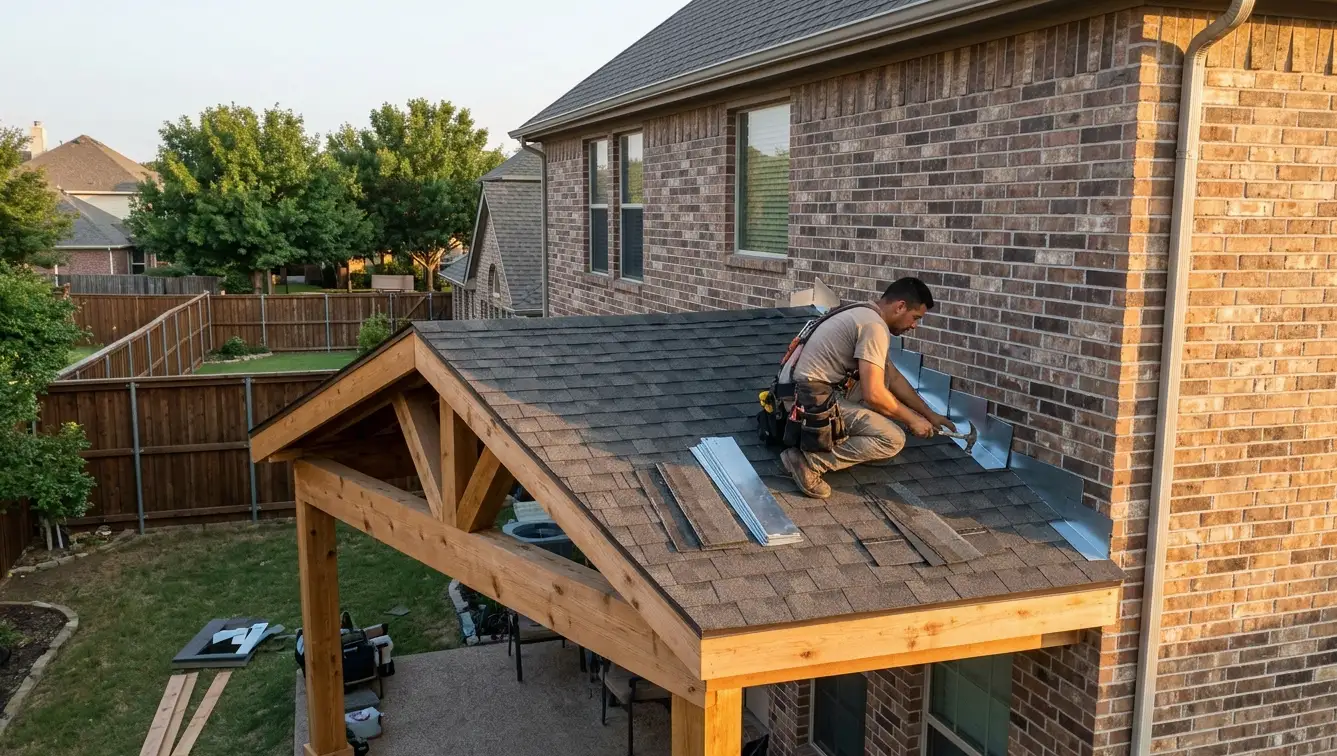
Patio cover and porch roofing means building or reroofing an attached cover so it sheds water and joins the main roof cleanly. You need it when adding a covered patio, when a porch leaks at the house wall, or when a low-slope porch surface has worn out. In Dallas, reroofing an existing porch runs about $1,485 to $4,860, and a new framed and roofed cover usually starts near $8,750.
Attached patio covers and porch roofs cause more leaks than their size suggests. They sit at a lower pitch than the house, they meet the main roof or a wall at a joint that has to shed every drop running off above, and they are often built by a different crew than the one who did the roof. When the tie-in is wrong, water runs behind the siding or brick and shows up as a stain by the back door or a rotted beam at the ledger.
We frame and roof new attached covers and fix leaking ones on existing homes. Our crews measure the pitch first, because pitch decides which roofing materials will hold up. Then we tie into the main roof by cutting back shingles and weaving the new slope in, or we flash against the wall with step flashing and counterflashing. We match the house's shingle or metal where the pitch allows, and choose a low-slope membrane where it does not.
Signs your porch or patio roof needs work
- A stain by the back door: a water mark on the ceiling or wall inside, near where the porch meets the house, usually points to the tie-in.
- Ponding on a flat porch: water that sits on a low-slope porch for a day after rain wears out the surface and finds every seam.
- Shingles on a shallow pitch: standard shingles on a porch below their rated pitch lift, curl and leak in wind-driven rain.
- A rotted ledger or beam: dark, soft wood where the porch frame bolts to the house means water has been getting behind the flashing.
- A sagging cover: a dip in the middle of a patio cover points to undersized framing or rot, and it holds more water every year.
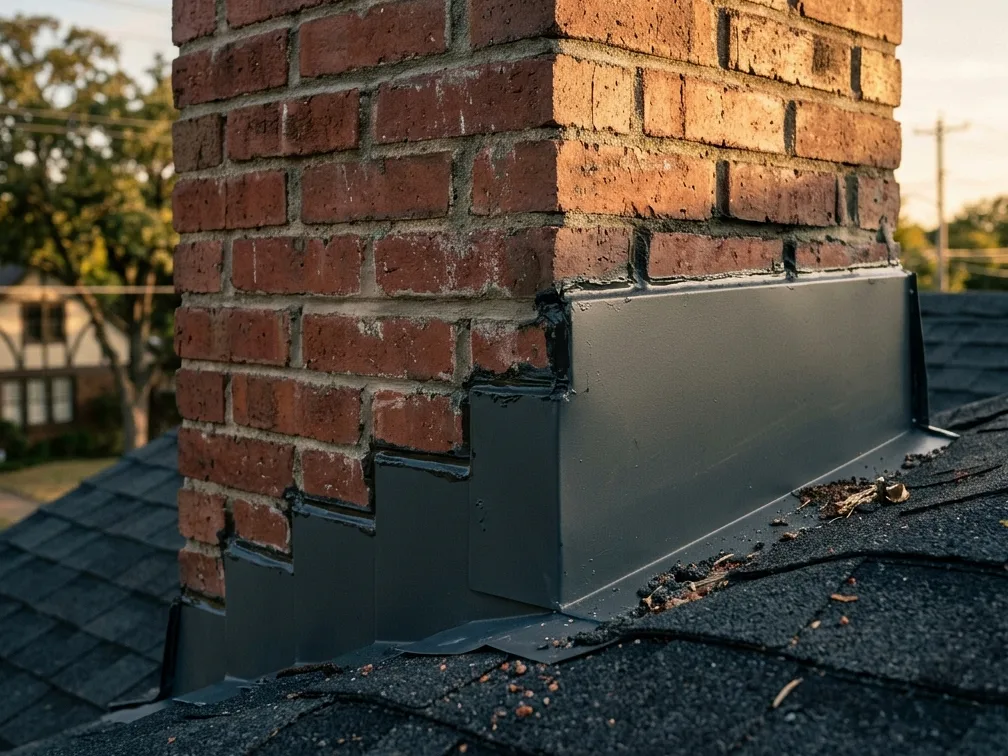
- Caulk instead of flashing: a bead of sealant along the wall in place of metal flashing cracks in Texas heat and starts leaking.
What goes into a porch roof done right
- We measure the pitch of the porch and the main roof so the material we choose matches what that slope can actually shed.
- On new covers, framing is sized for the span and fastened to the house with a ledger that is flashed before any roofing goes on.
- Where the cover joins the main roof, we cut back and weave shingles into the new slope or build a cricket so water leaves the joint.
- Along walls, step flashing goes in with each course and counterflashing is cut into brick or tucked behind siding, never just caulked on top.
- Low-slope sections get modified bitumen, a single-ply membrane or low-slope metal, with drip edge and a gutter sized to the runoff.
- We hose test the tie-in when the job allows and photograph the flashing before it gets covered.
Porch roofs, HOAs and permits around Dallas
An attached cover counts as an addition to the house, so a new patio cover in Dallas and most suburbs usually needs a building permit, and the plans have to show framing, posts and how the roof attaches. In HOA neighborhoods across Plano, Frisco, Allen and similar suburbs, architectural review usually wants the roofing and colors to match the house. We prepare the roofing details the city and HOA ask for, and we schedule the work once both have approved it.
North Texas weather is hard on these joints. Wind-driven spring rain pushes water sideways under shallow porch shingles, and the May 28, 2024 windstorm, with 80+ mph gusts across Dallas, showed how fast a loosely attached porch roof can lift. Expansive Blackland Prairie clay also moves slab foundations and porch footings at different rates, which can tear the joint between porch and house over a few seasons. We plan for that movement with flashing that can flex instead of rigid sealant.
Roofing materials for low-pitch porches and patio covers
Porch and patio roofs often sit at half the pitch of the main house or less, and that limits what will keep water out. Here is how the materials we use compare on attached covers around Dallas, from steeper front porches to nearly flat back patios.
| Option | Best for | What to know |
|---|---|---|
| Architectural shingles | Porches at 4/12 pitch or steeper | Matches the house; from 2/12 to 4/12 it needs a double underlayment, and below 2/12 shingles do not belong |
| Standing seam metal | Low-pitch porches and modern patio covers | Sheds water fast and stands up to hail; each panel system has its own minimum pitch |
| Modified bitumen | Nearly flat porch roofs and carport-style covers | Self-adhered or torch-applied cap sheet; the granule surface holds up well under Texas sun |
| TPO membrane | Flat porches seen only from upstairs windows | White surface stays cooler; seams are heat welded, so the wall details need extra care |
| Polycarbonate or aluminum panels | Owners who want light through the cover | Lighter framing and lower cost; hail can crack or dent the panels, so we talk through that tradeoff |
What patio cover & porch roofing costs in Dallas
| Tear-off and reroof, small front porch | $1,485 to $2,935 |
| Low-slope membrane on a patio cover, per sq ft | $7.85 to $13.40 |
| Wall step and counterflashing rebuild, per linear foot | $26 to $58 |
| Ledger or beam replacement at the house | $685 to $1,940 |
| New framed and roofed cover, about 12 by 20 feet | $8,750 to $19,600 |
Size and pitch set the base price, but the tie-in usually moves it most. A cover that joins the main roof needs shingles cut back and woven in, while one that meets a brick wall needs counterflashing cut into the mortar joints. Rotted ledgers, beams or decking add carpentry. New covers also carry framing, posts, footings and permit drawings, which is why they start well above a reroof.
How the job runs
Call
Tell us what failed. Overflowing gutters, a sagging run, cracked siding after hail or bare wood showing: describe it and we set a visit.
Measure
Measure and match. We measure runs, wall areas and downspout locations, and match colors and profiles to what is already on the house.
Price
Written proposal. Material, gauge or thickness, color and the full price are written down before work begins.
Install
Built to drain. We set pitch, fasteners and flashing so water leaves the house the way it should during a North Texas downpour.
Clean up
Haul away and check. Old material leaves with us, and we run water through new gutters before we call it done.
Patio Cover & Porch Roofing questions
How low can a porch roof pitch go before shingles stop working?
Most shingle manufacturers set 2/12 as the absolute minimum, and between 2/12 and 4/12 they call for a double layer of underlayment. Below 2/12, shingles leak no matter how carefully they are installed. On those porches we use modified bitumen, a membrane or a metal panel rated for low slopes, and we match the color to the house as closely as we can.
Why does my porch ceiling leak only during sideways rain?
That pattern almost always points to the wall joint or a shallow pitch. Wind pushes water up under low-pitch shingles and behind flashing that was caulked on instead of tucked under siding or cut into brick. In a straight-down rain the same joint stays dry. We check the flashing, the pitch and the underlayment before deciding whether a flashing rebuild or a reroof fixes it.
Do you handle the permit for a new attached patio cover?
We pull the building permit for the framing and roofing we do and supply the drawings the city asks for, such as post spacing, beam sizes and how the cover attaches to the house. In an HOA neighborhood, architectural approval usually comes first, and we give you the material and color details to include with that application.
Will a polycarbonate patio cover survive Dallas hail?
Lighter panels can crack or chip in a strong storm, and DFW sits in hail alley with peak season roughly March through June. Thick multiwall polycarbonate holds up better than thin corrugated sheets, but it is still the weakest choice for hail. If hail is your main worry, a metal or shingled cover tied into the house costs more up front and usually less over time.