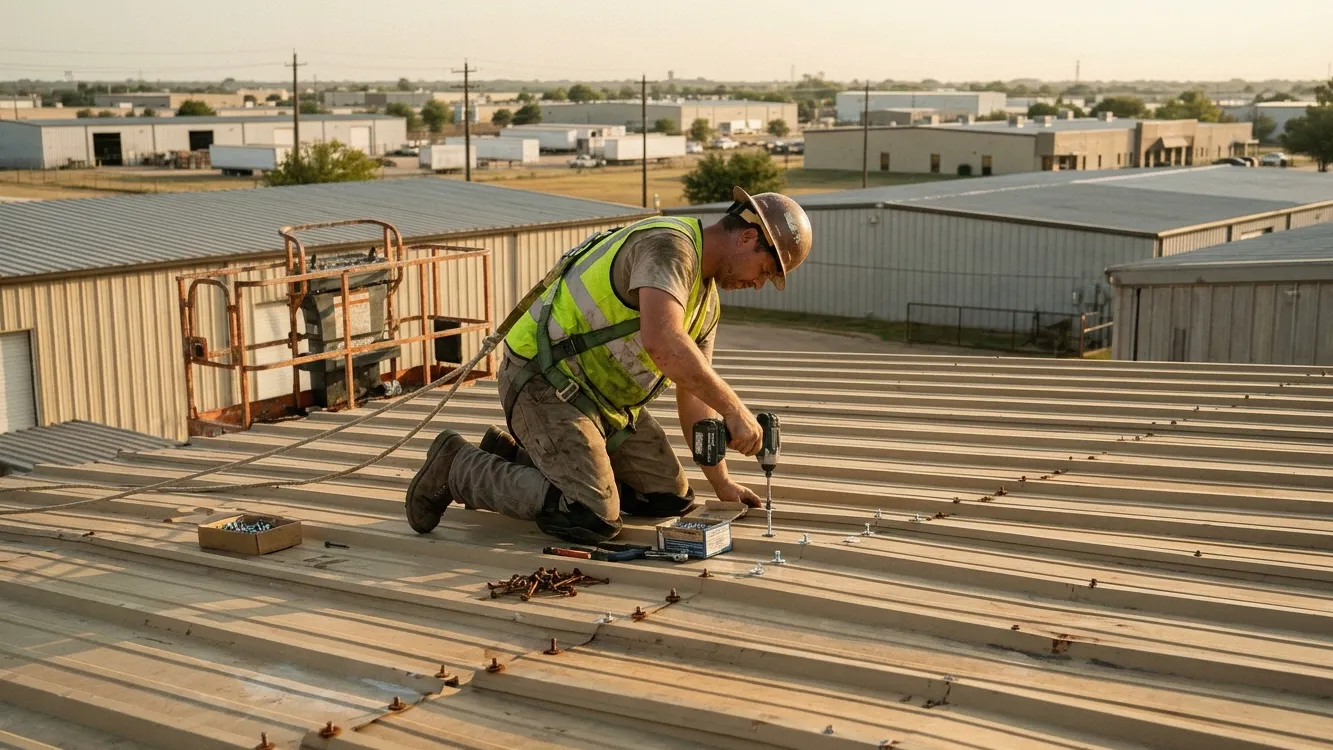
Commercial metal roofing covers repair, restoration and installation of R-panel and standing seam roofs on warehouses, retail and metal buildings. Owners usually call when fastener leaks multiply, panels rust at the laps, or hail dents and splits panels. In Dallas, a fastener replacement program runs about $1.15 to $2.35 per sq ft, and new R-panel on existing framing typically runs $7.85 to $12.60 per sq ft.
Metal roofs top many of the warehouses, shops, churches, self-storage buildings and retail strips around Dallas. Exposed-fastener R-panel is the most common, with thousands of screws holding the panels to the purlins. Each screw has a rubber washer that hardens in North Texas sun, and thermal movement works the screws loose over the years. Standing seam roofs hide their fasteners, but they have their own wear points at clips, end laps, curbs and the ridge.
We repair, restore and install metal roofs on commercial and light industrial buildings. Our crews replace backed-out or stripped screws with oversized fasteners, reseal end laps and ridge closures, rebuild curb flashing, and swap out panels damaged by hail or wind. On aging flat roofs, we can frame a sloped retrofit system and put new metal over it. For sound metal roofs with rust and leaking fasteners, we install a coating system that seals every screw and lap at once.
Signs your metal building roof needs attention
- Drips at screw heads: leaks that line up with rows of fasteners mean the washers have dried out or the screws have backed off.
- Rust at end laps: orange staining where panels overlap shows water is sitting between them and the sealant tape has failed.
- Ponding at panel ends: low spots near the eave or ridge hold water against the laps on shallow-pitch R-panel roofs.
- Loose ridge closures: foam closures that have shrunk or fallen out let wind-driven rain and birds into the building.
- Hail dents with split seams: panels dented badly enough to crack the paint or open a seam will rust and leak.
- Curb leaks at rooftop units: HVAC and exhaust curbs on metal roofs leak where the flashing was sealed with caulk alone.
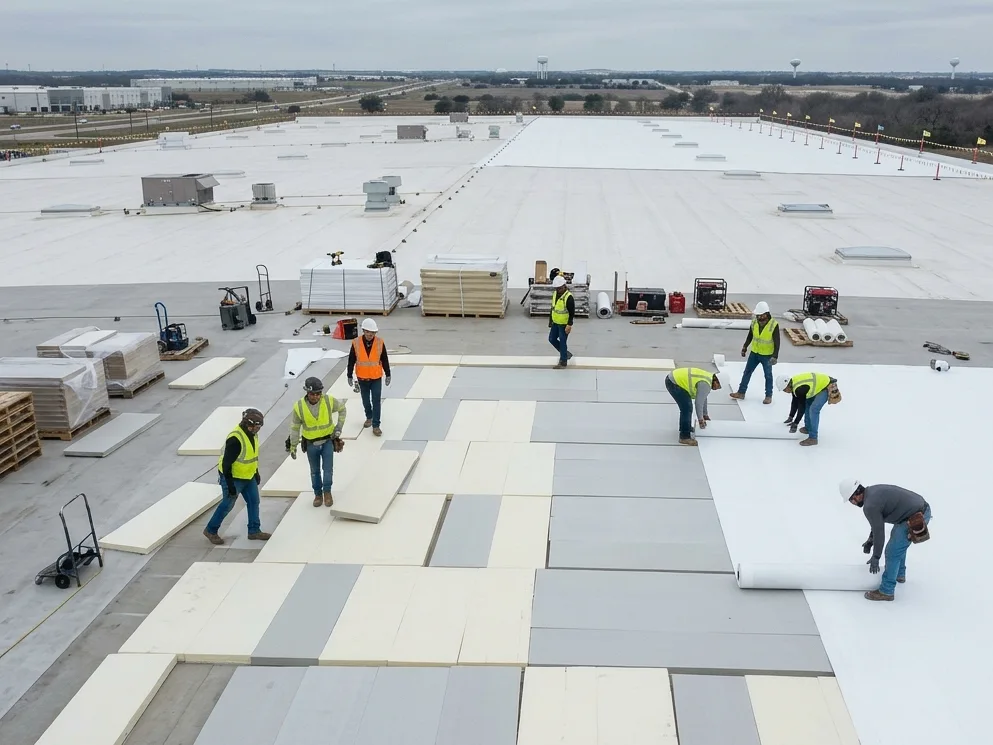
Our commercial metal roof process
- We walk the roof and the interior, mapping leaks against panel laps, fastener rows, curbs and gutters before we price any repair.
- Backed-out or stripped screws come out and are replaced with longer or oversized fasteners and new EPDM washers, driven to proper compression.
- End laps and side laps get new butyl tape or sealant, and ridge and eave closures are replaced where they have shrunk or crumbled.
- Panels with hail splits, rust-through or wind damage are cut out and replaced with matching profile and gauge.
- Rooftop curbs and pipe penetrations are reflashed with metal curbs, boots and closures made for the panel profile.
- For coatings, we clean and treat rust, seal fasteners and seams with fabric and base coat, then apply the topcoat at the specified thickness.
How Dallas weather wears on metal buildings
Metal moves. On a summer day a dark panel heats far above the air temperature, then cools quickly when an afternoon storm rolls through. Every cycle stretches and shrinks the panels against the fasteners, and over the years that motion elongates screw holes and loosens screws until the washers stop sealing. North Texas sees a lot of those swings, which is why exposed-fastener roofs here often need a full screw replacement program long before the panels themselves wear out.
Hail is the other big factor, since DFW sits in hail alley and peak season runs roughly March through June. Light hail leaves cosmetic dents that some commercial policies treat differently from functional damage, while large hail can crack paint, split seams at the ribs and puncture skylight panels. After a storm we document dents, seam splits, damaged skylights and gutter damage separately, so owners and adjusters can see which damage actually affects the roof's ability to keep water out.
Repair and upgrade paths for commercial metal roofs
The right path depends on panel condition, how widespread the leaks are and how long you plan to hold the building. A roof with sound panels and tired fasteners needs a very different plan than one with rust-through at the laps. Here is how we lay out the choices for Dallas owners.
| Option | Best for | What to know |
|---|---|---|
| Spot repairs | A few leaks on a roof that is otherwise tight | Fast and low cost, but leaks tend to return elsewhere if washers are aging across the roof |
| Fastener replacement program | Exposed-fastener roofs with widespread screw leaks | Every screw is replaced with an oversized fastener, often with lap resealing at the same time |
| Metal restoration coating | Rusting but structurally sound panels | Seals fasteners and laps under one membrane and adds reflectivity; the panels must be solid first |
| Panel replacement | Hail-split, rusted-through or wind-torn sections | Matching the old profile is the hard part, so we confirm the rib pattern before ordering |
| Retrofit framing over a flat roof | Failing built-up or membrane roofs on solid structures | Light gauge framing builds slope over the old roof, then new R-panel or standing seam goes on top |
What commercial metal roofing costs in Dallas
| Fastener replacement program, per sq ft | $1.15 to $2.35 |
| Metal restoration coating system, per sq ft | $2.95 to $5.40 |
| Hail-damaged panel swap, per panel | $285 to $640 |
| New R-panel over existing framing, per sq ft | $7.85 to $12.60 |
| Retrofit framing plus new R-panel, per sq ft | $9.85 to $15.75 |
Scope drives the price more than anything. A fastener program on a simple warehouse roof stays near the low end, while retrofit framing and new panels over a flat roof sit at the top. Roof height, lift access, panel profile, rooftop equipment, insulation changes and how much of the building must stay open during the work all change labor. We price each building after a roof walk and leak map.
How the job runs
Call
Talk to us about the building. Tell us the building type, roof size, current membrane and whether there is an active leak, and we schedule a survey.
Survey
Core cuts and moisture. We walk the roof, check seams, drains and edges, take core samples where needed and map wet insulation.
Propose
Options with numbers. Repair, coating, recover or full replacement are priced side by side so owners and managers can plan the budget.
Schedule
Work around tenants. We plan staging, noise and access around business hours, and pull any permit the city requires.
Install
Membrane and details. Crews install insulation, membrane and flashing details, then water-test drains and transitions.
Close
Turnover package. You receive photos, material data and maintenance notes for the building file.
Commercial Metal Roofing questions
Why do the screws on my metal building keep backing out?
Thermal movement is the usual cause. Panels expand and contract every day, and that motion slowly works screws loose and enlarges the holes, especially where screws were overdriven or missed the purlin. Replacing them with the same size screw rarely holds. We use oversized or longer fasteners that bite fresh metal, with new washers set to the right compression.
Can metal panels go over our old flat roof without a tear-off?
Often, yes. A retrofit system uses light gauge framing fastened through the old roof into the structure, building slope so the new metal sheds water. It avoids tear-off debris and keeps the building open during the work. We first confirm the structure can carry the added load and that the old roof is not holding so much water that it would rot the deck underneath.
Is hail damage on a metal building covered if it is only dents?
That depends on your policy. Some commercial policies exclude cosmetic damage to metal roofs and pay only when hail affects water-tightness, while others cover dents outright. We separate cosmetic dents from functional damage such as split seams, cracked paint at the ribs, punctured skylights and loosened fasteners, and we document each one so your adjuster has a clear picture.
How long does a coating on a metal building last before a recoat?
It depends on the coating type, the thickness applied and how much sun and hail the roof sees. Thicker silicone and acrylic systems outlast thin ones, and manufacturer warranty terms depend on the product line and thickness. We plan the thickness with you, then check the roof after major storms so a recoat happens while the base system is still sound.