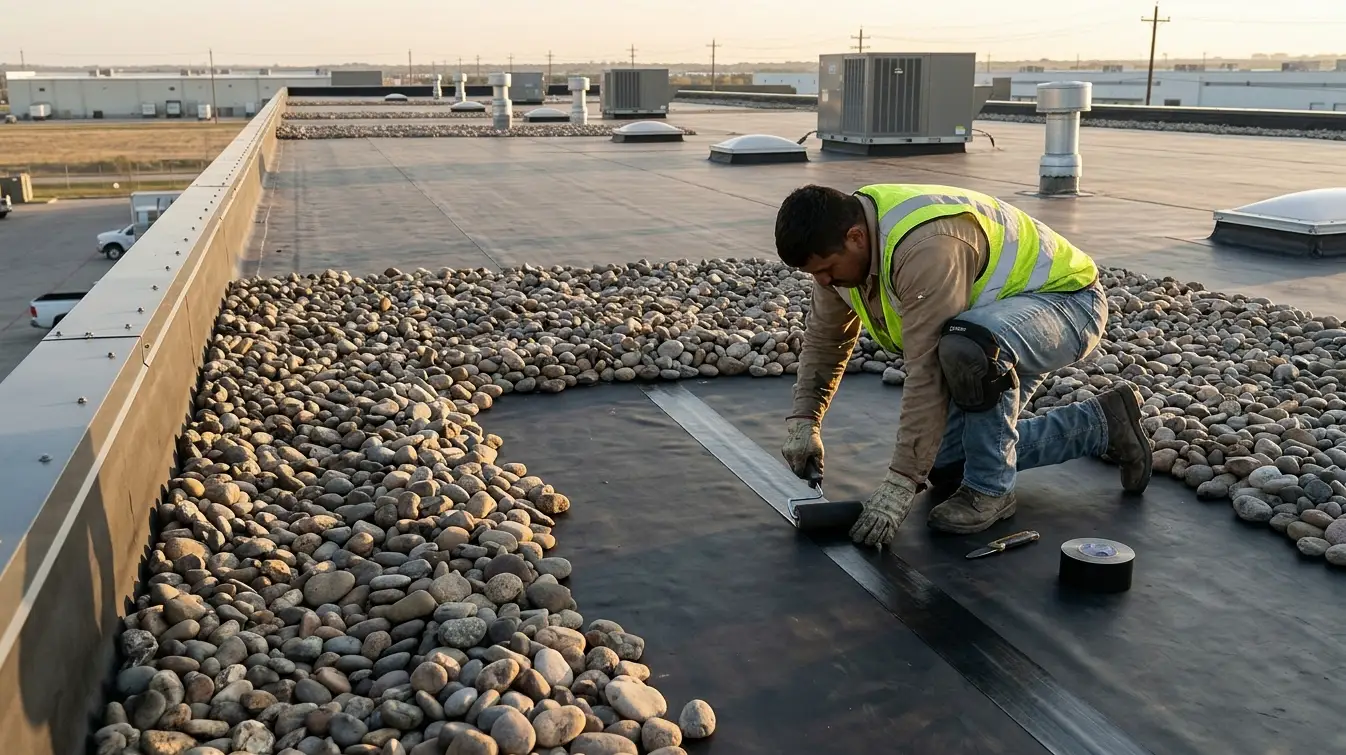
EPDM roofing is a synthetic rubber single-ply membrane used on low-slope commercial roofs, installed ballasted, fully adhered or mechanically attached with taped seams. It suits owners keeping an existing rubber roof or wanting a flexible, long-lived system. In Dallas, new EPDM systems usually run about $6.95 to $11.85 per square foot, with seam repairs from a few hundred dollars.
EPDM is a synthetic rubber membrane that has covered low-slope commercial roofs for decades, and many Dallas buildings from the 1980s and 1990s still have one. It is flexible, handles temperature swings well, and can last a long time. The weak points are its seams, which are glued or taped rather than welded, and its edges, where the rubber slowly shrinks over the years and pulls away from walls, curbs and drains.
We repair, recover and install EPDM on warehouses, retail buildings, office buildings and churches across the Dallas area. That includes ballasted roofs held down with river rock, fully adhered roofs glued to insulation, and mechanically attached systems. Our crews fix seams and flashings on existing rubber roofs, add reinforced cover strips where edges have pulled away, and install new EPDM where the building's layout, budget or existing system makes rubber the best choice.
Signs your EPDM roof needs work
- Seams lifting at the laps: Seam tape or adhesive has let go, leaving edges you can lift with a finger.
- Membrane pulled tight at walls: Shrinkage has stretched the rubber from the base of parapets, creating bridged gaps that tear.
- Ballast scattered or thin: Wind or foot traffic has moved river rock, exposing membrane to UV and uplift.
- Punctures from debris: Tree limbs, dropped tools or hail have left holes or cuts in the rubber field.
- Chalky, cracked surface: Very old EPDM shows surface crazing that worsens around flashings and drains.
- Wrinkles and loose areas: Adhered membrane bubbling or wrinkling means adhesive has failed under the sheet.
EPDM repair and install work
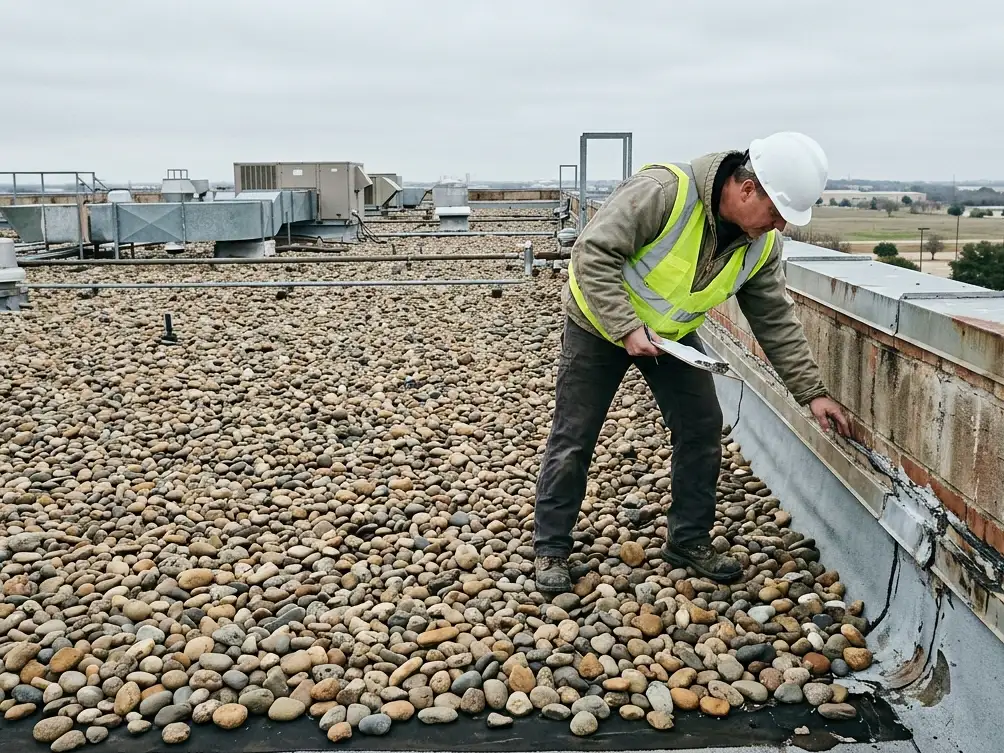
- We inspect seams, edges, flashings and drains, take cores, and decide whether repair, recover or replacement fits the roof.
- Lifted seams are cleaned, primed and closed with new seam tape, then covered with a reinforced strip for added strength.
- Shrunken edges are released and re-terminated with new flashing and termination bars at walls and curbs.
- On ballasted roofs, rock is moved aside for repairs, then reset at the correct weight so the membrane stays put.
- New EPDM goes in as large sheets with few seams, fully adhered or ballasted depending on the deck and design.
- Pipe boots, drains and corners get factory-formed flashings, and a white coating can be added to cut heat gain.
EPDM in Dallas heat
Black EPDM absorbs heat, and on a Dallas summer afternoon its surface runs far hotter than a white roof next door. That heat does not hurt the rubber as much as it hurts the building, since it raises the cooling load and works on seams and adhesives. Many owners now coat existing EPDM with a white elastomeric coating or choose white EPDM on new work. Both cool the surface considerably, though a coated roof needs periodic touch-ups over its life.
Ballasted EPDM roofs are common on older Dallas warehouses and big retail buildings, where river rock holds the membrane down instead of adhesive or fasteners. These roofs handle hail well when the rock is evenly spread, since the stone absorbs impacts. Trouble starts when wind or foot traffic moves the ballast, leaving bare spots exposed to UV and uplift. After windstorms, a walk-through to redistribute rock and check seams prevents larger problems.
EPDM attachment styles
EPDM roofs differ mainly in how the membrane is held to the building. Each method affects cost, wind resistance, weight on the structure, and how repairs are handled down the road when a seam or flashing needs work. Here is how the common systems compare.
| System | Best for | What to know |
|---|---|---|
| Ballasted EPDM | Large, low roofs with structure for the weight | River rock holds the sheet; low installed cost, but repairs mean moving stone |
| Fully adhered EPDM | Offices, churches and wind-exposed roofs | Glued to insulation across the field; smooth surface and strong uplift resistance |
| Mechanically attached EPDM | Steel decks on mid-size buildings | Fastened through the insulation in rows; lighter than ballast, moderate cost |
| White EPDM | Owners wanting a cooler rubber roof | Reflective top layer cuts heat gain; costs more than black sheets |
| Coated black EPDM | Sound existing rubber roofs | Elastomeric coating cools the surface and adds UV protection without tear-off |
What epdm rubber roofing costs in Dallas
| Seam repair with cover strip, per linear foot | $12.75 to $24.90 |
| Edge re-termination at parapets, per linear foot | $16.40 to $31.65 |
| New fully adhered 60 mil EPDM, per sq ft | $8.20 to $11.85 |
| Ballasted EPDM replacement, per sq ft | $6.95 to $9.70 |
| White elastomeric coating over EPDM, per sq ft | $2.35 to $4.15 |
Attachment method, sheet thickness (45, 60 or 90 mil), insulation, and tear-off depth drive most of the price. Ballasted systems cost less to install but add structural load. Fully adhered systems cost more for adhesive and labor. On existing roofs, repairs are priced by seam footage and flashing details, and white or coated EPDM adds to the base cost.
How the job runs
Call
Talk to us about the building. Tell us the building type, roof size, current membrane and whether there is an active leak, and we schedule a survey.
Survey
Core cuts and moisture. We walk the roof, check seams, drains and edges, take core samples where needed and map wet insulation.
Propose
Options with numbers. Repair, coating, recover or full replacement are priced side by side so owners and managers can plan the budget.
Schedule
Work around tenants. We plan staging, noise and access around business hours, and pull any permit the city requires.
Install
Membrane and details. Crews install insulation, membrane and flashing details, then water-test drains and transitions.
Close
Turnover package. You receive photos, material data and maintenance notes for the building file.
EPDM Rubber Roofing questions
Why are the seams on my EPDM roof coming apart?
Older EPDM seams were often glued with liquid adhesive that dries out and loses grip over many Texas summers. Movement from heat and wind keeps working the laps until they open. Modern repairs use primer and seam tape, finished with a reinforced cover strip, which holds far better than re-gluing. We open, clean and rebuild failed seams rather than smearing sealant over them.
What causes EPDM to pull away from the walls?
EPDM shrinks slightly over its life, and on adhered or ballasted roofs that shrinkage concentrates at the edges. The membrane stretches tight across the joint between the roof and the wall, eventually tearing or pulling its flashing loose. We release the tension, install new flashing membrane and termination bar, and secure the edge so it can move without tearing.
Can a white coating go on a black rubber roof?
Yes, on EPDM that is sound and dry. The roof is cleaned, primed with a product made for EPDM, and coated with a compatible elastomeric coating. The white surface cools the roof considerably in the Dallas sun and adds a UV shield. Coating will not fix wet insulation or failing seams, so those are repaired first.
Is EPDM a good choice for a new roof on my building?
It can be, especially for owners already familiar with rubber roofs, buildings where ballast is practical, or roofs with simple layouts that suit large sheets with few seams. For buildings where reflectivity or welded seams matter more, TPO is often preferred. We compare EPDM and TPO side by side on cost, attachment method and how each handles your building's conditions.