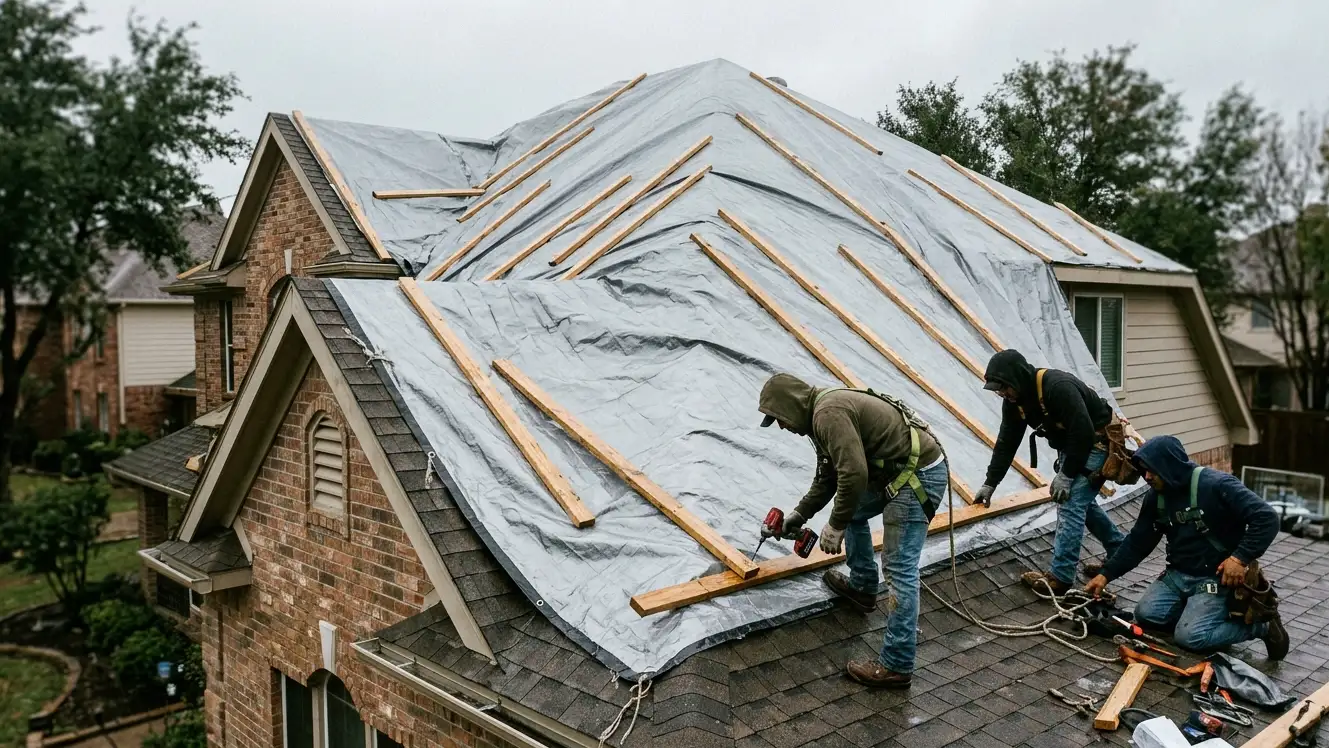
Emergency roof tarping covers a storm-damaged section of roof with a heavy fastened tarp to keep water out until the permanent repair or replacement. You need it when shingles, decking or flashing are missing or broken and rain is coming. In Dallas, a tarp on one slope typically runs $385 to $1,190, with larger or steep roofs above that.
After a big Dallas storm, roofing crews and adjusters get stretched thin, and it can be days or weeks before a permanent repair or a reroof is scheduled. A properly installed tarp is what keeps the attic dry in that gap. Done well, it protects the decking, the insulation and the ceilings below. Done badly, it flaps, tears, funnels water under itself and adds nail holes in shingles that were not damaged in the first place.
Our crews tarp roofs the way we would want our own houses covered. We use heavy reinforced poly tarps sized to reach past the ridge, wrap the edges around wood battens and fasten the battens through to the decking, so wind pulls against the wood rather than the tarp grommets. The upper edge goes over the peak so water sheds off the top instead of running underneath. The low edge is left to drain toward the gutter.
When a roof needs to be tarped
- Bare decking: plywood or plank boards visible from the ground mean nothing is stopping the next rain.
- Torn underlayment: felt or synthetic underlayment flapping in the wind will not survive another storm on its own.
- Puncture holes: a limb, a flying fence panel or debris has broken through and left an open hole.
- Delayed claim or crew schedule: the permanent repair is more than a day or two out and the forecast shows rain.
- Active leaks with unknown source: a tarp over the suspect area buys time while the true entry point is traced.
- Old tarp failing: an existing tarp is torn, sagging or holding water from weeks of sun and wind.
How our crews install a tarp that holds
- We measure the damaged area and choose a tarp large enough to run from below the damage up and over the ridge onto the opposite slope.
- Loose debris, broken shingle pieces and nails are cleared from the area so nothing punctures the tarp from below.
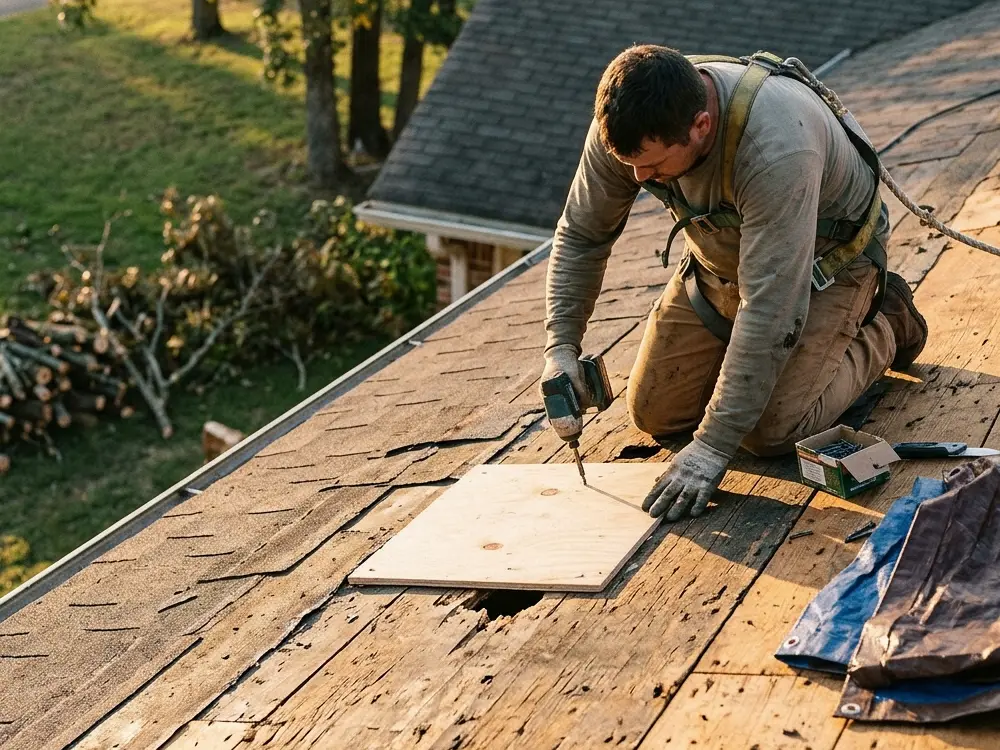
- Any hole in the decking is first covered with plywood screwed to rafters, so the tarp has a flat surface and cannot pond.
- Tarp edges are rolled around 2x4 battens, and the battens are fastened through the roof at spacing tight enough to resist gusts.
- The tarp is pulled taut and positioned so water drains off the low edge into the gutter, not back under the shingles.
- We photograph the finished tarp, note the date for your claim and check it after any severe weather before the permanent repair.
Why tarps take a beating in North Texas
A tarp in Dallas has to survive more than rain. The same spring storm pattern that tore the roof in the first place often repeats several times in a few weeks, bringing gusty winds and heavy downpours again and again. In summer, ultraviolet light and attic-level heat on the roof surface break down cheap blue tarps quickly, turning them brittle until they split along the folds. We use heavier reinforced material for that reason.
After a widespread event like the May 28, 2024 windstorm, many homes across Dallas needed tarps at the same moment, and lightweight tarps stapled at the grommets were ripping loose all over the city within days. Live oak and pecan debris landing on tarped roofs adds another hazard. We check our tarps after storms, re-fasten what moves and keep the house covered until the real repair goes on, even when that wait stretches across several storms.
Tarp methods and how long each lasts
There is more than one way to cover a damaged roof. The right one depends on how big the opening is, how long the house will wait for repair and how much wind the roof sees. These are the methods we use most often on Dallas homes.
| Option | Best for | What to know |
|---|---|---|
| Battened ridge-over tarp | Missing shingles across part of a slope | Our standard install; usually holds through several weeks of storms |
| Plywood plus tarp | Punctures and broken decking from limbs | The plywood carries load and the tarp keeps the patch dry |
| Full-slope cover | A whole face of the roof stripped or torn | Large tarps need more battens and a careful layout to shed water |
| Shrink-wrap cover | Extended waits or complex roofs with many angles | Heat-sealed film fits tightly and holds up longer than poly tarps, at a higher cost |
What emergency roof tarping costs in Dallas
| Tarp, battens and fasteners, per slope | $385 to $1,190 |
| Plywood under tarp, per sheet | $115 to $235 |
| Shrink-wrap cover, per square | $165 to $315 |
| Tarp check and re-fasten after a storm | $95 to $210 |
| Tarp removal at permanent repair | $75 to $165 |
Size, pitch and height drive the price most. A small ranch slope is near the low end; a steep second-story face or a roof that needs plywood under the tarp costs more. After-hours calls during a storm add a response charge. Tarping is commonly treated as a reasonable measure to prevent further damage under homeowner policies, so we provide itemized receipts and dated photos.
How the job runs
Call
Tell us what you see. Describe the stain, the noise in the wind or the shingles in the yard. If water is coming in, we talk you through what to move and when a crew can be there.
Look
We find the entry point. A crew walks the roof and checks the attic side, because the wet spot on a ceiling is often several feet downslope of the real failure.
Price
Written scope, fixed number. You get the repair in writing, with what we will replace, the materials and the price, before anyone pulls a shingle.
Fix
Repair matched to the roof. We seal, flash, replace or rebuild the damaged section with materials that match what is already up there as closely as the market allows.
Check
Water test and cleanup. Where it makes sense we hose-test the area, then magnet-sweep the yard for nails and photograph the finished work for your records.
Emergency Roof Tarping questions
How long can a tarp stay on my roof?
A battened, heavy-duty tarp installed correctly can protect a roof for several weeks and sometimes a few months, though sun and repeated storms wear it down. The goal is always the permanent repair. If your claim or schedule stretches longer, we check the tarp after storms and replace it if the material starts to break down.
Will a tarp damage my shingles?
Some fasteners go through the roof to hold the battens. We place them in areas already being replaced when we can, and seal any that land in good shingles. Weighting a tarp with bricks or tying it to gutters causes more harm than careful fastening, since loose tarps scrub granules off and gutters bend under the strain.
Do I need a tarp if the roof is not leaking yet?
If shingles are missing and you can see underlayment or decking, yes. Underlayment is meant to be a backup layer under shingles, not a roof surface, and it tears and degrades quickly in sun and wind. Covering it before the next rain prevents the leak that would otherwise follow.
Can you tarp a roof at night?
When it is safe, yes. We carry lights and work in teams, but we will not put a crew on a roof during lightning or in winds strong enough to move a tarp out of their hands. In those conditions we help you protect the inside of the house and get on the roof as soon as the storm cell clears.