Winnetka Heights sits in North Oak Cliff between West Davis Street and West Twelfth Street, a short walk from the Bishop Arts District, with blocks along Rosemont, Windomere and Edgefield lined with early twentieth century homes. Most were built from roughly 1910 through the 1920s as Prairie-style foursquares and Craftsman bungalows, with broad hipped roofs, deep eaves, wide front porches and dormers. The neighborhood is a designated City of Dallas historic district, one of the best known in Oak Cliff.
In a landmark district, visible exterior work, including roofing, generally needs approval from the city preservation office before it begins. We handle that step: photograph the existing roof, prepare material and color details and fit the review into the schedule. On the roof itself, Prairie hips with deep boxed eaves and Craftsman gables with exposed tails each have their own weak spots. We repair the wood, rebuild flashing and choose shingles that keep the roof's broad, horizontal look.
Winnetka Heights is one of the Dallas neighborhoods our crews reach straight from the McKinney Avenue office. See the full Dallas roofing page for citywide permit and storm notes.
Homes and roofs in Winnetka Heights
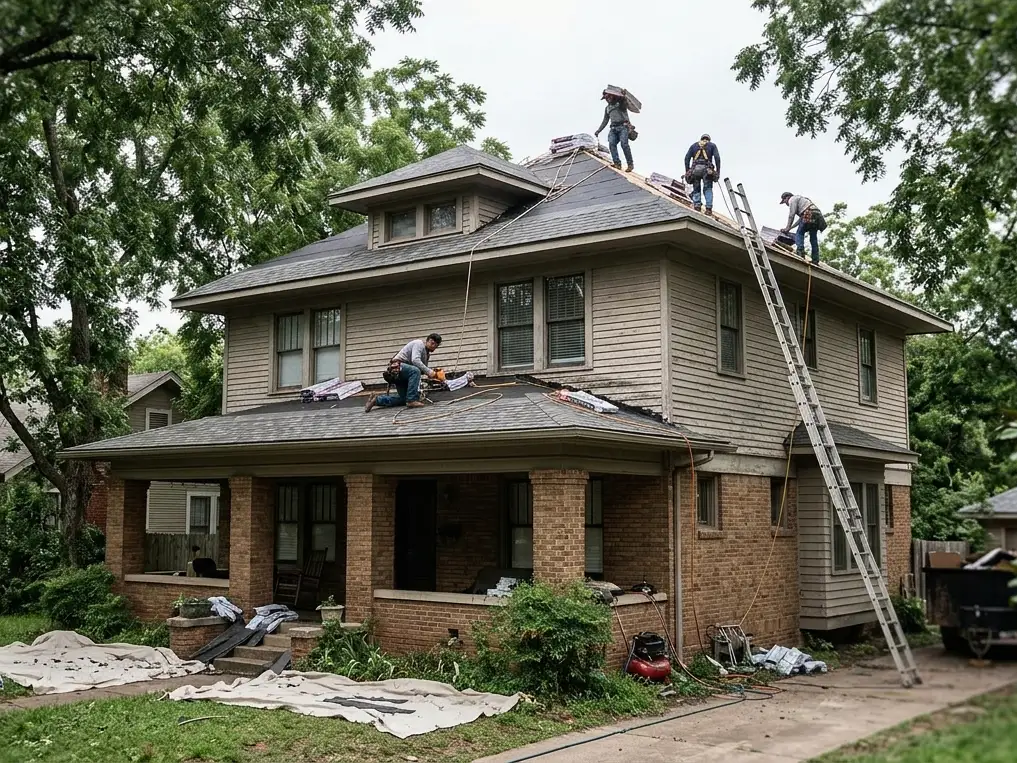
Prairie foursquares and Craftsman bungalows from about 1910 to the late 1920s, many two stories, with low-pitched hip roofs, deep boxed or open eaves, hipped dormers and wide porches. Decking is original plank, and many roofs carry two shingle layers. Some homes have built-in gutters hidden in the eaves. Alleys serve many blocks, and big pecans shade the parkways and drop limbs in storms.
Storm exposure in Winnetka Heights
Winnetka Heights faces the same spring hail season as the rest of Dallas, mostly from March through June, and the May 28, 2024 windstorm dropped trees and shingles across Oak Cliff. Broad, low hip roofs present a large surface to hail, and deep eaves can catch wind uplift along their edges during strong storms.
Roofing jobs we do most in Winnetka Heights
- Preservation review support: we prepare photos, material details and color choices for the city preservation review.
- Prairie hip reroofs: we strip to plank decking, sheathe, and install shingles that suit low broad hips.
- Built-in gutter repair: we reline or rebuild box gutters hidden in the eaves of older homes.
- Eave and porch roof repair: deep eaves and wide porch roofs get new fascia, soffit boards and flashing where they meet the house.
- Hipped dormer flashing: dormers on two-story foursquares get new step flashing and cheek wall repair.
Good to know before we start
- Landmark district: visible roofing work generally needs preservation approval before it starts, so we build that time into your schedule.
- Box gutters: built-in gutters are easy to miss and cause hidden eave rot, so we inspect them on every Winnetka Heights job.
- Alley staging: most blocks have alleys, so the dumpster goes in back and the historic front yard stays untouched.
Around the area
- West Davis Street
- West Twelfth Street
- Bishop Arts District
- Kidd Springs Park
- Rosemont Avenue
Winnetka Heights roofing questions
Do I need city approval to reroof in Winnetka Heights?
Generally, yes. Winnetka Heights is a City of Dallas landmark district, and visible exterior changes, including a new roof, usually need preservation approval from the city before work begins, along with the regular building permit. We prepare the material and color details and schedule the job around the review.
What are built-in gutters, and does my Winnetka Heights home have them?
Built-in, or box, gutters are troughs set inside the eave rather than hung on the fascia. Many early 1900s homes have them, sometimes covered over by later work. When the lining fails, water soaks into the eave framing unseen. We check for them on every inspection and reline or rebuild them when needed.
Which shingles look right on a Prairie-style home in Winnetka Heights?
Prairie roofs read as broad, flat planes, so a flatter dimensional shingle in a muted color usually suits them better than a heavy, shadowed designer line. We bring samples and confirm the choice fits district expectations. The goal is a roof that keeps the horizontal look the style is known for.