Midlothian sits in northwest Ellis County where US-287 and US-67 cross, with FM 663 running north and south through town. The city calls itself the Cement Capital of Texas, and its older center around the historic downtown is ringed by newer subdivisions and acreage homes. Larger lots are common here compared to the inner suburbs, and many owners also have shops, barns or detached garages. Our crews come down US-67 from Dallas to reach it.
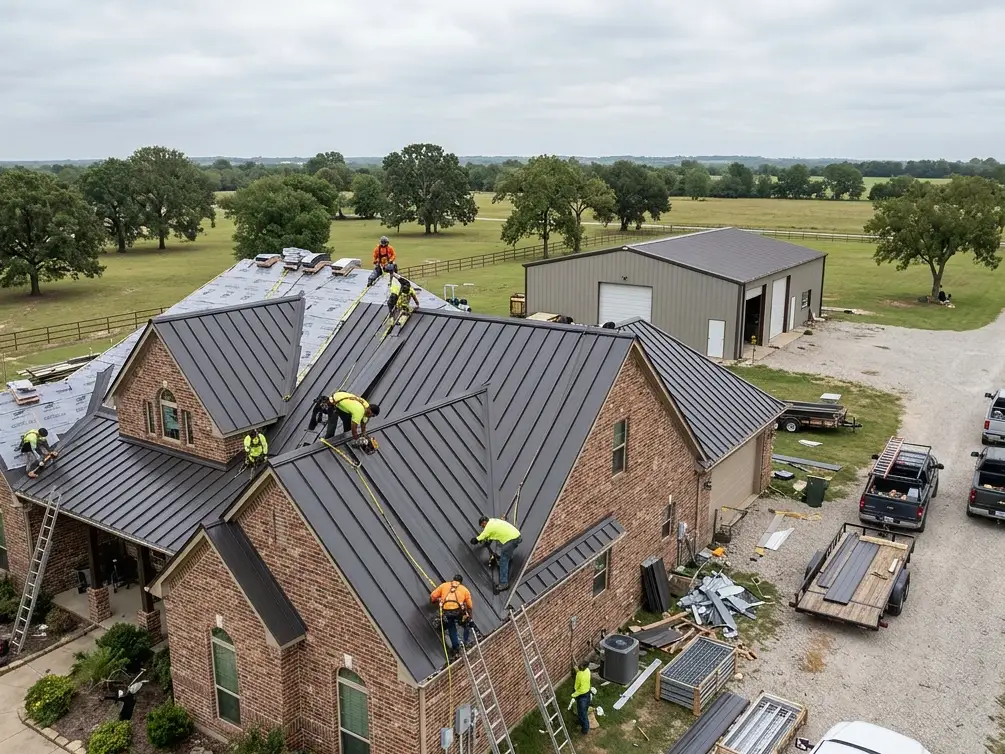
Most Midlothian homes are newer, built from the 1990s on, and many sit on acreage or half-acre lots in the newer subdivisions. With hail coming through most springs, a lot of owners here ask about metal roofing or Class 4 impact-resistant shingles when it is time to replace. We install both, plus standard architectural shingles, and we handle outbuilding roofs at the same visit. Midlothian's building inspections department handles permits, and we pull the permit wherever the city requires one.
Homes and roofs in Midlothian
Midlothian is mostly 1990s through 2020s one- and two-story brick and stone homes, many on larger lots, with architectural shingle roofs and attached side-entry garages. Acreage properties often add metal shops, barns and covered patios. A smaller older core around downtown has frame homes and brick ranches. Newer subdivisions have HOAs, while acreage homes often do not. Covered porches and bay windows are common on the larger homes.
Storm exposure in Midlothian
Midlothian shares North Texas hail season, which peaks roughly from March through June. Open pasture and wide lots give hail and straight-line winds a clear path to roofs, and outbuildings with older screw-down metal take a beating too. The expansive Blackland Prairie clay common in Ellis County can also shift foundations enough to twist rooflines over time.
Roofing jobs we do most in Midlothian
- Standing seam metal roofs: installing concealed-fastener metal on homes where owners want a long-term roof.
- Class 4 shingle replacements: reroofing with UL 2218 Class 4 lines after hail.
- Shop and barn roofs: replacing or refastening exposed-fastener metal on outbuildings.
- Patio cover roofs: building or reroofing covered patios and outdoor kitchens tied into the house.
- Roofline twist repairs: correcting valley and ridge problems caused by foundation movement.
Good to know before we start
- Acreage homes often have long gravel drives, so we plan dumpster and material placement to avoid ruts and septic fields.
- Some Midlothian HOAs limit metal roofing styles or colors, so we check the rules before pricing a metal roof.
- Midlothian's building inspections department issues reroof permits, and we pull the permit where the city requires one.
Around the area
- US-287 and US-67 interchange
- Historic downtown Midlothian
- FM 663
- Midlothian Heritage High School
Midlothian roofing questions
Is metal or Class 4 shingle the better choice for a Midlothian home?
Both resist hail well. Standing seam metal costs more up front but lasts longer and handles wind well, while Class 4 shingles keep a traditional look at a lower price and may earn an insurance discount with some carriers. Your HOA rules, budget and how long you plan to stay usually decide it. We price both side by side.
Can you reroof my Midlothian house and shop building in one visit?
Yes. We often handle the house and a metal shop or barn on the same job, which saves setup time. The shop may only need new fasteners and trim, or it may need new panels. We inspect both and give you separate prices, so you can decide what to do now and what can wait.
Why does my Midlothian roofline look wavy?
A wavy ridge or a valley that seems to twist can come from foundation movement in Ellis County clay, sagging decking or undersized framing. We check the attic and the deck to find which one it is. Decking issues are fixed during a reroof, while foundation movement may need a foundation contractor first.