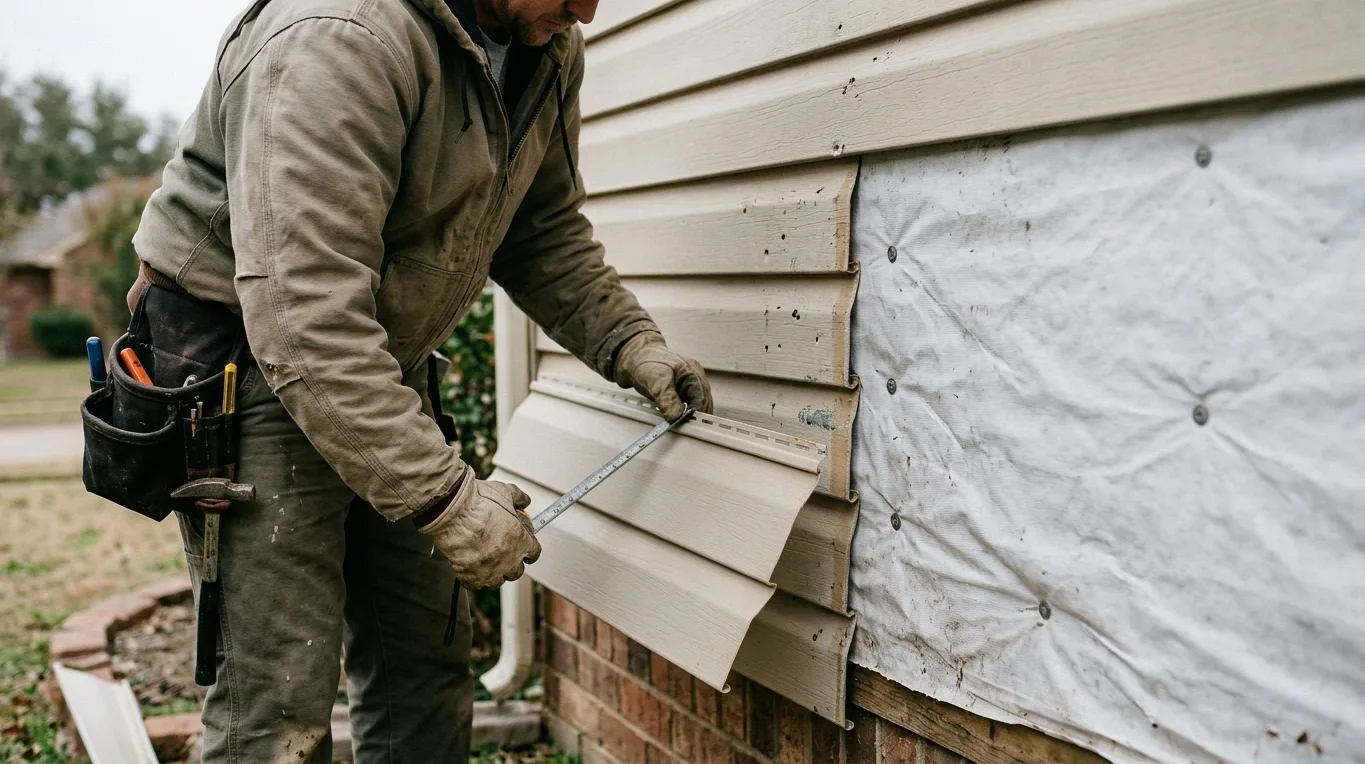
Siding repair means replacing cracked, rotted or loose boards, fixing the sheathing and flashing behind them, and blending the patch into the rest of the wall. It suits damage confined to a few areas rather than a whole elevation. Most Dallas siding repairs run about $345 to $2,185, depending on how many boards are involved and how hard the match is.
Siding damage often starts small. One cracked vinyl lap from a spring hailstorm, a strip of swollen hardboard behind a downspout, a corner post that blew loose in a windstorm. Left alone, each of those lets water reach the sheathing, and a ten minute fix turns into replacing part of a wall. Catching it early keeps the repair to a few boards, and on most Dallas homes that is all the job needs.
The harder part of siding repair is making it blend in. Vinyl colors fade, old hardboard patterns have been out of production for years, and fiber cement comes in several reveals and textures. We match profile, reveal and texture first, then color, and we tell you up front when an exact match does not exist. In those cases we often borrow matching pieces from a less visible wall and put new siding there instead.
Siding damage that needs attention
- Cracked or holed vinyl: Hail or a stray baseball has punched through laps, leaving open gaps on the wall.
- Swollen bottom edges: Hardboard or wood boards near grade, decks or the roof are puffed, soft and shedding paint.
- Loose or missing pieces: Wind has unhooked vinyl courses or popped off a corner trim, exposing house wrap or bare sheathing.
- Stains below a roof edge: Streaks on siding where a roof meets the wall point to a missing kickout flashing.
- Woodpecker or critter holes: Round holes in engineered wood or a gap around a vent let birds and wasps into the wall.
- Gaps around windows: Caulk joints have split, and trim boards have pulled away from the window frame.
How we handle a siding repair
- We remove damaged boards carefully, unzipping vinyl or cutting fiber cement and hardboard free without hurting the courses above.
- The sheathing and house wrap behind each opening are checked, and wet or rotted wood is cut out and replaced.
- We patch the house wrap and add flashing at any roof-to-wall joint or window that was letting water in.
- Replacement boards are matched for profile, reveal and texture, using salvaged pieces where a current product does not match.
- New boards are nailed to the manufacturer's spacing and clearance, then trim and corners are reset.
- Fiber cement and engineered wood repairs are primed and painted to match, and joints are sealed where the system calls for it.
Matching siding on older Dallas homes
Many houses built in the Dallas area from the 1980s and 1990s used hardboard lap siding, and much of it has reached the point where lower boards are swelling and edges are crumbling. Those exact products have been gone for years. We replace hardboard with fiber cement or LP SmartSide in the same reveal, and once painted, the new boards sit alongside the old with little visible difference. Where only a few boards are affected, this is far cheaper than residing.
Vinyl is trickier. Profiles and colors change over the years, and sun fades vinyl unevenly, so the shaded north side of a house often looks different from the west wall. After spring hailstorms we often find salvage pieces from a garage wall or rear gable that can patch the front, with new material placed where it shows least. When a hail claim covers the damage and no match exists, the adjuster may consider replacing the full elevation.
Repair approaches by siding type
How a repair goes depends mostly on what your house is clad in and how old that material is. These are the siding types we repair most on Dallas homes, along with how each one is usually handled and where matching gets difficult.
| Siding type | Common damage | How we repair it |
|---|---|---|
| Vinyl lap | Hail cracks, wind blow-off, heat warping | Unzip and replace courses with matched or salvaged panels; refasten loose sections |
| Hardboard lap | Swelling and rot at low edges | Replace with fiber cement or LP in the same reveal, then prime and paint |
| Fiber cement | Cracked boards, impact chips, failed caulk | Cut out and replace boards, fix flashing, paint to match |
| LP SmartSide | Woodpecker holes, unsealed cut edges | Replace damaged boards, seal and paint every cut edge |
| Wood lap or shiplap | Rot on historic homes | Patch in matching wood or milled profiles, prime all sides before install |
What siding repair costs in Dallas
| Vinyl panel replacement, per course section | $68 to $165 |
| Fiber cement or LP board, each installed and painted | $94 to $218 |
| Sheathing patch behind siding, per sheet | $91 to $147 |
| Kickout flashing added during repair | $58 to $136 |
| Corner post or trim board reset | $72 to $186 |
The board count and siding type set the base price. Rot behind the siding adds sheathing work, and flashing fixes at roof-to-wall joints add a little more. Height matters, since a second-story gable needs ladders or staging. Hard-to-match profiles may require ordering material or swapping salvage from another wall. Fiber cement and wood repairs include paint, which vinyl does not need.
How the job runs
Call
Tell us what failed. Overflowing gutters, a sagging run, cracked siding after hail or bare wood showing: describe it and we set a visit.
Measure
Measure and match. We measure runs, wall areas and downspout locations, and match colors and profiles to what is already on the house.
Price
Written proposal. Material, gauge or thickness, color and the full price are written down before work begins.
Install
Built to drain. We set pitch, fasteners and flashing so water leaves the house the way it should during a North Texas downpour.
Clean up
Haul away and check. Old material leaves with us, and we run water through new gutters before we call it done.
Siding Repair questions
Can you find vinyl to match my older siding?
Sometimes. We start by identifying the profile, reveal and texture, then check current product lines and suppliers. If the color has faded or the line is discontinued, the cleanest fix is often pulling matching panels from a hidden wall, such as behind a fence or on a garage side, and installing new vinyl there. You see the plan before work starts.
What causes the bottom boards of my siding to swell and rot?
Usually water hitting the same spot over and over: a downspout splashing, sprinklers aimed at the wall, a roof edge without a kickout flashing, or siding installed too close to mulch or a patio. Replacing the boards without fixing the source means the new ones fail the same way. We find the water source and fix it during the repair.
Is it better to repair siding or replace all of it?
Repair makes sense when damage is limited to a few spots and the rest of the siding is sound. Replacement makes sense when rot shows up on several walls, the material is brittle across the house, or patches would be so obvious they hurt the look. We look at every elevation and give you a repair price and a replacement range so you can compare.
Why does my wall get wet behind the siding near the roof?
That is very often a missing or failed kickout flashing, which sits where a roof edge ends against a sidewall and turns water into the gutter. Without it, water runs down behind the siding and into the wall framing. It is one of the most common hidden leaks on two-story Dallas homes, and we add it during any repair in that area.