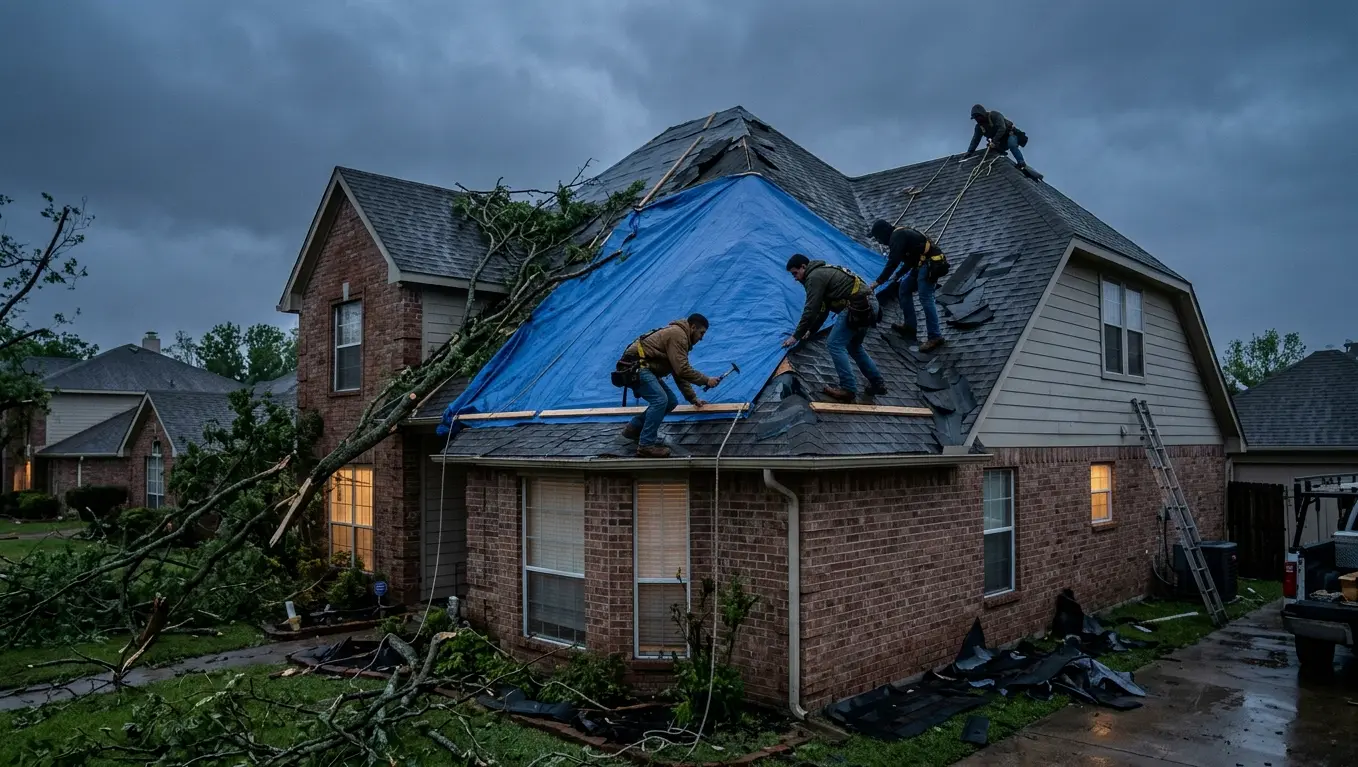
Emergency roof repair is the immediate response to sudden damage that lets water or weather into the home, such as a limb strike, wind blow-off or a failed flashing during heavy rain. You need it when water is actively entering or the roof is open. In Dallas, emergency stabilization usually runs $465 to $2,350 before the permanent repair.
Emergency roofing is a different kind of work from a scheduled repair. The house is open to the weather, the homeowner is moving furniture and setting out buckets, and the next rain band may be an hour away. Our phone is answered around the clock, and the person who picks up will ask the questions that matter: where the water is showing, whether anything structural has come down and whether power lines are involved.
Our crews arrive with tarps, plastic cap nails, plywood, sealant and cutting tools so we can make the opening weathertight on the first trip. Once the house is dry, we come back in daylight to assess the damage properly and make the permanent repair. That two-stage approach keeps crews off wet, dark roofs longer than necessary and gives you a clean record for your insurance carrier, with dated photos from both visits.
When roof damage counts as an emergency
- Water through a light fixture: water finding electrical fixtures is a safety issue, so shut off that circuit and call right away.
- A limb through the decking: any branch that has broken the roof plane leaves an opening that will take on water in the next rain.
- Sagging ceiling: a bulging spot in drywall is holding water and can drop without warning, so move belongings out from under it.
- Whole sections blown off: bare underlayment or exposed decking after high wind will not survive a second storm.
- Rapid dripping in several rooms: multiple active leaks at once usually mean wind lifted shingles across a whole slope.
- Fire or lightning damage: scorched decking or a split chimney after a strike needs immediate stabilization before more weather arrives.
How our emergency response works
- We answer your call 24/7 and talk through interior safety first, including shutting off power to wet circuits and clearing space under bulging drywall.
- Our crew checks the roof for downed lines, unstable limbs and broken structure before anyone steps onto it.
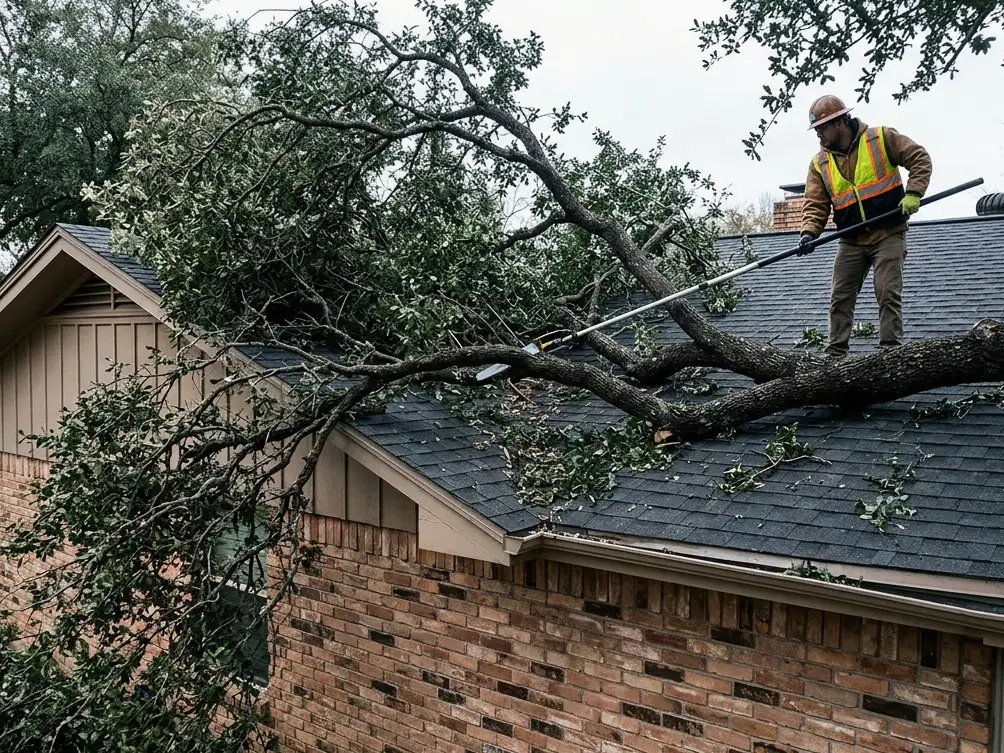
- Branches resting on the roof are cut down in sections and lowered so they do not tear more decking on the way off.
- Openings are covered with plywood where the decking is broken and with a heavy tarp anchored past the ridge where shingles are gone.
- We document every area with timestamped photos for your claim and note the interior damage we can see from the attic.
- We return in dry daylight to scope the permanent repair, replace broken decking and shingle the area back to a finished roof.
Dallas storms do not wait for business hours
Severe weather in North Texas has a habit of arriving after dark. Spring squall lines build west of the Metroplex in the afternoon heat and roll into Dallas in the evening, and that is when calls come in about limbs on roofs and water in hallways. The May 28, 2024 windstorm pushed gusts above 80 mph across Dallas in the early morning, and much of the roof damage from it was discovered by homeowners waking up to wet floors.
The October 20, 2019 tornado that tore through Preston Hollow and Walnut Hill is a reminder that serious roof damage here is not limited to spring. Large live oaks and pecans in older neighborhoods mean a single storm can put heavy limbs on many roofs at once. Answering the phone at 2 a.m. and getting a tarp on before the next band arrives is the part of this trade that homeowners remember.
Emergency fixes, from stopgap to permanent
In an emergency the goal is to get the house dry, then do the job right. Some fixes are meant to last days, some last months and some are the finished repair. We tell you which one you are getting and why, so nothing gets left as a temporary patch by accident.
| Option | Best for | What to know |
|---|---|---|
| Interior water control | Active drips while crews are on the way | Buckets, a small hole in a bulging ceiling to drain it and moving valuables; we coach you through it on the call |
| Tarp over missing shingles | Blow-offs and torn areas where decking is intact | Anchored over the ridge with battens; holds through weeks of weather while the claim moves |
| Plywood and tarp over a puncture | Limb strikes and broken decking | The hole is boarded first so the tarp does not sag and pond |
| Same-visit permanent repair | Small, clean damage found in dry weather | If materials are on the truck and the damage is limited, we finish it on the first trip |
What emergency roof repair costs in Dallas
| After-hours emergency response | $195 to $425 |
| Tarp installation, per slope | $385 to $1,190 |
| Limb cutting and removal from roof | $340 to $1,275 |
| Plywood board-up over a puncture | $165 to $435 |
| Interior moisture check from the attic | $95 to $185 |
Night calls during an active storm, steep or two-story roofs and large limbs that need cutting and lowering all push the number up. A small blow-off on a single-story ranch at dawn sits near the low end. Tree removal from the yard is separate from removing what is on the roof. Many homeowner policies cover reasonable emergency measures taken to prevent further damage, so we keep receipts and photos ready for your adjuster.
How the job runs
Call
Tell us what you see. Describe the stain, the noise in the wind or the shingles in the yard. If water is coming in, we talk you through what to move and when a crew can be there.
Look
We find the entry point. A crew walks the roof and checks the attic side, because the wet spot on a ceiling is often several feet downslope of the real failure.
Price
Written scope, fixed number. You get the repair in writing, with what we will replace, the materials and the price, before anyone pulls a shingle.
Fix
Repair matched to the roof. We seal, flash, replace or rebuild the damaged section with materials that match what is already up there as closely as the market allows.
Check
Water test and cleanup. Where it makes sense we hose-test the area, then magnet-sweep the yard for nails and photograph the finished work for your records.
Emergency Roof Repair questions
Should I go on the roof myself to put a tarp down?
We ask homeowners not to. Wet shingles are slick, storms leave limbs hanging that can drop, and power lines are sometimes tangled in the debris. The safest thing you can do is control the water inside, take photos and stay off the ladder until our crew gets there.
Will my insurance pay for the emergency visit?
Most homeowner policies expect you to take reasonable steps to prevent further damage after a covered event, and the cost of those steps is commonly part of the claim. Coverage depends on your policy, so we provide itemized receipts and photos that your adjuster can review alongside the permanent repair.
Can you come out during the storm?
We send crews as soon as it is safe to be on a roof. During lightning or high wind, nobody should be up there, but we can still help you protect the interior over the phone and we stage close by so we are first on the roof once the cell passes.
What if a tree company and a roofer both need to be there?
Our crew cuts and lowers the limbs that are on the roof itself so we can cover the opening right away. If the trunk or a large leader is still attached to the tree and leaning on the house, that needs a tree crew with rigging, and we coordinate timing so the roof is covered the moment the weight comes off.