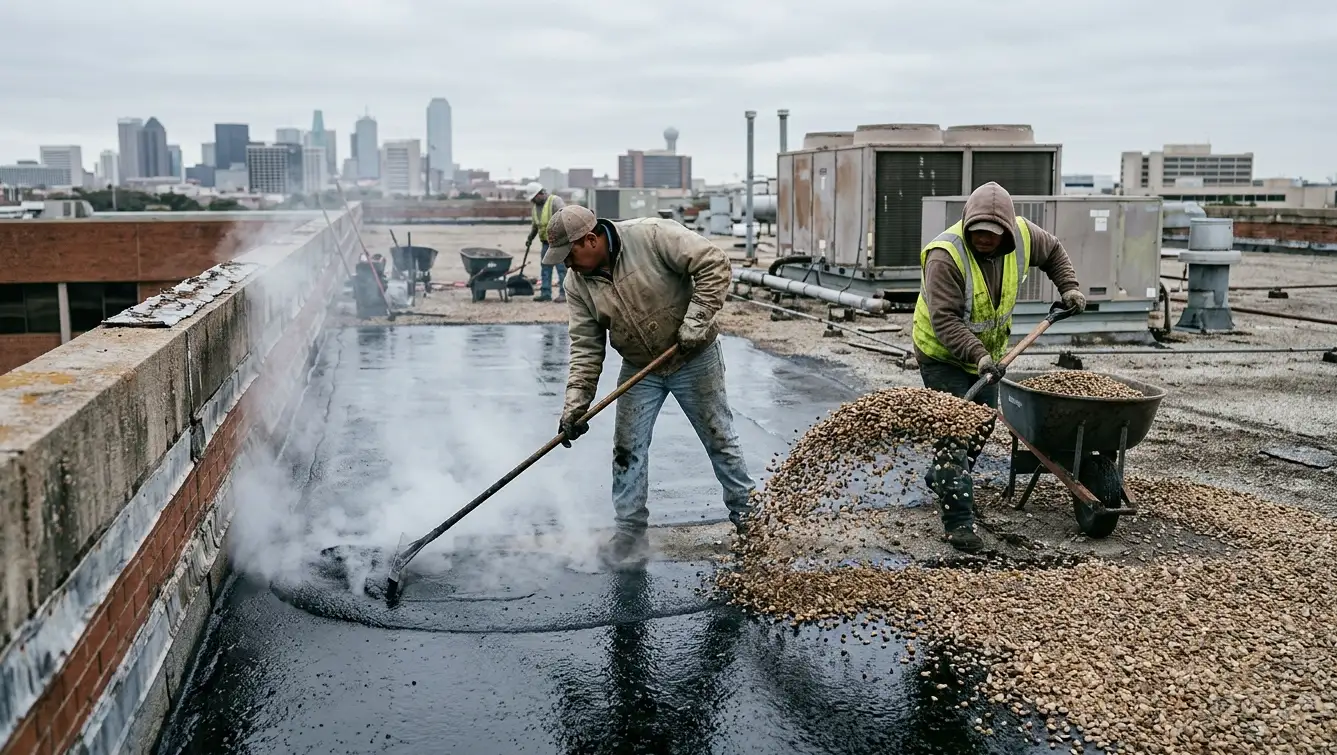
Built-up roofing service covers repair, resurfacing and replacement of multi-ply tar and gravel roofs on commercial buildings. You need it when blisters, cracking, bare spots or flashing leaks show up on an aging BUR. In Dallas, repairs usually run $685 to $3,450, a new flood coat and gravel about $2.35 to $3.90 per sq ft, and tear-off and replacement $8.65 to $14.20 per sq ft.
Built-up roofs, called BUR or tar and gravel, are layers of felt mopped together with hot asphalt or coal tar pitch and topped with a flood coat and embedded gravel. They cover many older office buildings, shopping centers, schools and warehouses around Dallas. A well-built BUR is tough and forgiving, but age shows up as blisters between plies, alligator cracking in exposed bitumen, gravel blown or washed away from corners and drains, and tired flashing at walls and curbs.
We repair, resurface and replace built-up roofs on commercial buildings across Dallas County and the surrounding counties. Before recommending anything, our crews run a moisture survey and pull cores, because the answer to repair, recover or tear-off depends on what is happening under the gravel. Small problems get spudded, patched and regraveled. Sound roofs with worn surfacing get a new flood coat and gravel. Wet roofs get a straight answer about replacement.
Signs your built-up roof is wearing out
- Blisters underfoot: soft, raised bubbles between plies that give when stepped on show trapped air or moisture in the membrane.
- Alligatoring: a cracked pattern like reptile skin in exposed asphalt means the bitumen has dried out from sun exposure.
- Bare spots in the gravel: areas where gravel has blown or washed off leave the flood coat open to UV and hail.
- Splits along felt laps: long straight cracks follow the felt laps or deck joints where the membrane has been pulled apart.
- Pitch pan and flashing leaks: filler in pitch pans shrinks and cracks, and base flashings at parapets pull loose from the wall.
- Ponding near drains: water standing more than a day or two after rain points to sagging deck, clogged drains or uneven insulation.
How we handle a built-up roof
- We start with an infrared or capacitance moisture survey and confirm readings with core cuts that show ply count, insulation type and wetness.
- Blisters are cut open, dried and patched with new felt plies in hot or cold-applied bitumen, then covered with gravel again.
- Bare and alligatored areas are swept, primed and given a new flood coat with fresh gravel embedded while the asphalt is still hot.
- Base flashings at walls, curbs and parapets are torn out where they have failed and rebuilt with modified bitumen flashing plies.
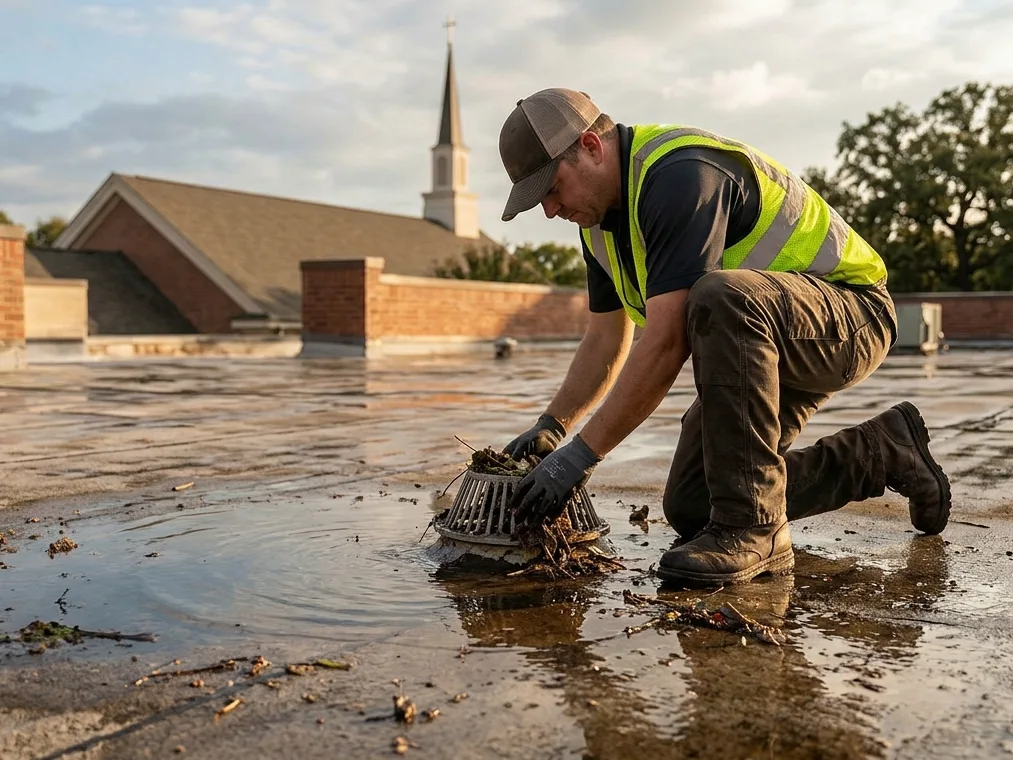
- Pitch pans are refilled or replaced, and drains get new clamping rings and lead flashing where the old ones have corroded.
- For a recover or replacement, we remove loose gravel, add tapered insulation where drainage needs help and install the new system.
Why so many older Dallas buildings still have tar and gravel
For much of the last century, built-up roofs were the standard choice for low-slope commercial work in North Texas, and plenty are still in service on mid-century office buildings, shopping centers and warehouses around Dallas. Gravel surfacing holds up well against UV and gives the membrane some protection from hail. The weak spots tend to be the details: flashing at parapets, pitch pans around equipment supports and roof drains, all of which have moved and aged along with the building.
Dallas heat and storms speed up the aging. Summer sun dries exposed asphalt until it alligators, and quick temperature drops when an afternoon storm cools a hot roof stress the plies. Strong wind scours gravel off corners and edges, while spring hail can fracture exposed bitumen and crush gravel into the flood coat. Expansive clay under older buildings can also shift walls slightly over the years, which tears base flashings away from parapets and opens leaks at the roof edge.
Repair, recover or tear-off: choosing a path for your BUR
The decision turns on moisture, ply condition and how many roofs are already on the building. A moisture survey shows how much of the roof is wet, and core cuts confirm what sits underneath. Here is how we lay out the options for Dallas building owners and property managers.
| Option | Best for | What to know |
|---|---|---|
| Targeted repair | Dry roofs with isolated blisters, splits or flashing leaks | Lowest cost; we match plies and surfacing so repairs blend into the existing roof |
| Flood coat and gravel renewal | Dry roofs with worn surfacing and alligatoring | Restores UV and hail protection; adds weight, so we confirm the structure can carry it |
| Coating over the BUR | Dry roofs where owners want a reflective surface | Loose gravel must come off first, and the coating has to be rated for asphalt surfaces |
| Recover | Mostly dry roofs on buildings with only one existing roof | A new membrane goes over the old BUR on a cover board, after wet areas are cut out |
| Full tear-off | Wet roofs or buildings that already have two roofs | Highest cost, but it resets the roof completely and fixes drainage with tapered insulation |
What built-up roofing costs in Dallas
| Moisture survey with core cuts | $465 to $1,240 |
| Blister or split repair, per area | $165 to $435 |
| Flood coat and gravel renewal, per sq ft | $2.35 to $3.90 |
| Recover with new membrane, per sq ft | $5.85 to $9.40 |
| Tear-off and replacement, per sq ft | $8.65 to $14.20 |
Repair cost depends on how many blisters, splits and flashing areas need work and how far they sit from roof access. For larger scopes, the moisture survey drives the number: dry roofs can be resurfaced or recovered, while wet insulation has to come out. Gravel removal, the number of existing roofs, tapered insulation, rooftop equipment and disposal of old material all move the price of replacement.
How the job runs
Call
Talk to us about the building. Tell us the building type, roof size, current membrane and whether there is an active leak, and we schedule a survey.
Survey
Core cuts and moisture. We walk the roof, check seams, drains and edges, take core samples where needed and map wet insulation.
Propose
Options with numbers. Repair, coating, recover or full replacement are priced side by side so owners and managers can plan the budget.
Schedule
Work around tenants. We plan staging, noise and access around business hours, and pull any permit the city requires.
Install
Membrane and details. Crews install insulation, membrane and flashing details, then water-test drains and transitions.
Close
Turnover package. You receive photos, material data and maintenance notes for the building file.
Built-Up Roofing questions
Should blisters on a tar and gravel roof be cut open?
Not always. Small, firm blisters that are not cracked are often better left alone and watched, since cutting them creates a new repair seam. Blisters that are soft, cracked, growing or sitting in a traffic path should be cut, dried and patched with new plies. We mark and photograph each one so you can see which ones we fix and why.
What causes alligatoring on a built-up roof, and can it be fixed?
Alligatoring happens when exposed asphalt dries out under the sun and shrinks into a pattern of cracks. It usually shows where gravel has blown or washed away. If the cracks have not reached the felts and the plies are dry, a new flood coat with embedded gravel or a compatible coating can restore the surface. Deep cracks into wet felts need repair first.
Can a new roof go over our tar and gravel without removing it?
Often, if the roof is mostly dry and it is the only roof on the building. Loose gravel is vacuumed or scraped off, wet areas are cut out and replaced, a cover board goes down, and a new membrane is installed over it. If the building already has two roofs or the survey shows widespread wet insulation, tear-off is the right call.
Is coal tar pitch on older Dallas roofs handled differently than asphalt?
Yes. Coal tar pitch and asphalt are different materials that do not always bond well together, so repairs need compatible products. Coal tar also gives off strong fumes when heated or cut, and crews need proper protection during tear-off. Core cuts tell us which one your roof has before we choose materials for a repair, a recover or removal.