Collin County runs north from the edge of Dallas toward Prosper and Celina, with McKinney as the county seat and US-75, the Dallas North Tollway and the Sam Rayburn Tollway (SH-121) as its spines. Neighborhoods were built in waves, starting with Plano in the 1970s and 1980s and pushing north each decade after. The result is a county where a 1985 roof and a 2021 roof can sit a few miles apart, and each needs a different approach.
The main cities we serve in Collin County are Plano, Frisco, Allen and Wylie, and we also work in Murphy, McKinney and the Collin County side of Richardson. Lavon Lake marks the eastern edge near Wylie. Each city runs its own permits and many neighborhoods require HOA approval for shingle color, so we line up both before work starts. The city pages below go deeper on each place. A single spring storm line can cross the whole county in one afternoon, which is why whole streets often file claims together.
Homes and roofs in Collin County
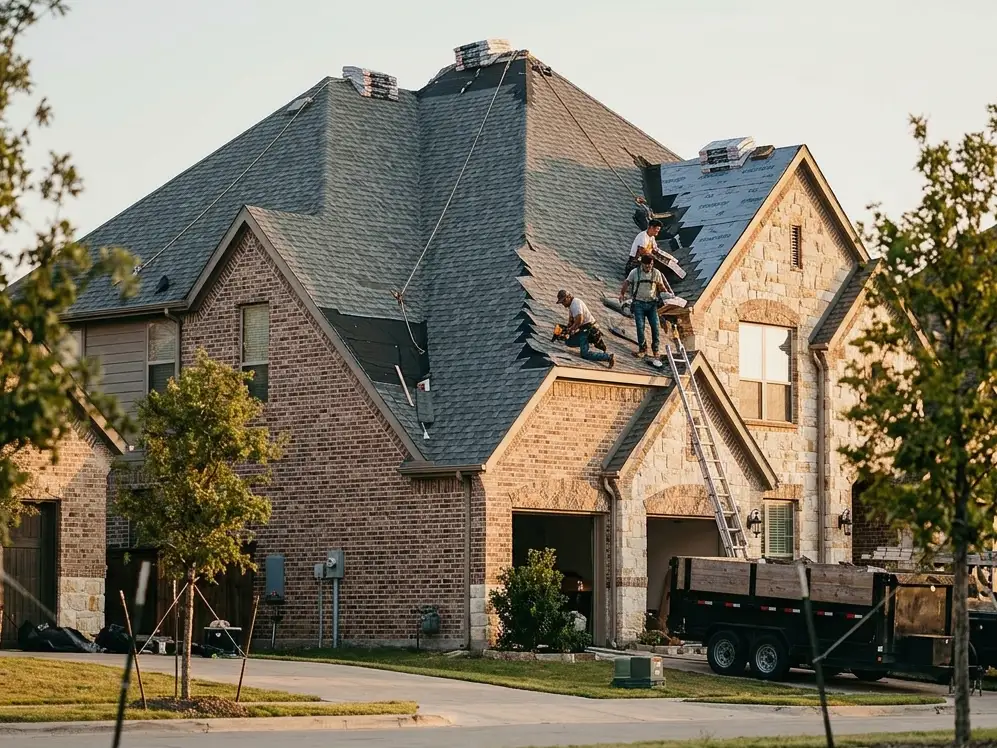
Most homes here are two-story brick and stone with steep roofs, many hips and valleys, and attached front or side garages. Early Plano subdivisions have wood shake history and some original 1980s decking. Newer Frisco and Allen communities carry architectural shingles laid by production builders, which can mean thin underlayment and short ventilation. HOA rules commonly set approved colors, and many allow Class 4 impact-resistant lines.
Storm exposure in Collin County
Collin County sits squarely in hail alley. The April 2016 hailstorms dropped very large hail across Wylie, Plano and Murphy and set off a long run of replacements. Spring storm lines between March and June remain the main threat, and wide-open new subdivisions with few mature trees give hail and wind a clean shot at every roof.
Roofing jobs we do most in Collin County
- Class 4 upgrades: replacing hail-bruised roofs with UL 2218 Class 4 shingles that some insurers discount.
- Steep two-story tear-offs: harnessed crews working 10/12 and steeper roof sections over brick and stone.
- Builder roof corrections: adding the intake and exhaust vents that production builds left short.
- Valley rebuilds: replacing worn closed-cut valleys that leak where two big roof planes meet.
- Adjuster meetings: walking the roof with your insurance adjuster after a spring hail event.
Good to know before we start
- Most Collin County HOAs review shingle color and style, so we prepare the approval request with manufacturer name and color to speed approval.
- Front-entry two-story homes rarely have alley access, so we protect beds, sprinkler heads and driveways during tear-off.
- Cities here issue their own reroof permits, and we pull the permit wherever the city requires one.
Around the area
- Lavon Lake
- Legacy West
- Sam Rayburn Tollway (SH-121)
- Historic downtown McKinney
- Arbor Hills Nature Preserve
Collin County roofing questions
Do Collin County HOAs approve Class 4 shingles?
Many do, because most Class 4 lines come in the same colors and profiles as standard architectural shingles. The HOA usually cares about appearance, not impact rating. We send in the exact product and color, and if your community has a short approved list we match one of those so the review stays simple.
How soon after a Collin County hailstorm should my roof be checked?
As soon as it is safe, ideally within a few weeks. Hail bruises are hard to see from the ground, and granule loss often shows up in gutters and downspouts first. Most policies also set a window for reporting damage, so an early inspection keeps your options open. We can usually come out the same week.
Is a production-builder roof in Collin County worth repairing?
Often yes, if the decking is sound and the damage is limited. The usual weak spots are short ventilation, thin starter courses and nails placed above the nail line. We correct those during the repair rather than only swapping the visible shingles, which helps the rest of the roof last longer.