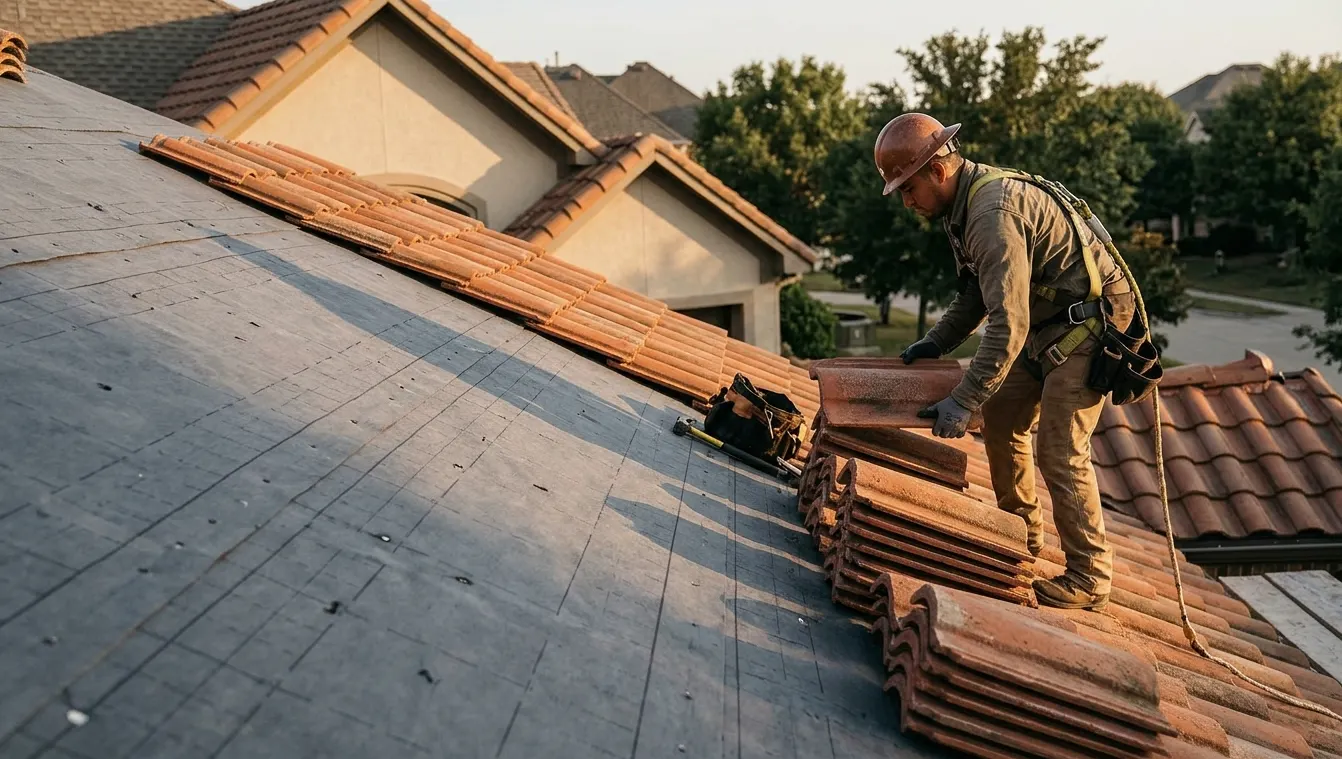
Tile roofing covers concrete and clay tile laid on battens over underlayment. Dallas homes need tile work when pieces crack from hail or foot traffic, or when the underlayment beneath has aged out. Repairs typically run $465 to $1,875, a lift-and-relay with new underlayment $17,900 to $34,600, and new concrete tile starts near $28,700.
Tile roofs in North Texas fall into two families. Concrete tile is the common one, molded from sand and cement, colored on the surface or through the body, and heavy at roughly ten to twelve pounds per square foot. Clay tile is fired in a kiln, keeps its color for generations, and costs more, but it breaks more easily under foot traffic. Both shed water well. Neither is a waterproof layer on its own, which surprises a lot of homeowners who bought a tile house expecting a fifty-year roof with no work at all.
The waterproofing on a tile roof is the underlayment. Older Dallas tile homes often have a single layer of felt that has dried out and split after decades under the summer heat trapped beneath the tile. When that layer fails, a roof can look perfect from the street while the deck rots underneath. Our tile work is mostly lifting existing tile, replacing underlayment and battens, and resetting the same tile, plus cracked piece repairs and full new installs where the old tile is past saving.
Signs your tile roof needs attention
- Stains on upper-floor ceilings: Water is getting past the tile and a failing underlayment, often near a valley or chimney.
- Slipped or shifted tiles: Fasteners or battens have rotted, letting tiles slide down and open gaps in the field.
- Cracked tiles after a hailstorm: Concrete tile chips and splits under large hail, and each crack sends water to the underlayment.
- Mortar falling from ridges: Old mortar-set hips and ridges crack as the house shifts on clay soil.
- Brittle felt at the eaves: Underlayment visible along the eave edge crumbles when you touch it.
- Sagging rooflines: The frame may be struggling with tile weight, or the deck has softened from a long-term leak.

What a tile roof project with our crews includes
- We lift tile by hand, sort it, and stack it on the roof or a padded staging area so reusable pieces stay intact.
- Old felt and rotted battens come off, and any soft decking is cut out and replaced with sheathing of matching thickness.
- A two-ply or high-temperature synthetic underlayment rated for tile goes down, with membrane run through every valley.
- New pressure-treated or composite battens are fastened on the layout the tile profile needs, with drainage spacers where required.
- Tiles are reset with wind clips or foam adhesive per the manufacturer, and broken pieces are swapped for matched salvage or new stock.
- Hips and ridges get a dry-set ridge system over a vented ridge underlayment instead of brittle mortar.
What North Texas weather does to concrete and clay tile
Hail is the main enemy here. Concrete tile shrugs off small hail, but stones the size of golf balls and larger can crack the nose of a tile or punch through a thin flat profile. Clay tile has a harder surface and is also more brittle. After a spring storm we walk tile roofs on marked paths to avoid making the damage worse, then photograph each cracked piece and count them by slope, so you know whether the job is a repair or a reroof.
The other Dallas issue is heat under the tile. Surface temperatures on a dark tile slope in August are hot enough to cook felt underlayment in fifteen to twenty years, well short of the tile's own life. Expansive clay soil also moves the house, which cracks mortar at ridges and hips. Full reroofs in the city of Dallas need a building permit, and tile replacements in suburbs like Frisco or Flower Mound usually need HOA approval for color and profile as well.
Tile choices for Dallas homes
Most tile projects start with one question: can your existing tile be reused? If it can, a lift-and-relay saves money and keeps the original look. If not, the choice comes down to weight, budget, profile and what your HOA allows. These are the options we price most often.
| Option | Best for | What to know |
|---|---|---|
| Lift and relay existing tile | Sound tile over failing underlayment | Most solid tile survives careful lifting; we source matching salvage for any breakage. |
| New concrete tile, S or barrel profile | Mediterranean homes in hail-prone suburbs | Heavy, so the frame must be checked if the house never carried tile before. |
| New concrete flat tile | Contemporary and modern builds | Shows hail cracks more readily than curved profiles; thicker products resist better. |
| Clay tile | Historic and high-end Spanish revival homes | Color never fades, but pieces are fragile and replacements cost more. |
| Lightweight concrete tile | Homes converting from shingles to tile | Lower weight per square foot, which often avoids extra framing work. |
What tile roofing costs in Dallas
| Cracked tile replacement, first 10 tiles | $465 to $1,140 |
| Underlayment and batten replacement, per square | $385 to $640 |
| New concrete tile installed, per square | $865 to $1,320 |
| Dry-set ridge and hip system, per linear foot | $14.60 to $22.85 |
| Salvage clay tile sourcing, per tile | $11 to $37 |
Reusing tile cuts material cost but not labor, because every tile gets handled twice. Price rises with roof pitch, the number of hips and valleys, how much tile breaks during lifting, and how much decking has rotted. New tile adds material cost and may call for an engineer's look at the framing. Clay replacements and discontinued colors take longer to source.
How the job runs
Call
Start with the house. We ask about the roof's age, the material you have, the material you want and any HOA rules, so the first visit is useful.
Measure
Inspection and measurements. We measure every plane, check decking from the attic, count penetrations and photograph the existing roof before we price anything.
Price
Line-item proposal. Tear-off, decking allowance, underlayment, flashing, ventilation and the roofing itself are listed separately, so you can compare honestly.
Permit
Permit and materials. Where the city requires a reroof permit we pull it in our name, and materials are delivered the day before the tear-off.
Build
Tear-off to ridge. Most homes are torn off, dried in and roofed in one or two working days, with the yard tarped and the gutters protected.
Close
Final walk and records. We walk the finished roof with you, sweep for nails, pass any required inspection and hand over photos and product details.
Tile Roofing questions
How long does underlayment last under a concrete tile roof in Dallas?
Old-style felt under tile often gives out somewhere around fifteen to twenty-five years here, depending on slope direction and attic ventilation. Modern synthetic underlayments rated for tile handle the heat far better. The tile itself can outlast two underlayments, which is why lift-and-relay is such a common job on older Dallas tile homes.
Can you match my discontinued concrete tile color?
Often, yes. We keep track of salvage sources around DFW and can pull matching tile from teardown jobs. When no match exists, we move sound tile from a back slope to the street-facing side and use the closest new tile on the rear, so the front stays consistent and the patch sits out of view.
Is it safe for me to walk on my tile roof to check a leak?
We would rather you did not. Concrete tile breaks when stepped on in the wrong place, and clay tile breaks even more easily. Our crews walk the lower third of each tile where it rests on the one below, or use foam pads. A pair of binoculars from the yard is the safer way for a homeowner to look.
Can my house switch from asphalt shingles to tile?
Sometimes. Concrete tile weighs several times more than shingles, so the rafters and trusses need to be checked before we price it. Many homes built for shingles need added bracing or a lightweight tile product. We look in the attic first and tell you plainly if a tile-look stone-coated steel panel would be the better fit.