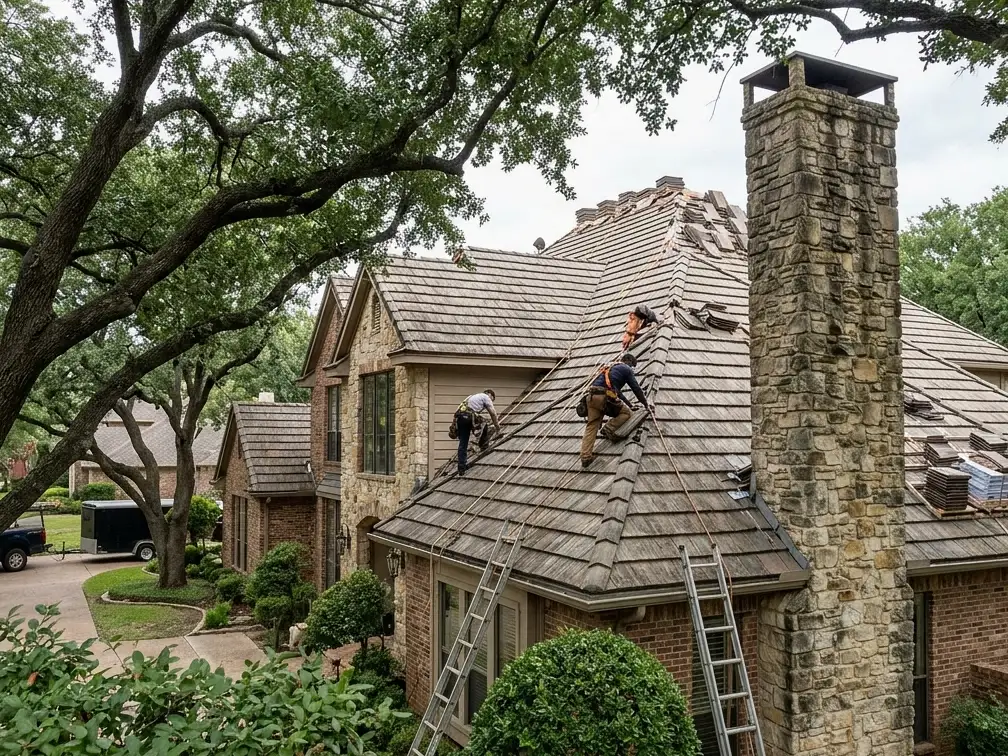
Bent Tree wraps around Bent Tree Country Club in the far northwest corner of Dallas, with Westgrove Drive, Frankford Road and Trinity Mills Road running between the Dallas North Tollway and Midway Road. Most of the houses went up in the late 1970s and 1980s on generous lots, and many are large two-story homes with multiple hips, turrets, tall chimneys and three-car garages. Rooflines here are rarely simple, and a single home can have a dozen valleys and several different pitches meeting at one ridge.
Plenty of Bent Tree homes started out with cedar shakes. Over the years most were reroofed with heavy designer shingles, concrete tile or synthetic slate, so the materials on any given street vary widely. Our crews carry matching products for each, and on tile roofs we step only on supported points so we do not crack more pieces than the storm did. We also look closely at old skylights, tall chimney crowns and copper accents, which often outlast the field shingles and need their own repairs.
Bent Tree is one of the Dallas neighborhoods our crews reach straight from the McKinney Avenue office. See the full Dallas roofing page for citywide permit and storm notes.
Homes and roofs in Bent Tree
Expect late 1970s to early 1990s homes, many well over 4,000 square feet, with very steep pitches, many hips and dormers, and stone or brick chimneys. Roofing ranges from designer laminated shingles and concrete tile to synthetic slate and a few remaining cedar shake roofs. Mature oaks shade many lots, and some streets carry HOA or deed rules on visible roofing materials.
Storm exposure in Bent Tree
Spring storms rolling across Denton and Collin counties often reach Bent Tree during the March through June hail season, and large stones crack concrete tile, chip synthetic slate and split old shakes. Tall stone chimneys and high ridges also take the full force of straight-line wind, which loosens ridge tiles and lifts shingles near the peaks.
Roofing jobs we do most in Bent Tree
- Concrete tile replacement: we swap cracked and slipped tiles, reset ridge and hip pieces and fix the underlayment beneath any broken section.
- Shake conversions: owners leaving old cedar shake behind usually move to impact-resistant designer shingles or stone-coated steel.
- Chimney crown and cap work: tall masonry chimneys get new crowns, caps and counterflashing so water stops entering at the top.
- Synthetic slate repairs: we replace chipped synthetic slate pieces with matching product and correct uneven exposure lines.
- Copper and metal accents: bay window roofs and turret caps in copper or standing seam get resoldered, reflashed or replaced.
Good to know before we start
- Material matching: some tile and designer shingle lines have been discontinued, so we source the closest match and place salvaged originals on the most visible slopes.
- Steep slopes: pitches this steep need roof jacks and toe boards on every course, which we price into the job up front.
- Tree canopy: big oaks over Bent Tree lots drop branches and leaves into valleys, so we clear valleys and gutters at the end of every job.
Around the area
- Bent Tree Country Club
- Westgrove Drive
- Frankford Road
- Dallas North Tollway
- Midway Road
Bent Tree roofing questions
Can you repair a few cracked tiles on my Bent Tree roof without replacing it?
Yes, if the underlayment under the tile is still sound. We lift the surrounding tiles, replace the cracked ones with matching pieces and reset the fasteners. If we find brittle felt underneath, we show you photos and explain whether relaying that section makes more sense than spot repairs.
What should replace an old cedar shake roof in Bent Tree?
Most owners choose impact-resistant designer shingles, stone-coated steel or synthetic slate. All three keep the heavy, textured look these homes were built with and stand up to hail better than aging shakes. We bring samples to the house, check any HOA or deed rules on your street and price each option on the same estimate.
Why does my Bent Tree home leak only during heavy rain?
Large homes with many valleys and dormers can overflow at one weak spot when rain comes down hard, usually a valley, a dormer side wall or a chimney cricket. Light rain drains past it, while a downpour backs up. We water-test the suspect area and repair the flashing or underlayment where the overflow starts.