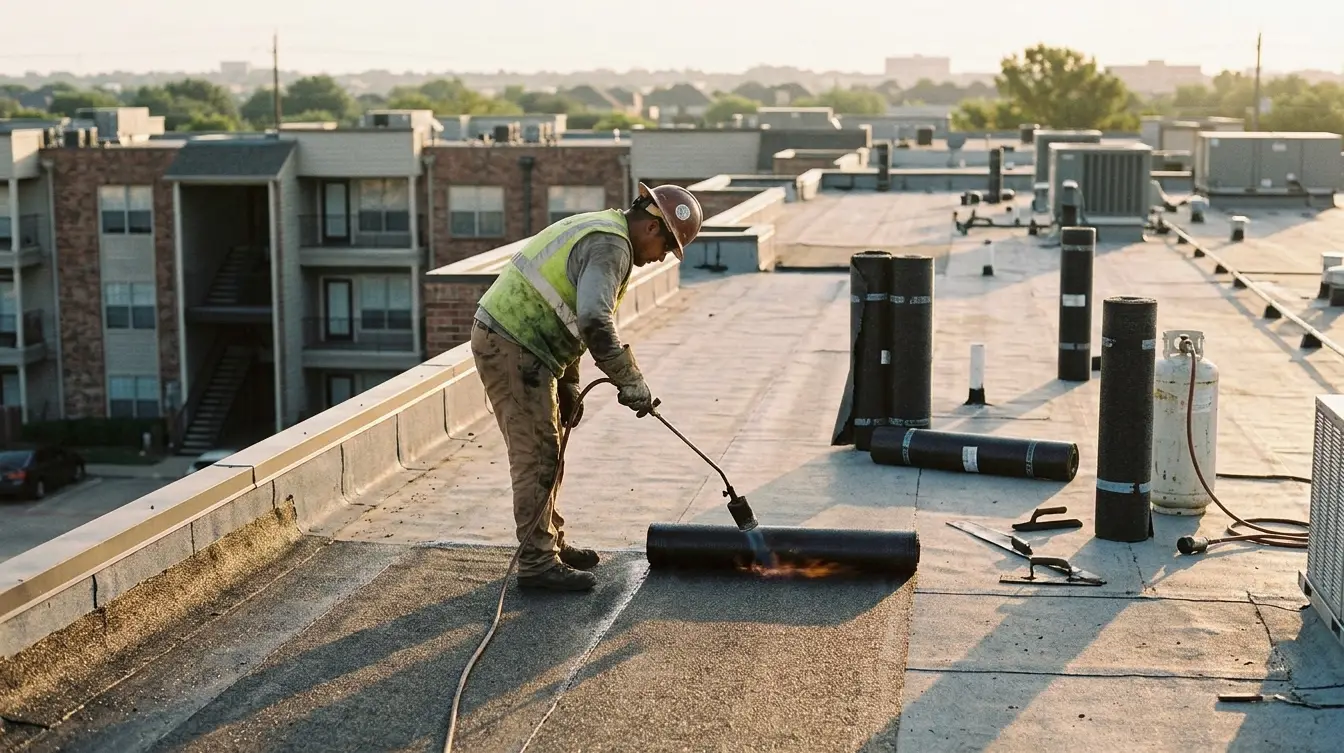
Modified bitumen roofing is a multi-ply asphalt membrane, reinforced with SBS or APP polymers, installed on low-slope commercial roofs. It suits roofs with heavy traffic, many penetrations or high hail exposure. In Dallas, a full two-ply mod bit system with tear-off usually runs about $7.85 to $12.95 per square foot, depending on application method and insulation.
Modified bitumen is asphalt roofing reinforced with polymers and a fabric mat, laid in two or more plies to build a thick, layered membrane. That redundancy is its strength: a puncture in the cap sheet does not mean a leak, because the base ply beneath is still sealed. On Dallas buildings with frequent service traffic, many rooftop units, or a history of hail damage, that toughness is often worth the added labor compared to single-ply systems.
We install and repair SBS and APP modified bitumen on retail buildings, churches, apartment complexes, older office buildings and small commercial properties. Systems can be torch-applied, set in cold adhesive, or self-adhered, depending on the building, the deck and safety needs. Our crews pay careful attention to the flashing details, since mod bit's ability to be shaped around curbs, walls and drains is one of the main reasons owners choose it.
When mod bit is the right fit
- Heavy rooftop traffic: HVAC techs, sign crews and maintenance staff walk the roof often and puncture thinner membranes.
- Many penetrations and curbs: Restaurant exhaust fans, vents and conduit runs need flashings shaped around complicated details.
- Repeat hail claims: Single-ply roofs keep taking hail fractures, and a thicker multi-ply system resists impacts better.
- Existing mod bit at end of life: Cap sheets have lost granules, blistered, or cracked along the laps.
- Built-up roof replacement: An aging gravel built-up roof needs a system with similar redundancy and toughness.
- Small low-slope sections: Porch roofs, additions and flat areas behind parapets on mixed-roof buildings.
How we install modified bitumen
- We core the existing roof, check the deck and insulation, and choose torch-applied, cold-applied or self-adhered plies to fit the building.
- Old roofing comes off in workable sections, and a new insulation layer with a cover board goes down where specified.
- A base sheet is installed and sealed, then a granulated cap sheet is laid on top with staggered, fully fused laps.
- Walls, curbs and penetrations get two-ply flashings that extend well up the vertical surfaces and terminate under metal.
- Torch work follows fire-watch steps, with extra caution around wood blocking, parapets and roof edges.
- Laps are checked by hand, loose granules are swept, and exposed asphalt at laps gets a granule touch-up.
Why mod bit holds up on Dallas roofs
The two-ply build gives mod bit a margin for error that single-ply systems lack. A hailstone or a dropped wrench can break the cap sheet without reaching the base sheet, which keeps a small injury from becoming a leak. That is why it remains common on Dallas apartment complexes, restaurants and older retail buildings, where foot traffic and rooftop equipment are constant. SBS sheets stay flexible in cooler weather, while APP sheets handle sustained high heat well.
Heat and UV are the slow threats. Over many Dallas summers, the asphalt in a cap sheet oxidizes, granules wash off, and the surface can crack along laps and around flashings. A reflective coating applied over a sound mod bit roof can slow that aging and cool the surface. On buildings where the cap sheet is worn but the base ply and insulation are dry, a coating or a single new cap sheet can extend the roof's life at a fraction of replacement cost.
Modified bitumen application methods
Modified bitumen comes in two main polymer types and can be applied in several ways. The right combination depends on the building's occupancy, fire concerns, the deck type, and how much heat and rooftop traffic the roof sees over a typical year.
| Method | Best for | What to know |
|---|---|---|
| SBS torch-applied | Most commercial roofs with good access | Strong fused laps; requires torch safety procedures and a fire watch after work |
| APP torch-applied | Roofs with very high sun and surface heat | Plastic-modified sheet resists UV and heat well; less flexible in cold weather |
| SBS cold-applied adhesive | Occupied buildings and fire-sensitive areas | No open flame; adhesive cure time adds a little to the schedule |
| Self-adhered SBS | Small roofs, wood decks and tight sites | Peel-and-stick plies with no torch or kettle; best on clean, dry surfaces |
| Mod bit with reflective coating | Owners wanting lower roof temperatures | A coating over the cap sheet cools the surface and slows granule loss |
What modified bitumen roofing costs in Dallas
| Two-ply SBS torch-applied, per sq ft | $7.85 to $11.20 |
| Two-ply cold-applied or self-adhered, per sq ft | $8.95 to $12.95 |
| New cap sheet over sound base, per sq ft | $3.65 to $5.90 |
| Two-ply curb or wall flashing, per linear foot | $18.50 to $36.75 |
| Reflective coating over cap sheet, per sq ft | $1.85 to $3.40 |
Application method sets much of the price, since cold-applied and self-adhered systems use pricier materials while torch work needs more safety labor. Insulation thickness, cover board, tear-off depth and the number of curbs and penetrations add to the total. Granulated cap sheets cost more than smooth sheets. A reflective coating over the finished roof is an optional add.
How the job runs
Call
Talk to us about the building. Tell us the building type, roof size, current membrane and whether there is an active leak, and we schedule a survey.
Survey
Core cuts and moisture. We walk the roof, check seams, drains and edges, take core samples where needed and map wet insulation.
Propose
Options with numbers. Repair, coating, recover or full replacement are priced side by side so owners and managers can plan the budget.
Schedule
Work around tenants. We plan staging, noise and access around business hours, and pull any permit the city requires.
Install
Membrane and details. Crews install insulation, membrane and flashing details, then water-test drains and transitions.
Close
Turnover package. You receive photos, material data and maintenance notes for the building file.
Modified Bitumen Roofing questions
What is the difference between SBS and APP modified bitumen?
SBS uses a rubber-like polymer that keeps the sheet flexible, even in cold weather, and is common in torch, cold-applied and self-adhered forms. APP uses a plastic-like polymer that stands up very well to heat and UV but is stiffer. In Dallas both work, and we choose based on the roof's exposure, the application method and the flashing details.
Is torching a roof safe on an occupied building?
Torch work done correctly is routine, but it calls for trained crews, careful handling near wood and flammable materials, and a fire watch after work ends each day. Where an open flame is a concern, such as near wood blocking, older buildings, or fire-sensitive tenants, cold-applied or self-adhered mod bit gives the same multi-ply build without a torch.
How does mod bit compare to TPO on a Dallas roof?
Mod bit is thicker and more forgiving of punctures and foot traffic, and it shapes well around complicated flashing. TPO is lighter, faster to install, and more reflective out of the box. For roofs with heavy traffic and lots of penetrations, mod bit often wins. For large open roofs where cooling costs matter most, TPO is often the better fit.
Can a worn mod bit roof be recapped instead of replaced?
Often, yes. If cores show the base ply and insulation are dry and firmly attached, a new granulated cap sheet can be applied over the old one, adding years at a lower cost than tear-off. If the insulation is wet or the base ply is delaminated, recapping would trap moisture and replacement is the better path.