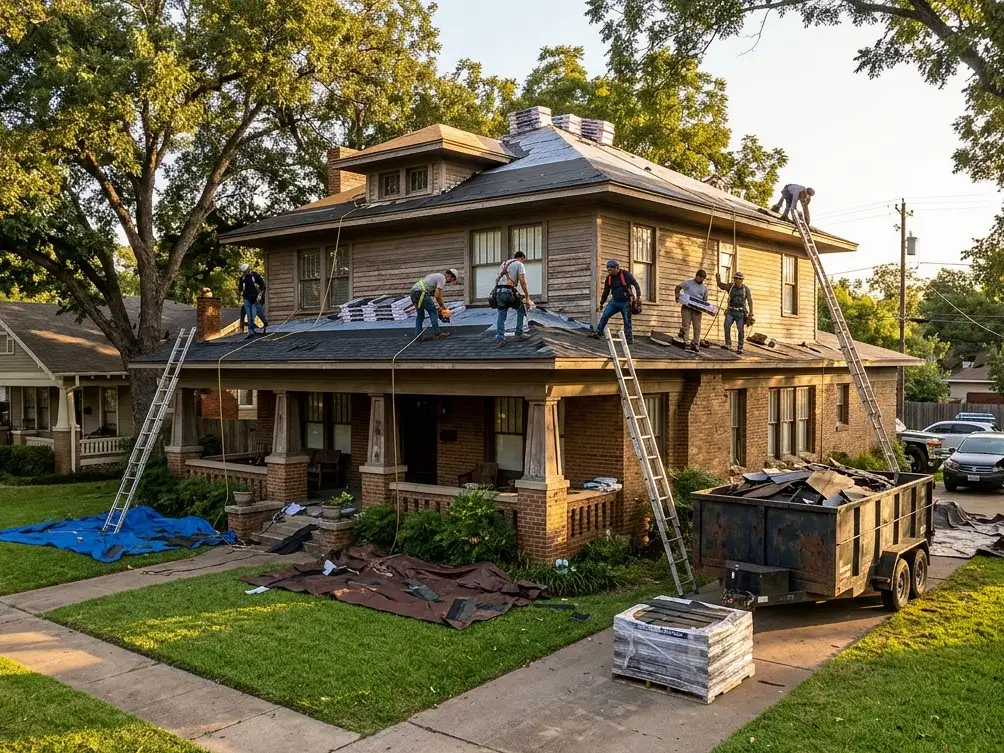
Munger Place lies in Old East Dallas, east of downtown, where Robert S. Munger began selling lots in the early 1900s as one of the city's first deed-restricted neighborhoods. Streets like Tremont, Reiger, Worth and Victor are lined with two-story Prairie foursquares: broad hipped roofs, wide boxed eaves, hipped dormers and deep front porches. The Swiss Avenue Historic District sits right alongside it, and Baylor's medical campus is a short drive toward downtown.
Because Munger Place is a City of Dallas historic district, roofing that changes what you see from the street generally needs a Certificate of Appropriateness before work begins. We prepare that request with photos, product details and colors, then build the review into the schedule. Up top, the work centers on the big hips: long hip ridges, dormer cheek walls and those generous eaves, where century-old rafter ends and soffit boards often need repair before new shingles go on.
Munger Place is one of the Dallas neighborhoods our crews reach straight from the McKinney Avenue office. See the full Dallas roofing page for citywide permit and storm notes.
Homes and roofs in Munger Place
Two-story Prairie foursquares fill most of the district, mixed with a smaller number of Craftsman and Colonial Revival houses, nearly all built between about 1905 and the 1920s. Roofs are low to moderate hips with hipped or shed dormers and wide boxed eaves. Decking is usually old plank, sometimes spaced for the wood shingles the houses first wore. Many lots have rear garages or garage apartments reached from the alley.
Storm exposure in Munger Place
Old East Dallas sees the metroplex's usual spring hail from March through June, and a broad Prairie hip puts a lot of roof surface in the path of every storm. The May 28, 2024 windstorm, with gusts above 80 mph, brought down mature trees across East Dallas. Wide eaves give wind a lever, so straight-line gusts tend to work at the first course of shingles and the soffit boards beneath them.
Roofing jobs we do most in Munger Place
- Preservation-ready reroofs: product and color details for review, then a tear-off and replacement that keeps the hip lines intact.
- Eave and soffit carpentry: replacing rotted rafter tails, fascia and beadboard soffit before the new roof goes on.
- Dormer flashing: rebuilding step and counterflashing on dormer cheek walls, a common leak point on these houses.
- Decking upgrades: sheathing over old plank boards so modern shingles have a solid nailing surface.
- Garage apartment roofs: reroofing rear outbuildings off the alley in the same visit as the main house.
Good to know before we start
- Certificate of Appropriateness: visible roof work generally needs one, so we prepare the request and plan around the review.
- Plaster ceilings: old plaster can crack under tear-off vibration, so we work in sections and check interiors as we go.
- Rear access: we place the dumpster and materials off the alley to keep historic front yards and porches clear.
Around the area
- Swiss Avenue Historic District
- Gaston Avenue
- Columbia Avenue
- Fitzhugh Avenue
- Baylor University Medical Center
Munger Place roofing questions
What does a Certificate of Appropriateness mean for my Munger Place roof?
It is the city's approval that visible exterior work fits the historic district standards. For a reroof, that usually means showing the existing roof and the proposed shingle, color and trim. We prepare the photos and details, follow the request through review and order materials only after approval, so the new roof never has to be redone to satisfy the district.
Why are the eaves on my Munger Place house rotting?
Wide boxed eaves on Prairie homes trap water when gutters overflow or a drip edge was never installed. Over decades the rafter tails, fascia and soffit boards soften. We open the damaged runs, replace wood to match the original profile, add drip edge under the new roof and set the gutters so water clears the eave instead of soaking it.
How do you protect old plaster ceilings during a Munger Place tear-off?
We strip and re-deck one section at a time rather than the whole roof at once, which cuts the pounding the framing takes. Our crew checks upstairs ceilings before work and again at the end of each day. If a house already has loose plaster, we tell you before we start so you can move valuables and decide whether to brace any ceilings.